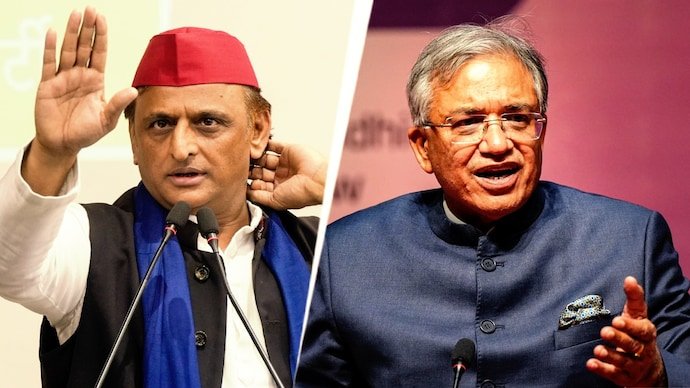
A report detailing repeated disagreements within the Election Commission of India over the Special Intensive Revision (SIR) of Electoral Rolls has triggered a fresh political controversy, with opposition leaders questioning the transparency and internal functioning of the constitutional poll body.
An investigation by The Indian Express reported that Election Commissioners Sukhbir Singh Sandhu and Vivek Joshi recorded objections 14 times over a period of 10 months concerning different aspects of the SIR exercise. The reported objections involved issues including the registration of new voters, deletion and restoration of names, changes to statutory voter forms and appeals against decisions involving electoral rolls.
The report has drawn a sharp response from opposition leaders. Samajwadi Party chief Akhilesh Yadav urged the Supreme Court to take suo motu cognisance of the matter, while congress MP Manish Tewari questioned whether the Election Commission’s decision-making process had been properly followed.
The allegations concern the internal functioning of an institution responsible for maintaining electoral rolls and conducting elections. The reported disagreements do not by themselves establish that any election was improperly conducted or that decisions taken by the Commission were unlawful. They do, however, raise questions about how disagreements among the three commissioners are recorded, resolved and communicated when they concern electoral procedures.
What the report says about dissent within the Election Commission
The Election Commission is a three-member constitutional body headed by Chief Election Commissioner Gyanesh Kumar, with Election Commissioners Sukhbir Singh Sandhu and Vivek Joshi as the other members.
According to the Indian Express investigation, Sandhu and Joshi repeatedly recorded objections to decisions or procedures associated with the SIR exercise.
The reported disagreements covered several aspects of electoral-roll management, including the addition of new voters, deletion and restoration of names and the filing of appeals against decisions involving voters.
One particularly significant issue concerned appeals filed against voters whose names had been included in electoral rolls following decisions by judicial officers in West Bengal.
The Election Commission recently told the Supreme Court that more than 38 lakh appeals were pending before tribunals dealing with the West Bengal SIR process. Of these, 22.21 lakh appeals had been filed by voters whose names were deleted and who sought restoration. Another 16.10 lakh appeals sought deletion of names that had been included following decisions by judicial officers. :contentReference[oaicite:0]{index=0}
The investigation reported that Sandhu questioned why the Commission itself was appealing against voters whose names had been included by judicial officers. He also recorded that neither he nor Joshi nor the Chief Electoral Officer of West Bengal had been informed about the basis or process through which those appeals were filed.
Dispute over changes to Form 6
Another reported disagreement involved Form 6, the statutory application used by people seeking inclusion in the electoral roll.
The Indian Express reported that changes were made to the form through the Election Commission’s ECINet portal to introduce questions connected with the previous SIR exercise. New applicants were asked to indicate whether their own name, or the name of a parent or grandparent, appeared on an electoral roll prepared during the previous SIR.
According to the report, Joshi objected in May to changing the statutory form without amending the Registration of Electors Rules, 1960. Sandhu subsequently concurred with his position.
The two commissioners reportedly argued that the statutory forms could not simply be altered through an SIR order or guideline and that the proposed changes should be referred to the government through the appropriate legal process. :contentReference[oaicite:1]{index=1}
Sandhu later wrote to officials raising concerns that the changes remained on the ECINet portal despite the objections. He described them as “unauthorised/illegal” changes and called for the original form to be restored, according to the report.
The dispute matters because Form 6 is used by new voters to register themselves. Any additional requirement affecting the registration process can therefore have a direct impact on people reaching voting age and attempting to enter the electoral rolls.
Concerns over centralisation of electoral-roll management
The reported disagreements extend beyond individual voter cases and touch on the technology used to manage electoral rolls.
The Election Commission launched ECINet in January 2026 as an integrated technology platform bringing together numerous applications and portals used in election administration.
According to a separate Indian Express investigation, Sandhu and Joshi raised concerns that access to parts of the electoral-roll database was becoming increasingly centralised through the Commission’s IT division in New Delhi.
The two commissioners reportedly argued that statutory officers responsible for electoral-roll work at the state and constituency levels should have the access required to perform their legal duties. Sandhu questioned whether the IT division had authority to restrict that access. :contentReference[oaicite:2]{index=2}
The issue is significant because electoral rolls are not maintained solely at the headquarters level. Electoral Registration Officers and other officials operate through a decentralised legal framework, making the allocation of authority and access an important part of the system’s checks and balances.
The reported objections therefore raise a broader question about how technological centralisation interacts with the statutory responsibilities of officials working on the ground.
What is the Special Intensive Revision?
The Special Intensive Revision is an extensive exercise to review and update electoral rolls. The Election Commission has described the process as a means of identifying and removing entries relating to people who are dead, permanently shifted, duplicated or otherwise ineligible, while ensuring eligible voters remain on the rolls.
The exercise began with Bihar in 2025 and has subsequently expanded to other states and Union territories.
More than 13 crore names have been left out of draft electoral rolls across the exercise so far, according to figures cited in the report. The scale of the revisions has made the process one of the most consequential electoral-roll exercises undertaken in recent years.
The SIR process has also become politically contentious because deletion from a draft electoral roll does not necessarily mean that a person is permanently barred from voting. Affected voters can challenge deletions through the prescribed claims and appeals process.
That distinction is particularly important in West Bengal, where a large number of voters sought restoration after their names were removed during the revision process.
West Bengal became the biggest test of the SIR process
The SIR exercise attracted particularly intense scrutiny in West Bengal ahead of the 2026 Assembly election.
The Election Commission told the Supreme Court that 27.16 lakh voters had been removed during the process in West Bengal and that more than 22 lakh of those voters subsequently filed appeals seeking restoration. In total, the Commission reported 38.31 lakh appeals, including petitions seeking the deletion of additional names. :contentReference[oaicite:3]{index=3}
The Supreme Court had directed that retired High Court judges serve on tribunals hearing appeals connected with the deletion process. The arrangement was introduced amid concerns over the large number of voters affected and the need for a mechanism to review individual cases.
The volume of appeals illustrates the administrative challenge created by a revision affecting millions of electoral entries. It also makes the procedures used to delete, restore and challenge names particularly important for public confidence in the electoral roll.
The reported internal objections within the Election Commission have therefore emerged at a time when the SIR process is already under close judicial and political scrutiny.
Akhilesh Yadav asks Supreme Court to take note
Samajwadi Party president Akhilesh Yadav described the reported dissent as a serious development and called on the Supreme Court to take suo motu cognisance of the matter.
Yadav argued that disagreements recorded by members of an independent constitutional body raise questions about whether the commissioners are able to perform their duties freely and whether their concerns are being properly considered.
His intervention adds another political dimension to an issue that is already before the Supreme Court in connection with electoral-roll revisions.
However, a political demand for judicial intervention is distinct from an actual judicial finding. The Supreme Court would have to determine independently whether the reported circumstances raise an issue within its jurisdiction and what, if any, action would be appropriate.
Manish Tewari questions the Election Commission’s credibility
Congress MP Manish Tewari also reacted strongly to the report, arguing that the alleged procedural irregularities could affect perceptions of the Election Commission’s credibility.
Tewari questioned whether decisions had been taken in accordance with the Commission’s internal rules and whether matters requiring collective consideration were properly placed before all three commissioners.
He also raised the possibility of impeachment proceedings, while framing the larger issue as one concerning public confidence in the Election Commission.
Those are political arguments rather than established legal findings. Whether any particular decision was valid would depend on the applicable constitutional and statutory provisions, the Commission’s internal procedures and the underlying records.
How decisions are supposed to work inside the poll panel
The Election Commission’s three-member structure is designed to provide collective decision-making rather than concentrating the institution’s authority in a single individual.
Under the legal framework governing the Commission’s Business, matters are generally intended to be handled unanimously where possible. Where members disagree, decisions can be taken according to the applicable majority mechanism.
The existence of disagreement between commissioners is therefore not automatically evidence of wrongdoing. Constitutional bodies can legitimately contain differing views, and dissent can form part of institutional decision-making.
The more important question raised by the current controversy is whether the reported disagreements were properly brought into the Commission’s formal decision-making process and whether decisions were taken through the procedures required by law.
The Indian Express investigation reported that Sandhu and Joshi repeatedly said they had not been consulted or informed about certain actions taken in the Commission’s name. :contentReference[oaicite:4]{index=4}
If established, such circumstances could raise questions about internal Governance and accountability. But the reports themselves are not equivalent to a judicial determination that the Commission violated the law.
Why the controversy matters for voters
The significance of the dispute extends beyond the three commissioners because the issues under discussion affect the electoral rolls on which citizens rely to exercise their right to vote.
A clean electoral roll is necessary for credible elections. At the same time, procedures for removing names must provide eligible voters with meaningful opportunities to establish their eligibility and challenge incorrect deletions.
The same principle applies to new voters. Registration procedures must allow eligible citizens who reach voting age to enter the electoral roll without facing requirements that are not supported by the applicable legal framework.
This is why disagreements over Form 6, voter deletions, restoration procedures and access to electoral-roll systems have significance beyond internal administrative disputes.
The Supreme Court has already been involved in several aspects of the SIR process, including the mechanisms used to review disputed deletions. The latest controversy could add another layer to the court’s consideration of how electoral-roll administration should operate.
The Election Commission faces questions on transparency
The reports of dissent come at a time when the Election Commission is under sustained scrutiny over the SIR exercise.
The Commission has defended the revision process and maintained that electoral rolls must be updated to remove ineligible entries while protecting the rights of eligible voters.
At the same time, the large number of appeals and the internal objections reported by two commissioners have intensified demands for greater transparency around the procedures used to make changes.
The Commission has not publicly endorsed the allegations contained in the investigations, and the reported objections should not be treated as final findings against CEC Gyanesh Kumar or any other official.
The central institutional question is whether all three commissioners were given the opportunity to participate meaningfully in decisions taken in the Commission’s name and whether the processes used for modifying electoral-roll systems and forms complied with the governing legal framework.
What could happen next
The controversy could now develop along several tracks. The Election Commission may be called upon to explain the decisions and procedures described in the reports. The Supreme Court could also consider whether the reported circumstances have relevance to cases already before it concerning the SIR process.
Political parties are likely to continue using the issue to press their broader arguments about electoral transparency and institutional independence.
For the judiciary, any examination would require distinguishing between political allegations, reported internal correspondence and legally established facts. The content of the objections, the authority under which decisions were taken and the applicable statutory procedures would all be relevant to such an assessment.
Internal dissent puts focus on Election Commission’s decision-making
The reported 14 objections by Election Commissioners Sukhbir Singh Sandhu and Vivek Joshi have brought the internal functioning of the Election Commission into the centre of the SIR controversy.
The issues described in the reports range from changes affecting new voter registration to the deletion and restoration of names and the administration of the technology supporting electoral rolls.
Disagreement within a constitutional body is not, by itself, evidence that the institution has acted unlawfully. The key issue is whether the Commission’s statutory procedures and safeguards were followed when those disagreements arose.
With millions of electoral entries affected by the SIR process and the Supreme Court already examining aspects of the exercise, the questions surrounding the reported internal dissent are likely to remain part of the wider debate over electoral-roll administration.
For voters, the most consequential issue is straightforward: whether the systems used to maintain electoral rolls allow eligible citizens to register and remain on the rolls while providing a transparent and legally grounded process for correcting disputed entries. How the Election Commission, the courts and other institutions address the reported disagreements will help determine how that process is understood going forward.
For breaking news and live news updates, like us on Facebook or follow us on Twitter and Instagram. Read more on Latest India on thefoxdaily.com.






COMMENTS 0