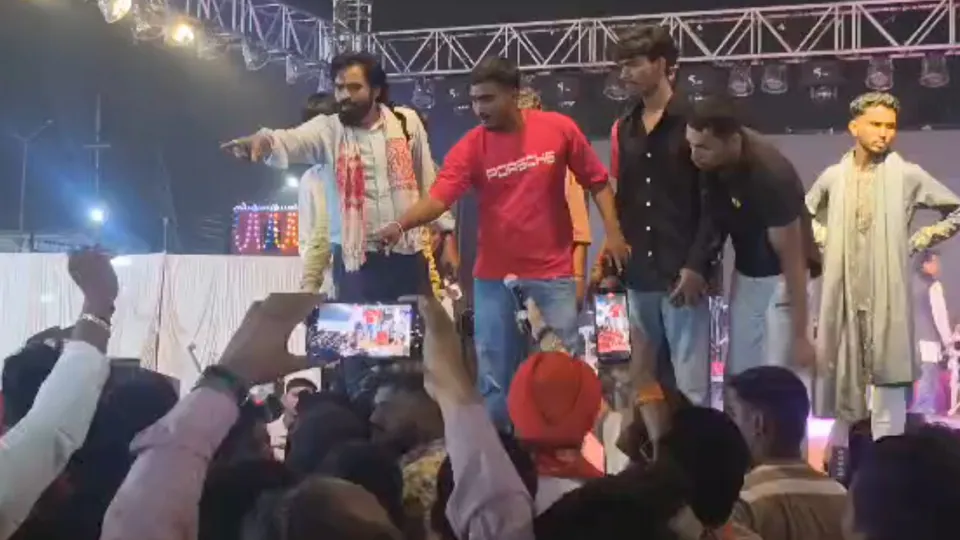
A garba event in Durg, Chhattisgarh, turned chaotic on Wednesday night after members of right-wing organisations allegedly confronted organisers over the presence of Muslim youths at the venue. The incident escalated into a heated exchange and a scuffle on stage, with Congress district president and former mayor Dheeraj Bakliwal reportedly being pushed during the confrontation.
According to reports, workers associated with the Bajrang Dal and the Vishwa Hindu Parishad (VHP) entered the venue while the event was underway and moved onto the stage to raise objections. Videos circulating on social media appeared to show members of the groups questioning the participation of Muslim youths.
The incident has brought questions about religious participation at public cultural events into focus, particularly during Navratri, when garba celebrations attract large crowds across India. While organisers said entry to the Durg event was free, objections were reportedly raised over who should be permitted to attend.
Police have registered a case based on a complaint from the organisers. Investigators are examining CCTV footage to identify those allegedly involved in the disturbance. The supplied information does not establish whether arrests have been made or whether the investigation has been completed.
What happened at the Durg garba event?
The confrontation took place on Wednesday night as participants were attending the garba event in Durg. Members of the Bajrang Dal and VHP reportedly arrived at the venue and entered the stage area, where they objected to the presence of Muslim youths.
The disagreement soon escalated into a heated argument, followed by a scuffle. According to a report by The Times of India, Bakliwal was pushed during the incident. Videos shared on social media showed the confrontation on stage and the objections raised by the visiting group members.
The disturbance disrupted an event intended to bring people together for garba, a traditional dance closely associated with Gujarat and widely performed during Navratri celebrations in several parts of India.
The available account does not provide a complete sequence of events leading to the confrontation or establish the individual actions of everyone present. The police investigation is expected to help identify those involved and clarify the circumstances surrounding the reported scuffle.
How a social media poster reportedly triggered the dispute
According to reports, the disagreement began after an office-bearer of the National Students’ Union of India (NSUI), identified as Adil Khan, shared a poster promoting the garba event on social media.
The poster reportedly included details about the programme and mentioned that entry passes were available free of charge. The announcement appears to have become a point of contention before the confrontation at the venue.
When the event was underway on Wednesday night, members of the Bajrang Dal and VHP reportedly arrived and challenged the participation of Muslim youths. Their objections led to the argument on stage and the subsequent scuffle involving Bakliwal.
The organisers’ position, as reported, was that the event was open to attendees because entry was free. Bakliwal was quoted as saying that anyone could attend the programme.
VHP’s Ramlochan Tiwari reportedly objected to Muslim participation and argued that entry checks should be made more stringent. The disagreement therefore centred not only on the presence of particular attendees but also on who should be allowed into the event and how entry should be regulated.
The reported sequence highlights the importance of distinguishing between an organiser’s admission policy and objections raised by outside groups. The available information does not establish that the organisers had imposed a religious restriction on entry before the confrontation.
Police register case, examine CCTV footage
Police have registered a case following a complaint from the event organisers. CCTV footage is being examined to identify those allegedly responsible for the disturbance.
The investigation will be important in establishing what happened inside the venue, including the circumstances of the reported confrontation and the alleged pushing of Bakliwal.
Video clips circulating on social media can provide information about particular moments, but they may not show the full sequence of events. CCTV recordings and statements from people present can help investigators reconstruct the incident more accurately.
The information supplied does not specify the legal provisions under which the case was registered. It also does not confirm whether particular individuals have been formally identified as accused or taken into custody.
Until investigators establish the facts, allegations concerning the conduct of individual participants should be treated as allegations rather than findings of guilt.
Ahmedabad garba event sparks a separate controversy over religious participation
The Durg incident comes amid another controversy involving religious participation at a garba event in Ahmedabad, Gujarat, during the Navratri festival.
At an event titled ‘Rang Morla ft. Aditya Gadhvi’, organised at Savvana Party Plot on Shela Road, anchor and radio jockey Akash Trivedi reportedly asked non-Hindus and Muslims to leave the venue in an announcement from the stage.
A video of the announcement circulated widely on social media. In the recording, Trivedi is heard requesting that people he described as non-Hindus and Muslims leave the grounds, while referring to the VHP’s presence at the event.
“A humble request to any ‘vidharmi’ (non-Hindus) and Muslims to leave the ground. The Vishva Hindu Parishad (VHP) has come here to protect Sanatan Dharma,” Trivedi said in the video, according to the report.
He also reportedly asked participants to look around and report people they considered suspicious to a helpline number.
The announcement prompted a response from Gujarati folk singer Aditya Gadhvi, who was performing at the event. According to a Press Trust of India report, Gadhvi distanced himself from the announcement, saying it was not his message.
Gadhvi’s response was significant because the announcement was made during an event associated with his performance. His reported clarification distinguished his involvement as a performer from the message delivered by the anchor.
VHP defends entry checks at Gujarat garba events
Gujarat VHP spokesperson Hitendrasinh Rajput defended the announcement, describing it as part of a routine exercise carried out by Bajrang Dal volunteers at garba events in the state.
Rajput said volunteers typically visit events in Ahmedabad, meet organisers and ask them to prevent non-Hindus from entering. He also described practices involving the application of tilak on men’s foreheads and the removal of people considered suspicious.
His remarks provided an explanation of the organisation’s stated approach to religious participation at such events. However, the account does not establish that every garba organiser follows the same practice or that the arrangements are uniform across Gujarat.
The Ahmedabad controversy and the Durg disturbance involve different events and locations. The supplied information does not establish a direct organisational connection between the two incidents beyond the reported involvement of the VHP and Bajrang Dal in discussions about access to garba celebrations.
Both incidents have nevertheless brought attention to how event organisers manage entry, how religious identity is treated at public celebrations and how disputes over participation can escalate.
Why garba entry disputes are drawing attention during Navratri
Garba is a traditional dance associated with Gujarat and widely performed during Navratri, a Hindu festival celebrated over several days. Events range from community gatherings and neighbourhood celebrations to ticketed programmes featuring professional performers.
Although the format and admission arrangements differ, these gatherings can bring together large numbers of people in shared public or commercial spaces. Questions about who may attend can therefore become contentious, particularly when religious identity is raised as a condition for entry.
The Durg incident involved a reported objection to Muslim youths attending an event whose organisers said entry was free. In Ahmedabad, the controversy arose after an announcement explicitly asked Muslims and non-Hindus to leave the venue.
These circumstances are not identical. One involved a confrontation after members of right-wing groups reportedly challenged attendees, while the other involved a public announcement requesting that people belonging to certain religious categories leave.
The distinction matters when assessing the events and the responsibilities of those involved. It is also important to establish what admission rules organisers had announced and what authority, if any, individuals making entry demands had to enforce them.
Questions about event security can be addressed through clear admission policies and lawful procedures. Concerns about particular individuals should be based on identifiable conduct rather than assumptions about religious identity alone.
What happens next in the Durg case?
The immediate next step is the police examination of CCTV footage and other available evidence following the organisers’ complaint. Investigators will need to establish the sequence of events, identify those involved in the reported scuffle and determine whether further action is warranted.
The outcome may also clarify the circumstances in which Bakliwal was allegedly pushed and the role played by the individuals who entered the stage.
Separately, the Ahmedabad controversy has highlighted disagreement over religious restrictions at garba events. Gadhvi’s reported distancing from the announcement and the VHP spokesperson’s defence of entry checks illustrate the different positions expressed in that dispute.
For the Durg incident, however, the facts established by the police investigation will be central to determining responsibility. The available report does not confirm arrests, charges against named individuals or a final investigative finding.
The confrontation has disrupted a cultural celebration and raised broader questions about religious participation at public events. Whether the dispute leads to further legal action will depend on the evidence gathered and the conclusions reached by the authorities.
For breaking news and live news updates, like us on Facebook or follow us on Twitter and Instagram. Read more on Latest India on thefoxdaily.com.




COMMENTS 0