The Supreme Court of India has sharply questioned the Food Safety and Standards Authority of India (FSSAI) over its reluctance to introduce prominent warning labels on packaged foods containing high levels of sugar, salt and saturated fat.
A bench of Justices JB Pardiwala and KV Viswanathan questioned why a proposal intended to give consumers clearer nutritional information had not yet resulted in a final regulatory decision. The court also raised concerns about the possible influence of food manufacturers and stressed that consumer Health, particularly the health of children, should remain central to the debate.
The hearing concerns a public interest litigation seeking mandatory front-of-pack warning labels that would allow consumers to identify potentially unhealthy levels of key nutrients before buying packaged food.
The court has now given the Centre and FSSAI two weeks to place their final decision before it. The deadline could become an important turning point in India’s long-running debate over how much nutritional information consumers should see on the front of food packaging.
What did the Supreme Court say about FSSAI?
The bench expressed strong dissatisfaction with what it viewed as regulatory hesitation over the proposed warning-label framework.
During the hearing, the judges questioned whether the regulator was being influenced by pressure from food manufacturers and asked what action FSSAI had taken so far. The court indicated that if the government and regulator did not take a clear position, the judiciary could consider issuing directions.
The judges also stressed that the issue was not about singling out a particular food company or product. The central question was whether consumers should receive clear information that helps them understand the nutritional characteristics of a packaged food before purchasing it.
The court’s intervention matters because front-of-pack labelling is fundamentally about how nutritional information is communicated. Most packaged foods already carry nutrition information, but consumers generally have to turn the package over and examine the nutritional panel to understand quantities of sugar, salt, fat and other nutrients.
A warning label would place the information where it can be seen immediately.
Why the court focused on children
The Supreme Court specifically highlighted growing children when questioning the government’s approach.
The concern is straightforward: children are major consumers of packaged snacks, beverages and other processed foods, while nutritional decisions are often made by parents or caregivers. A clearer front-of-pack system could make it easier for families to identify products containing particularly high amounts of nutrients that are intended to be limited in the diet.
The court’s comments do not mean that every packaged food containing sugar, salt or saturated fat is inherently unhealthy. These nutrients can occur naturally or be part of a normal diet. The regulatory question is about whether consumers should receive a prominent warning when their concentration in a particular product crosses a defined threshold.
That distinction is important. A warning label is intended to provide information, not automatically prohibit the sale of a product.
The proposed system would therefore preserve consumer choice while changing how quickly a shopper can understand the nutritional profile of a product.
What is front-of-pack labelling?
Front-of-pack labelling (FOPL) refers to nutritional information displayed prominently on the front of a packaged food rather than being confined to the detailed nutrition panel on the back or side.
The basic idea is to make important information easier to see at the point of purchase.
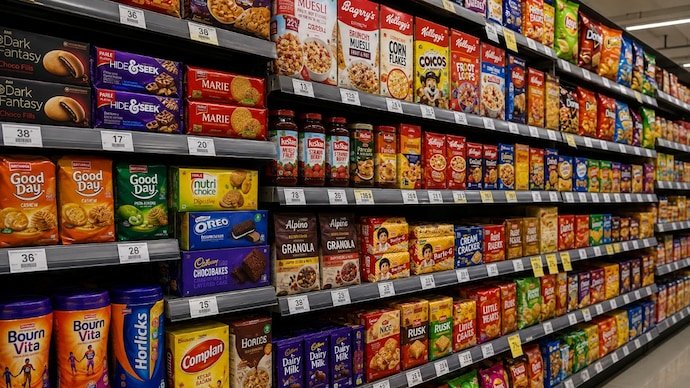
Imagine a shopper comparing several packets on a supermarket shelf. Under the conventional system, the shopper may need to pick up each package, turn it around and compare the nutritional tables. A prominent warning system would make certain nutritional characteristics visible immediately.
The debate in India has included different approaches to achieving that objective. One proposal considered by FSSAI involved the Indian Nutrition Rating system, while the wider discussion has also included warning-style approaches that specifically flag high levels of sugar, salt and saturated fat.
The choice between these systems is not merely a design question. It can influence how consumers interpret a product. A rating system attempts to provide an overall nutritional assessment, whereas warning labels can draw attention directly to specific nutrients that exceed defined levels.
Why FSSAI has not yet settled the issue
FSSAI has previously indicated that the proposed framework generated substantial stakeholder feedback.
More than 14,000 comments were received during the consultation process surrounding the proposed labelling changes. An expert committee was subsequently involved in examining the concerns and considering possible changes.
The regulatory process has therefore involved more than simply deciding whether consumers should receive nutritional information. Officials have had to consider how the information should be presented, what thresholds should apply and how the rules would work across India’s highly diverse food market.
Those questions are especially complicated because packaged foods range from highly processed snacks and beverages to products based on traditional recipes.
Why traditional Indian foods became part of the argument
During the Supreme Court hearing, Additional Solicitor General Brijender Chahar, appearing for the Centre and FSSAI, argued that warning labels could create practical difficulties because some traditional Indian foods naturally contain relatively high levels of salt or fat.
This is one of the central challenges in designing a food-labelling system for India.
A regulation that focuses only on individual nutrient levels could potentially apply the same warning to very different foods. A packaged snack designed primarily as an indulgent product and a traditional food containing naturally occurring fat or salt may have very different nutritional contexts even if a particular nutrient exceeds a numerical threshold.
However, the Supreme Court appeared unconvinced that this concern justified prolonged hesitation. The judges questioned whether concerns about particular food categories should prevent consumers from receiving clear information.
The debate therefore involves finding the right balance between scientific thresholds, cultural diversity, consumer understanding and regulatory practicality.
The court’s concern about industry pressure
One of the strongest aspects of the hearing was the court’s questioning of whether commercial interests were influencing the regulatory process.
The bench observed that manufacturers might oppose warning labels because prominent warnings could affect consumer purchasing decisions and, consequently, sales.
That possibility creates a classic regulatory tension. Food companies have a legitimate interest in how their products are labelled and sold, but regulators are responsible for establishing standards in the public interest.
The Supreme Court’s comments suggest that the judiciary wants the government to make its decision based primarily on consumer health and sound regulatory reasoning rather than commercial pressure.
Importantly, the court did not suggest that manufacturers should lose the right to participate in consultations. Stakeholder input is a normal part of regulation. The concern is whether consultation becomes an indefinite process that prevents a final decision on a public-health measure.
Warning labels do not ban packaged food
A key point often lost in the debate is that a warning label and a product ban are completely different regulatory measures.
A warning tells consumers that a product contains a high amount of a particular nutrient according to a defined regulatory threshold. It does not necessarily prevent the product from being manufactured, sold or consumed.
This distinction was reflected in the Supreme Court’s observation that consumers would continue to have the choice to purchase a product carrying a warning.
The proposed approach is therefore based on informed consumer choice. A shopper who sees a warning can decide whether to buy the product, purchase it less frequently or choose an alternative.
For parents, such information could be particularly relevant when comparing snacks and beverages marketed toward children.
What information consumers already receive
India already has rules requiring nutritional information on food packaging. FSSAI’s regulatory framework includes requirements for declaring nutritional information such as energy, protein, carbohydrates and fat, along with relevant nutrient information.
The issue before the Supreme Court is therefore not whether food manufacturers should provide nutritional information at all. The question is whether certain health-relevant information should be made significantly more prominent through a front-of-pack warning system.
That difference is crucial.
A detailed nutritional panel can contain useful information but still be difficult for a consumer to interpret quickly. Shoppers may not know how a listed quantity compares with recommended intake levels or how one product compares with another.
Front-of-pack systems attempt to solve that communication problem by reducing the amount of interpretation required at the moment of purchase.
Why sugar, salt and saturated fat are at the centre of the debate
The three nutrients at the heart of the proposed warnings are sugar, salt and saturated fat.
They are not automatically harmful in every amount or context. The concern is excessive intake, particularly when a diet repeatedly contains foods with high concentrations of these nutrients.
Packaged foods can make it easier for consumers to consume significant amounts without necessarily recognising how much of a nutrient a product contains. A prominent label could therefore act as a simple signal for shoppers who do not have time to study detailed nutrition panels.
This is particularly relevant in supermarkets and convenience stores, where purchasing decisions can happen within seconds.
Why the proposed system could affect food companies
Mandatory front-of-pack warnings could have implications for the food industry beyond simply changing packaging.
If products are required to display warnings prominently, manufacturers may have an incentive to reformulate products to reduce the amount of nutrients that trigger those warnings.
That could mean changes to recipes, ingredients, portion sizes or product positioning. However, whether such changes would occur and how extensive they would be depends on the final regulatory framework.
The economic impact could also vary by company. Large manufacturers may have greater resources to reformulate products and redesign packaging, while smaller businesses could face different compliance challenges.
These potential consequences help explain why the food industry has taken an active interest in the regulatory debate. But they also reinforce the court’s argument that commercial implications should not be allowed to override the consumer-information objective.
Indian Nutrition Rating versus warning labels
The regulatory debate has previously included the Indian Nutrition Rating (INR), a system intended to give packaged foods a star-based nutritional rating.
A rating system and a warning-label system communicate information differently.
A rating attempts to summarise nutritional characteristics into an overall score. A warning label, by contrast, can tell consumers directly that a product is high in a particular nutrient.
That difference matters because an overall score may not immediately tell a consumer why a product received a particular rating. A warning symbol can be more direct, particularly when the policy goal is to reduce excessive consumption of specific nutrients.
FSSAI’s consultation process and subsequent expert review indicate that the final Indian framework has been the subject of continuing debate rather than a straightforward regulatory decision.
Why the Supreme Court intervention matters
The Supreme Court’s latest intervention places the issue on a much tighter timeline.
The Centre and FSSAI have been given two weeks to place their final decision before the court. That does not mean warning labels have already been made mandatory. It means the government and regulator have been asked to take a definitive position.
The distinction is important for consumers and food companies alike. The current hearing is about the regulatory decision-making process; the final requirements will depend on what the government and FSSAI place before the court and what further directions the Supreme Court may issue.
The court has already made clear that it views consumer health as a serious consideration and expects the regulator to address the issue rather than allow it to remain unresolved indefinitely.
What could change for consumers if warnings are introduced?
If a mandatory warning system is eventually implemented, the most visible change would be on the front of packaged food products.
Consumers could potentially identify products exceeding specified thresholds for sugar, salt or saturated fat without having to search through the detailed nutrition panel.
The practical effect would depend heavily on the design of the final labels. A system that is clear, prominent and easy to understand could make nutritional comparison quicker. A complicated or visually crowded system might provide less benefit.
The thresholds would also matter. If they are set too high, consumers may see warnings on relatively few products. If they are set too low, warnings could become so common that consumers pay less attention to them.
These are technical regulatory questions that will need to be addressed through the final framework.
What happens next in the FSSAI food-label debate?
The immediate deadline is now clear: the Centre and FSSAI must return to the Supreme Court with their final decision within two weeks.
The outcome could determine whether India moves toward mandatory front-of-pack warnings, modifies the proposed approach or adopts another form of prominent nutritional information.
Whatever system emerges, the underlying objective will remain the same: helping consumers understand what they are buying.
The Supreme Court’s intervention has also brought the debate into sharper focus by challenging the idea that regulatory uncertainty can continue indefinitely when Public health is at stake.
For consumers, the most important issue is not whether a package carries a particular symbol or rating. It is whether the information is accurate, understandable and visible enough to influence an informed choice.
The court’s remarks suggest that this principle is now at the centre of the dispute. Manufacturers may have concerns about costs, packaging and consumer behaviour, while regulators must consider technical and scientific questions. But the Supreme Court has made clear that the health implications of the decision, especially for children, cannot be treated as a secondary consideration.
Until FSSAI presents its final position, no new warning-label requirement can be assumed to be in force as a result of Thursday’s hearing alone. The next two weeks will therefore be important for India’s packaged-food industry, regulators and millions of consumers who increasingly rely on labels to understand what is inside the products they buy.
For breaking news and live news updates, like us on Facebook or follow us on Twitter and Instagram. Read more on Latest India on thefoxdaily.com.






COMMENTS 0