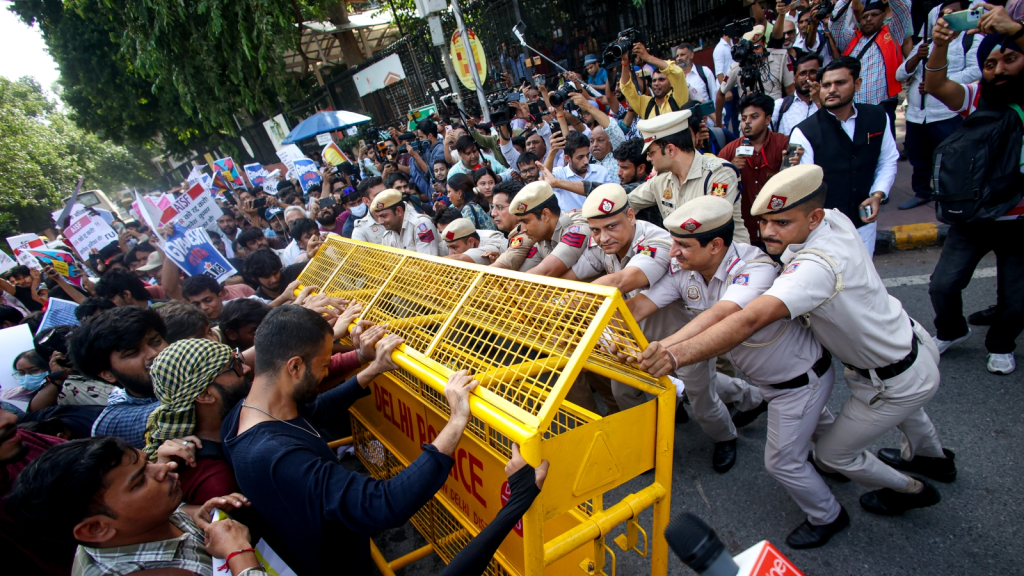
A political dispute over demands for Chief Election Commissioner Gyanesh Kumar’s resignation has escalated into a broader war of words between the Congress and the Bharatiya Janata Party (BJP). The confrontation intensified on October 16, 2026, after lawyer-activist Prashant Bhushan openly described the objective of the protests as regime change, prompting sharp responses from senior BJP leaders.
BJP president Nitin Nabin accused the opposition of pursuing an agenda that extended beyond electoral reform, while Delhi Chief Minister Rekha Verma responded with the phrase “Game over, bro,” turning a familiar expression associated with the protest movement against its supporters.
Congress leaders, meanwhile, challenged the BJP’s criticism, arguing that seeking to replace a government through elections is a normal function of political opposition. The disagreement has placed the meaning of regime change at the centre of a political argument over electoral institutions, protest movements and the limits of legitimate dissent.
At the heart of the dispute are demands for Kumar to resign, criticism surrounding the Special Intensive Revision (SIR) of electoral rolls, and allegations about the independence and functioning of the Election Commission. The competing claims have widened the debate beyond the original grievances of the protesters.
What triggered the Congress-BJP war of words?
The latest confrontation emerged from protests organised by the Cockroach Janta Party (CJP), the All India Students Association (AISA) and supporters of the Congress-led INDIA bloc. The groups have demanded the resignation of Chief Election Commissioner Gyanesh Kumar over allegations concerning the Election Commission’s handling of electoral rolls and the Special Intensive Revision process.
The movement has brought together student activists, opposition politicians and other critics of the government’s approach to electoral administration. Although their backgrounds and political affiliations differ, the groups have converged around demands for accountability from the country’s election authorities.
The immediate controversy intensified after Bhushan publicly embraced the phrase regime change. His remarks followed a press conference in which AISA leader Neha Bora drew a comparison between the protests in India and the youth-led agitation that resulted in the removal of Bangladesh’s then-prime minister Sheikh Hasina in 2024.
The comparison gave the BJP an opportunity to argue that the movement was moving beyond demands for electoral reform and towards a broader effort to remove the government.
However, the phrase itself has different meanings in different political contexts. In democratic politics, regime change can refer to replacing a government through elections. In other contexts, it can describe the removal of an existing government through extra-constitutional means.
The central disagreement is whether the opposition’s language describes an ordinary democratic objective or signals a more disruptive political strategy. The statements exchanged by both sides have not, by themselves, established that the protesters intend to pursue an unconstitutional transfer of power.
Why did the BJP invoke Bangladesh?
The political sensitivity surrounding Bhushan’s remarks increased because of the reference to Bangladesh’s 2024 uprising. The protests there culminated in the collapse of Sheikh Hasina’s government and her departure from the country.
For the BJP, the comparison raised concerns about whether Indian opposition leaders were drawing inspiration from a movement that had removed an incumbent government outside the usual electoral process.
The party has accused opposition groups of using demonstrations over electoral issues to undermine the government and destabilise democratic institutions. BJP leaders have also alleged that foreign interests are involved in attempts to create unrest, although such allegations must be distinguished from independently established evidence.
The comparison with Bangladesh is politically significant because it changes the focus of the debate. Instead of concentrating exclusively on electoral-roll revisions and the conduct of the Election Commission, the discussion shifts towards the methods through which governments should be challenged.
India’s constitutional system provides for governments to be replaced through elections and establishes procedures for addressing disputes involving public institutions. Protests and criticism are also part of democratic political activity, subject to applicable law.
Consequently, the relevant question is not simply whether opposition leaders want a change of government. It is whether their stated objectives and actions remain within democratic and constitutional processes.
Nitin Nabin accuses opposition of pursuing an agenda beyond electoral reform
BJP president Nitin Nabin responded to Bhushan’s remarks with a statement on X, arguing that the language of regime change had exposed what he described as the opposition’s real agenda.
“The use of terms like ‘regime change’ has exposed the true agenda of the opposition,” Nabin said.
He alleged that the protests were part of an attempt to destabilise India in collaboration with foreign powers and associated the campaign with what he called the agenda of urban Naxals.
Nabin also rejected the suggestion that the movement was principally concerned with electoral reforms, the SIR process or the future of young people. Instead, he accused the opposition of trying to spread anarchy and capture power at any cost.
In his Hindi statement, Nabin argued that political power in a democracy must come through the public mandate rather than disorder. He said the BJP and India’s citizens would not allow efforts to weaken the country’s democratic system to succeed.
His response reflects the BJP’s broader argument that the legitimacy of a government depends on electoral outcomes and that protests should not be used to bypass the democratic process.
The opposition’s position, however, is that challenging the government’s policies, questioning electoral administration and seeking political change are legitimate activities within a democracy.
Neither side’s characterisation of the other’s motives should be treated as an established fact without supporting evidence. Nabin’s claims about foreign involvement and destabilisation remain allegations in the statements provided.
‘Game over, bro’: Rekha Verma turns a protest slogan against CJP
Delhi Chief Minister Rekha Verma joined the BJP’s response by using the phrase “Game over, bro”, adapting a popular expression associated with CJP founder Abhijeet Dipke.
Verma argued that the demand for regime change demonstrated that the protests were not primarily about electoral reform. She accused the organisers of using young people and farmers as political instruments and attempting to undermine constitutional institutions.
“Game over, bro. The agenda is exposed. It was never about protest. It was all about ‘regime change’,” Verma said.
Her statement sought to turn the protesters’ own political language into an argument against their campaign. Rather than treating the demand for regime change as a normal expression of electoral opposition, she presented it as evidence that the movement’s stated objectives were misleading.
The exchange also illustrates how political arguments increasingly extend beyond formal speeches into short, easily circulated phrases on social media.
Such language can make a complex dispute more accessible to online audiences, but it can also compress important distinctions. A slogan does not explain whether a political group intends to contest elections, organise peaceful demonstrations or pursue a different course of action.
In this case, “Game over, bro” became the BJP’s shorthand for rejecting the opposition’s explanation of its objectives. It did not resolve the underlying questions about electoral-roll revisions or the Election Commission’s conduct.
Rajnath Singh tells Rahul Gandhi to respect the 2024 mandate
Defence Minister Rajnath Singh also criticised the opposition, accusing Congress leader Rahul Gandhi of practising what he described as the politics of disruption under the banner of protecting democracy.
Singh argued that the opposition should respect the verdict delivered in the 2024 Lok Sabha election. The BJP emerged as the single-largest party in that election but did not secure an outright majority on its own.
The BJP subsequently formed the Union government with support from its National Democratic Alliance partners. Singh’s argument was that the government obtained office through the electoral process and that its political opponents should challenge it within the same democratic framework.
The Congress and other opposition parties, however, have argued that respecting an electoral mandate does not mean abandoning scrutiny of the institutions responsible for conducting elections.
These are separate questions. An election determines which parties can form a government, while concerns about electoral administration can be raised through public debate, legal proceedings and other established mechanisms.
The opposition’s criticism of the Election Commission therefore cannot, on its own, establish that it is rejecting the 2024 electoral result. Equally, the fact that a government won the right to govern does not make every subsequent criticism of its institutions illegitimate.
The dispute has become a broader argument over how democratic accountability should work when political parties disagree about the credibility and administration of the electoral process.
Congress says changing the government is a legitimate political objective
Congress spokesperson Pawan Khera challenged the BJP’s interpretation of regime change, arguing that defeating an incumbent government is a normal objective for a political opposition.
Under India’s parliamentary system, opposition parties campaign against the ruling party, criticise government decisions and seek public support to replace it in subsequent elections. From this perspective, a demand for regime change does not necessarily imply an attempt to overthrow the constitutional system.
Khera also accused the BJP of hypocrisy, pointing to the 1977 Lok Sabha election following the Emergency imposed under then-prime minister Indira Gandhi.
In that election, the Congress suffered a major defeat, and the Janata Party formed the government. The result demonstrated how voters could remove an incumbent government through the electoral process after a period of intense political controversy.
The historical comparison is relevant because it separates the objective of changing the government from the means used to achieve that change. An opposition party can seek to replace the ruling party without seeking to abolish democratic institutions or bypass elections.
However, the disagreement cannot be settled by the phrase alone. The context of a political statement, the conduct of the organisations involved and their stated methods all matter when assessing what they mean by regime change.
The BJP’s criticism focuses on the wider protest movement and its references to Bangladesh. Congress’s response focuses on the democratic legitimacy of defeating an incumbent government. These arguments address related but distinct issues.
What is the controversy over the Special Intensive Revision of electoral rolls?
The protests began with concerns about the Election Commission’s handling of the Special Intensive Revision, commonly known as SIR, a process intended to review and update electoral rolls.
The exercise has generated controversy over the removal of names from voter lists, the procedures used to verify eligibility and the transparency of decisions taken by election officials.
Opposition parties have questioned whether the process could result in eligible voters being removed from electoral rolls and have demanded greater accountability from Chief Election Commissioner Gyanesh Kumar.
The Election Commission has maintained that the revision is intended to improve electoral-roll accuracy, including by removing entries associated with deceased people, duplicate registrations and voters who have moved or cannot be traced. The authorities have also indicated that eligible voters can seek inclusion through the applicable procedures.
The dispute therefore involves both administrative questions and concerns about the practical consequences for voters. Removing duplicate or ineligible entries is a legitimate objective of electoral-roll management, but the process must also protect eligible citizens from wrongful exclusion.
For voters, the central issue is whether the procedures provide a reliable way to verify entries, correct mistakes and ensure that eligible citizens can participate in elections.
For the political parties, the controversy has become part of a wider disagreement over the independence and credibility of electoral institutions. The opposition has called for Kumar’s resignation, while the BJP has accused its opponents of using the dispute to pursue political objectives.
Allegations of bias and administrative irregularities require examination through evidence and the appropriate institutional processes. Political accusations alone do not establish that the Election Commission has deliberately favoured one party.
Why the controversy matters beyond the latest political exchange
The dispute has implications for public confidence in electoral administration. Election authorities depend not only on their legal powers but also on the credibility of their procedures and the willingness of political parties and voters to accept their decisions.
When opposition parties question the handling of electoral rolls, the authorities must address the substance of those concerns through transparent procedures and appropriate explanations. At the same time, allegations of wrongdoing should be evaluated on the evidence rather than accepted solely because they are repeated by political leaders.
The confrontation also demonstrates how a dispute about a specific administrative process can expand into a national argument about democratic legitimacy.
Bhushan’s use of regime change gave the BJP a phrase with which to challenge the opposition’s intentions. The BJP’s response, in turn, prompted Congress to defend its right to seek a change of government through elections.
Neither argument eliminates the need to examine the original concerns about the SIR process. Whether electoral rolls have been revised correctly, whether eligible voters have adequate opportunities to correct errors and whether decisions have been taken transparently remain separate questions from the political rhetoric surrounding the protests.
What happens next?
The immediate political confrontation is likely to remain centred on the demands for Kumar’s resignation, the credibility of the SIR process and the competing interpretations of the protests.
The BJP has sought to frame the movement as an attempt to destabilise the government, while Congress and other critics argue that challenging the government and seeking political change are legitimate parts of democratic competition.
The significance of the dispute will depend partly on whether the underlying concerns about electoral administration receive substantive answers. Clear explanations of voter-list revisions, accessible correction procedures and scrutiny of specific allegations would address issues that slogans cannot resolve.
The political parties will continue to disagree over what the protests represent. But the distinction between changing a government through elections and seeking to remove it outside constitutional procedures remains essential to understanding the controversy.
For now, “regime change” and “Game over, bro” capture the competing political narratives. They do not settle the questions that triggered the protests: how electoral rolls should be revised, how the Election Commission should be held accountable and how public confidence in India’s electoral process can be maintained.
For breaking news and live news updates, like us on Facebook or follow us on Twitter and Instagram. Read more on Latest India on thefoxdaily.com.




COMMENTS 0