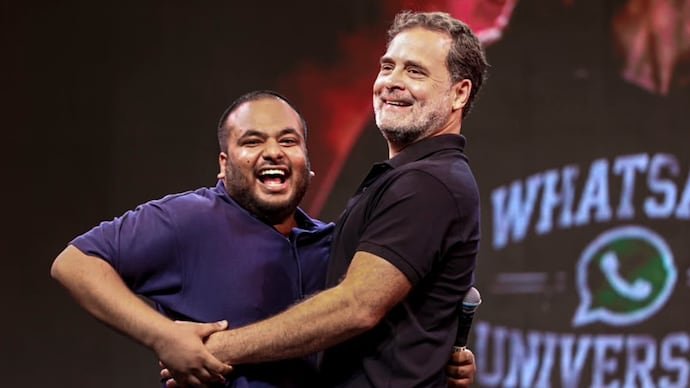
Bharatiya Janata Party leaders have sharply criticised Congress leader Rahul Gandhi over a recent stage performance in which he appeared alongside stand-up comedian Pulkit Mani and participated in a satirical skit mocking Prime Minister Narendra Modi.
The performance took place at the Congress’s “Chhatron Ki Goonj” event in Indore on Saturday. Mani imitated Modi’s speech patterns, mannerisms and public persona, while Gandhi joined the comedian on stage during the performance.
The episode quickly became a political controversy, with BJP leaders accusing Gandhi and the Congress of encouraging what they described as crude and disrespectful political humour. Congress and Gandhi’s side of the controversy was not detailed in the supplied account.
The BJP criticism included comments from Parliamentary Affairs Minister Kiren Rijiju, party spokesperson CR Kesavan, Union Education Minister Pralhad Joshi and Delhi Chief Minister Rekha Gupta. Their objections focused on the tone of the performance and what they said was an insult directed at Modi and his late mother.
How the Controversial Skit Unfolded
The performance centred on an exaggerated imitation of Modi. Mani adopted the prime minister’s familiar speaking style and gestures while interacting with Gandhi on stage.
At one point, the comedian used a recurring expression associated with Modi’s public conversations with foreign leaders. Mani asked Gandhi, “How are you, my friend?” Gandhi responded, “How are you, Modi ji?” Mani then replied, “Great harassment,” before laughing in an exaggerated manner.
The skit also reportedly included a reference to an earlier public incident involving Modi and an elderly woman at a BJP rally. According to descriptions of the performance, the comedian portrayed an exaggerated version of an occasion when Modi had asked organisers to arrange a chair for an elderly woman attending the event.
The reference became particularly contentious because BJP leaders interpreted the performance as mocking the elderly woman as well as the prime minister.
The controversy therefore went beyond ordinary political satire for the BJP, with party leaders arguing that the performance crossed a line between criticism and personal insult.
BJP Calls Performance ‘Foul-Mouthed Antics’
BJP spokesperson CR Kesavan strongly criticised the performance in a post on X. He described it as “foul-mouthed antics” by what he called “cheap, vulgar trolls” and argued that respectable audiences would not find the material amusing.
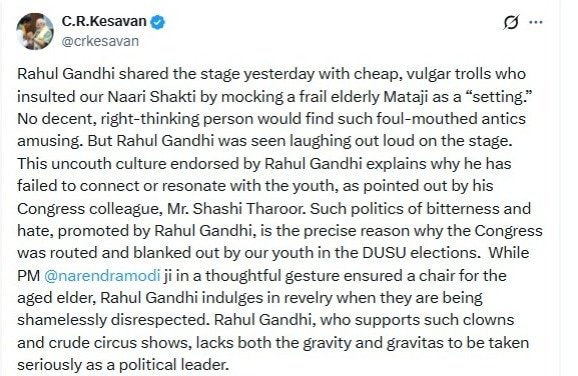
Kesavan also used the controversy to question Gandhi’s political approach and his relationship with younger voters. He argued that Gandhi’s association with the performance reflected what he characterised as an “uncouth Culture.”
Kesavan further connected his criticism to comments previously made by Congress leader Shashi Tharoor, referring to Tharoor’s views about Gandhi’s ability to connect with or resonate among young people.
He also argued that Gandhi’s participation in such performances undermined the seriousness expected from a political leader and said that supporting what he described as “crude circus shows” demonstrated a lack of political gravity.
These statements were part of the BJP’s political response to the controversy rather than independently established assessments of Gandhi’s standing among young voters.
BJP Accuses Gandhi of Insulting ‘Naari Shakti’
Kesavan also accused Gandhi of insulting “Naari Shakti,” or women’s power, by participating in a performance that he said mocked a frail elderly woman.
The criticism referred to the portion of the skit inspired by the incident involving the elderly woman at a BJP rally. The BJP presented that segment as an example of the performance going beyond political criticism and showing disrespect toward an elderly woman.
The controversy highlights a recurring challenge in political satire: the boundary between criticism of public figures and references to private individuals or members of the public who become part of political events.
In this case, the BJP’s criticism focused not only on the imitation of Modi but also on how the performance represented the elderly woman who appeared in the episode being referenced.
Kiren Rijiju Targets Congress Over the Performance
Parliamentary Affairs Minister Kiren Rijiju also responded to the controversy, targeting the Congress in a post on X.
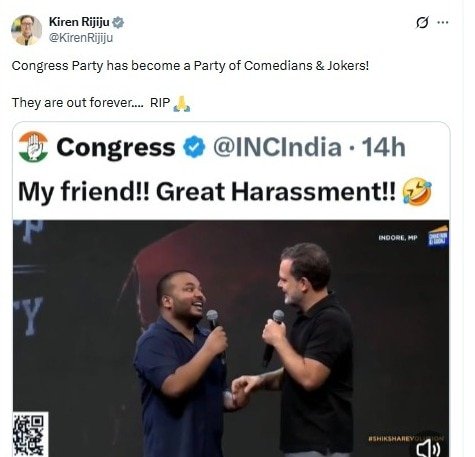
Rijiju wrote that the Congress had become a “Party of Comedians & Jokers” and used the post to criticise the direction of the opposition party.
His comments reflected the BJP’s broader response, which treated the performance as evidence of what party leaders characterised as a decline in political standards within the Congress.
The comments also show how the episode quickly moved from a stage performance into a wider political argument over the nature of opposition Politics and the public image of Rahul Gandhi.
Pralhad Joshi Says Modi’s Mother Was Mocked
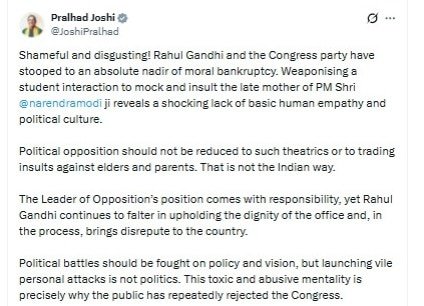
Union Education Minister Pralhad Joshi took a similarly strong position, arguing that the performance was intended to insult Modi’s late mother.
Joshi described the episode as shameful and said Gandhi and the Congress had reached what he called an unacceptable level of political conduct. He argued that using a student interaction to mock Modi’s mother demonstrated what he characterised as a lack of empathy and political culture.
The reference to Modi’s mother added an emotional dimension to the controversy. Political attacks involving family members can provoke stronger reactions than criticism directed solely at an elected official because they involve people who may not themselves hold political office.
Joshi’s criticism therefore framed the skit not simply as satire directed at a prime minister but as an attack involving a deceased family member.
Rekha Gupta Joins the BJP Criticism
Delhi Chief Minister Rekha Gupta also criticised Gandhi over the performance.
Gupta argued that laughing at what she viewed as an insult to a mother exposed Gandhi’s political upbringing. She also described the episode as evidence of what she characterised as political and moral decline within the Congress.
Her remarks continued the BJP’s focus on the treatment of Modi’s family in the performance and reinforced the party’s argument that political opponents should maintain limits even while engaging in criticism and satire.
DUSU Elections Become Part of the Political Attack
The BJP’s response did not remain limited to the skit. Kesavan also brought the recent Delhi University Students’ Union elections into the controversy, using the results to argue that Congress-backed student politics had struggled to establish a connection with younger voters.
The DUSU elections saw the RSS-affiliated Akhil Bharatiya Vidyarthi Parishad, or ABVP, win three of the four central panel positions. Independent candidate Deepanshu Shokeen won the vice-president’s position after reportedly being denied an NSUI ticket.
The National Students’ Union of India, or NSUI, is the student organisation associated with the Congress. The results therefore became politically significant for both parties, particularly because student elections are often treated as an indicator of the competing influence of political organisations among university students.
Kesavan argued that the Congress’s political messaging had failed to establish meaningful rapport with young voters. He specifically connected his criticism of Gandhi’s participation in the skit with the DUSU results.
However, an election result by itself does not establish a single reason for a party or organisation’s performance. Student elections can be influenced by local candidates, campus issues, alliances, organisational strength and individual campaign dynamics.
What Happened at the Indore Event
The controversy began at the Congress’s “Chhatron Ki Goonj” event in Indore, where Gandhi appeared with comedian Pulkit Mani.
Mani performed an imitation of Modi that incorporated the prime minister’s public speaking style, mannerisms and conversational patterns. The performance was structured as political comedy, with Gandhi participating in the exchange rather than simply watching from the audience.
The comedian also exaggerated Modi’s style of addressing foreign leaders as “my friend.” The interaction between the comedian and Gandhi was designed as a satirical exchange involving Modi’s public persona.
One part of the routine referred to an incident involving an elderly woman at a BJP rally. Modi had reportedly asked organisers to provide her with a chair, and that moment became part of the comedian’s imitation.
After the performance circulated publicly, BJP leaders argued that the joke was offensive and disrespectful. The controversy consequently shifted attention from the event itself to questions about the limits of political satire.
Political Satire and the Limits of Public Debate
Political satire has long been part of democratic debate. Politicians, comedians and commentators frequently use imitation, exaggeration and humour to criticise public figures and government policies.
At the same time, public reactions can differ sharply depending on whether satire focuses on a politician’s decisions and public conduct or extends to family members, private individuals and sensitive personal subjects.
The Modi-Gandhi skit has become controversial precisely because BJP leaders argue that it crossed that boundary. Their response focuses on the alleged treatment of Modi’s mother and the elderly woman referenced in the performance.
The episode also demonstrates how political humour can quickly become a political issue in its own right. A performance intended as satire can be interpreted by supporters of the target as disrespect, while supporters of the performer may view it as legitimate criticism or political comedy.
In India’s highly competitive political environment, such disagreements can rapidly spread through social media and become part of broader partisan messaging.
The Wider BJP-Congress Political Contest
The controversy is taking place within the broader political competition between the BJP and Congress. Rahul Gandhi, as Leader of the Opposition in the lok Sabha, remains one of the Congress’s most prominent national figures, while Modi is the BJP’s central political leader and the country’s prime minister.
As a result, even an event focused on students and comedy can quickly become part of the larger contest between the two parties.
The BJP’s response shows how the party is using the incident to challenge Gandhi’s political image, particularly among younger voters. References to the DUSU elections allowed BJP leaders to connect the controversy with a separate contest involving student organisations.
The Congress event, meanwhile, placed Gandhi in a less conventional political setting, alongside a comedian and before a student-oriented audience. The resulting debate illustrates how political leaders increasingly operate across formal political events, social media and cultural formats.
DUSU Results Add Another Dimension
The DUSU election results provide a separate but relevant backdrop to the BJP’s criticism. ABVP won three of the four central panel posts, while Deepanshu Shokeen, an independent candidate who had reportedly been denied an NSUI ticket, secured the vice-president’s position.
For the BJP, the result offered an opportunity to argue that its student organisation remains competitive on Delhi University’s campuses. For the Congress, the result represents a challenge for its student wing and its ability to build support among university voters.
However, the political significance of a student election should be kept distinct from the controversy surrounding Gandhi’s stage appearance. The two events involve different circumstances and electorates, even though both have been brought together in the BJP’s criticism.
Why the Controversy Has Grown
The dispute has gained attention because it combines several politically sensitive elements: an imitation of the prime minister, participation by the Leader of the Opposition, references to Modi’s late mother and an elderly woman, and comments about the performance of Congress’s student wing.
Each element has allowed political leaders to frame the episode according to a broader argument about political culture.
For BJP leaders, the skit is being presented as evidence of what they regard as a decline in political discourse within the Congress. Their comments have focused heavily on respect, political conduct and the treatment of Modi’s family.
The episode also gives the BJP an opportunity to question Gandhi’s appeal among younger voters by linking the controversy to the DUSU results.
The Congress event itself, however, was structured around engagement with students and included political comedy, illustrating the increasingly varied formats through which political figures communicate with younger audiences.
What the Dispute Says About Political Communication
The controversy illustrates how political communication has expanded beyond speeches, rallies and parliamentary debates. Social media, comedy performances and student events now provide additional platforms for politicians to communicate with voters.
Those formats can make political messages more accessible, particularly to younger audiences, but they can also create greater risks of controversy because jokes and informal comments can be interpreted differently by different groups.
Political satire often relies on exaggeration and imitation. When the target is a powerful public figure, supporters may view such humour as legitimate criticism while opponents may see the same material as insulting or offensive.
The reaction to Gandhi and Mani’s performance demonstrates that distinction clearly. What happened on stage as a comedic routine has since become part of a wider political dispute between the BJP and Congress over leadership, youth engagement and political standards.
A Political Controversy Beyond the Stage
The BJP’s attack on Rahul Gandhi over the Indore skit has expanded into a broader argument about the nature of political discourse and the Congress’s relationship with younger voters.
Kiren Rijiju, CR Kesavan, Pralhad Joshi and Rekha Gupta have all criticised the performance, with particular emphasis on what they described as offensive references to Modi and his late mother. Kesavan additionally linked the episode to the Congress’s performance in the DUSU elections.
The original event involved a comedian imitating Modi’s public persona and Gandhi participating in the performance. A portion of the routine drew on an earlier incident involving an elderly woman at a BJP rally, while another section exaggerated Modi’s familiar conversational style with foreign leaders.
The controversy now sits within the wider BJP-Congress political contest, where questions about political language, youth engagement and the limits of satire are increasingly intertwined.
As political communication continues to move across rallies, student events, comedy stages and social media, the episode highlights how quickly a satirical performance can become a national political controversy.
For breaking news and live news updates, like us on Facebook or follow us on Twitter and Instagram. Read more on Latest India on thefoxdaily.com.




COMMENTS 0