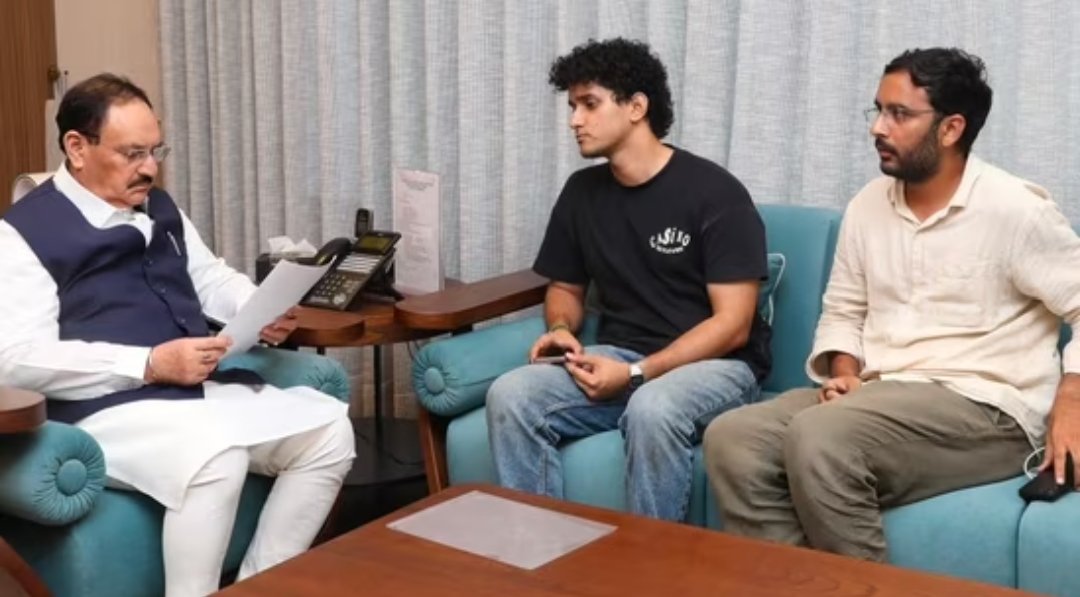
In a significant political development, the Central government has initiated its first formal engagement with representatives of the Cockroach Janta Party (CJP) amid the high-profile Parliament march led by supporters of activist Sonam Wangchuk. Union Minister and BJP National President JP Nadda met members of the protest group in New Delhi, where the delegation submitted a written charter of demands focused on education reforms, accountability, and student welfare.
The meeting came at a crucial moment as Parliament’s Monsoon Session commenced and thousands of protesters gathered in the national capital demanding greater transparency in India’s public examination system. While both sides described the discussions as cordial, the talks stopped short of any immediate commitments, with the government saying the demands would first be discussed with the senior leadership.
The dialogue marks an important shift in the ongoing movement. Until now, the protest had largely unfolded through demonstrations, hunger strikes, political statements, and court proceedings. Monday’s meeting represents the first structured attempt to address the concerns through direct communication between the government and protest leaders.
Why the JP Nadda-CJP Meeting Matters
Political negotiations often become the turning point in prolonged public movements. Although no concrete decisions emerged from the first round of discussions, the very fact that the government agreed to meet the protesters signals recognition that the issue has grown beyond a routine demonstration.
For weeks, the movement has dominated political discourse, with opposition parties, student organisations, and education activists demanding action over examination credibility and administrative accountability. By opening formal dialogue, the government has taken the first institutional step toward addressing at least some of the concerns raised by the protesters.
Whether these discussions ultimately lead to policy changes remains uncertain, but the meeting has reduced the possibility of complete political deadlock.
What JP Nadda Said After the Meeting
Speaking to reporters after meeting the CJP delegation, JP Nadda described the interaction as constructive and cordial.
According to the minister, the protesters themselves initiated the proposal for talks, after which discussions continued for several hours. During the meeting, the delegation submitted a written petition outlining its demands.
Nadda said he appealed to the protesters to end their agitation and cooperate with authorities while the government examined the issues raised.
However, he did not announce any immediate policy decisions, timelines, or commitments following the discussions.
The Three Key Demands Presented by the CJP
After the meeting, CJP representatives outlined the primary demands they placed before the government.
| Demand | Purpose |
|---|---|
| Immediate release of Sonam Wangchuk and permission to address supporters | Restore public communication with the movement’s leading figure. |
| Resignation or removal of Union Education Minister Dharmendra Pradhan | Demand accountability over examination-related controversies. |
| ₹1 crore compensation for families of students who allegedly died by suicide following the NEET controversy | Provide financial support and acknowledge the human impact of examination-related distress. |
According to the delegation, these demands represent both immediate humanitarian concerns and broader calls for accountability within the education system.
What Assurance Did the Government Give?
One of the biggest questions following the meeting was whether the government accepted any of the protesters’ demands.
Based on statements made after the discussions, the government’s assurance was limited but significant.
- The demands would be placed before the senior leadership.
- The government would examine the written petition.
- A response would be communicated after internal consultations.
- Protesters were requested to withdraw their agitation while discussions continue.
The CJP clarified that no commitment was made regarding the resignation of the education minister, compensation, or Sonam Wangchuk’s release during the meeting itself.
How the Protest Reached This Stage
The current movement has evolved rapidly over recent weeks.
Initially centred on concerns regarding examination integrity and educational accountability, the campaign expanded after Sonam Wangchuk began an indefinite hunger strike. As his health deteriorated, public attention intensified, drawing support from political leaders, student organisations, and civil society groups.
His transfer to Safdarjung Hospital further increased national attention, transforming the protest into a broader discussion on governance, transparency, and democratic engagement.
The Parliament march became the movement’s largest mobilisation so far, bringing together supporters from different states and placing additional pressure on the government to initiate dialogue.
Timeline of Key Developments
| Date | Major Event |
|---|---|
| Mid-June | CJP protest campaign began at Jantar Mantar. |
| June 28 | Sonam Wangchuk started his indefinite hunger strike. |
| July 18 | He was shifted to Safdarjung Hospital following health concerns. |
| July 20 Morning | Government initiated formal talks with CJP representatives. |
| July 20 Afternoon | CJP delegation submitted a written charter of demands to JP Nadda. |
Heavy Security During the Parliament March
Even as discussions were underway, Delhi witnessed one of its largest security deployments in recent months.
Thousands of supporters attempted to march toward Parliament while police established multiple barricades and traffic diversions across central Delhi.
Authorities cited security requirements associated with Parliament’s Monsoon Session and implemented additional measures to regulate public movement near sensitive government locations.
The combination of negotiations and heightened security illustrated the government’s attempt to balance public order with democratic engagement.
Why Education Reform Has Become the Core Issue
Although the protest includes several political demands, its central theme remains education reform.
Competitive examinations affect millions of Indian students every year, making transparency and fairness critical to public confidence.
Education experts often argue that examination systems require continuous improvements in technology, security, administrative oversight, and grievance redressal to maintain credibility.
The ongoing movement reflects growing public expectations that examination authorities should be both transparent and accountable whenever controversies arise.
Political Significance of the Government’s First Dialogue
The opening of negotiations carries political importance regardless of the immediate outcome.
Governments typically engage directly with protest groups only after movements achieve substantial public visibility or political significance. By agreeing to meet the CJP delegation, the government has acknowledged that the concerns raised deserve formal consideration.
At the same time, the absence of immediate commitments suggests that authorities are proceeding cautiously, likely weighing legal, administrative, and political implications before making any decisions.
What Happens Next?
Several developments could shape the direction of the movement in the coming days.
- The government may communicate its official response after internal consultations.
- Further rounds of dialogue between both sides remain possible.
- Parliament could witness debates on examination reforms during the Monsoon Session.
- CJP leaders will decide whether to continue or modify their protest strategy based on the government’s response.
- Public attention will remain focused on Sonam Wangchuk’s health and future participation in the movement.
Expert Perspective: Dialogue Is Only the First Step
Public policy experts generally view negotiations as an important beginning rather than a complete solution. Meaningful reforms often require parliamentary discussions, administrative reviews, expert committee recommendations, and implementation mechanisms.
Even if immediate political demands are not accepted, sustained dialogue can create opportunities for broader policy reforms addressing examination security, institutional accountability, and student welfare.
The success of such discussions ultimately depends not only on political willingness but also on practical implementation that restores confidence among students and parents.
Why This Movement Could Influence Future Education Policy
The current protests have already succeeded in bringing education governance to the centre of national political discussion.
Regardless of the eventual outcome, policymakers are likely to face increasing expectations regarding transparency in public examinations, faster investigations into alleged irregularities, improved communication with students, and stronger safeguards against future controversies.
These issues extend beyond any single examination and have implications for India’s broader education and recruitment systems.
Conclusion
The first formal meeting between JP Nadda and the Cockroach Janta Party marks a significant moment in an evolving nationwide movement centred on examination reforms and educational accountability. While the government has not yet accepted the protesters’ demands, its decision to open dialogue represents a shift from confrontation toward negotiation.
For now, the government’s assurance is limited to reviewing the written demands and consulting senior leadership before responding. Whether these discussions lead to concrete policy decisions or further negotiations will determine the next phase of both the protest and the national conversation on education reform. As Parliament continues its Monsoon Session, the issues raised by the movement are expected to remain at the forefront of India’s political and educational agenda.
For breaking news and live news updates, like us on Facebook or follow us on Twitter and Instagram. Read more on Latest India on thefoxdaily.com.




COMMENTS 0