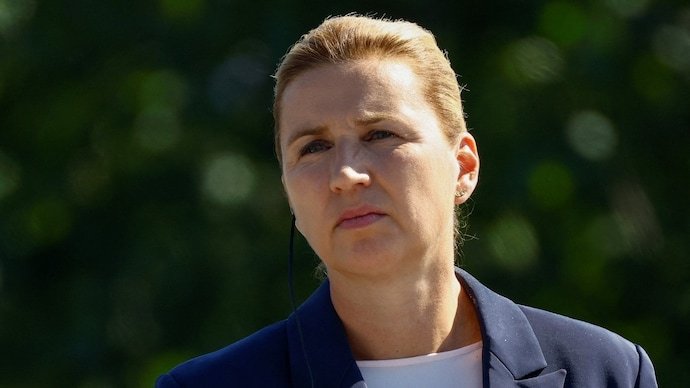
Danish Prime Minister Mette Frederiksen has publicly rejected unsolicited advice about her appearance after a cosmetic surgeon contacted her on social Media and offered to improve what he described as a flaw on her nose.
Rather than accept the suggestion, Frederiksen shared a screenshot of the exchange on Instagram and delivered a pointed response about the constant scrutiny women face over their looks. The 48-year-old Social Democrat said she was comfortable with her appearance and questioned why a male plastic surgeon felt entitled to offer an opinion about her body.
The incident quickly became more than an exchange about cosmetic surgery. In her lengthy Instagram post, Frederiksen connected the message to a broader issue she has experienced throughout her public life: repeated commentary about her teeth, hair, nose and other physical features.
Her response was particularly striking because it came after a visit to Kyiv, where she said she had heard air-raid sirens as Russia‘s war against Ukraine continued. After returning to Denmark, she said, one of the first messages she received was not about the serious issues facing Europe but about her nose.
What the cosmetic surgeon told Mette Frederiksen
The cosmetic surgeon, whom Frederiksen did not identify publicly, sent her a message offering to help “fix that little spot on your nose.” The message appears to have been intended as a professional offer, but Frederiksen clearly did not see it that way.
In the screenshot she posted, the Danish prime minister responded that she was happy with her body and did not need a male plastic surgeon to have an opinion about it.
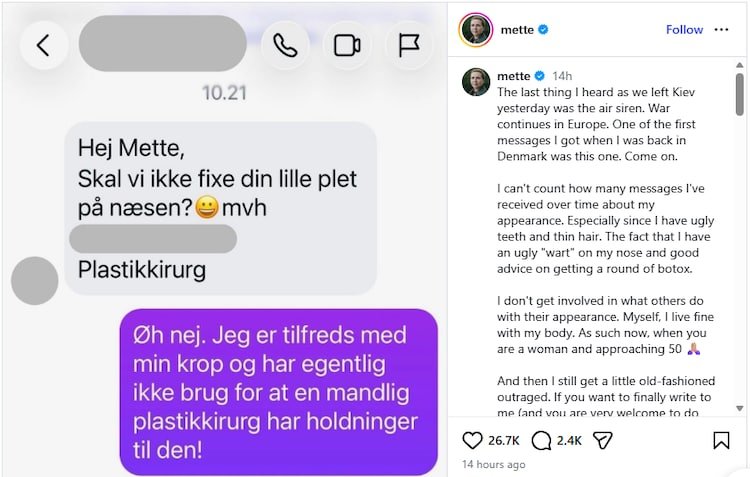
She then made her position even clearer in the caption accompanying the screenshot: she had no interest in the offer.
The exchange was brief, but Frederiksen’s accompanying remarks turned it into a wider statement about the expectations placed on women, particularly women in prominent public positions.
Frederiksen says she is tired of comments about her appearance
The prime minister explained that the message was not an isolated experience.
She said she has received countless comments over the years about the way she looks. Among the features mentioned by critics and unsolicited advisers, she pointed to her teeth, thin hair and the appearance of her nose.
She also referred to suggestions that she should undergo cosmetic procedures such as Botox.
Her frustration was not simply that someone had suggested cosmetic treatment. It was the assumption behind the message: that a woman in public life should regard certain physical characteristics as problems requiring correction.
Frederiksen’s response challenged that assumption directly. She said she is comfortable with her appearance and that she is living well as she approaches 50.
Why her Kyiv reference made the message more pointed
One of the strongest elements of Frederiksen’s post was the contrast she drew between the subject of the message and the issues she had been dealing with as prime minister.
She had recently visited Kyiv, where she said she heard air-raid sirens. Europe remains affected by the war in Ukraine, and Denmark has maintained strong support for Ukraine.
Against that backdrop, Frederiksen found it striking that one of the first messages waiting for her after returning home focused on the shape of her nose.
Her point was not that appearance should never be discussed. Rather, she questioned the priorities involved in contacting a head of government to recommend cosmetic treatment when there are far more consequential issues demanding political attention.
That contrast gave her response a political dimension without turning the post itself into a policy statement.
“I really don’t need” a male plastic surgeon’s opinion
Frederiksen’s response to the surgeon was particularly direct because she framed the issue around bodily autonomy.
She said she was satisfied with her body and did not need a male plastic surgeon to provide an opinion about it.
The remark reflects a familiar debate around unsolicited beauty advice: even when presented as professional expertise, comments about someone’s body can cross a personal boundary when they are neither requested nor necessary.
For a public figure, that boundary can become even harder to maintain. Politicians are constantly photographed and discussed, meaning their physical appearance can become part of public commentary alongside their political decisions.
Frederiksen’s decision to publish the exchange effectively reversed that dynamic. Instead of quietly ignoring the message, she used it to make the sender’s assumption the subject of public discussion.
The Danish PM’s message about “perfect imperfections”
Frederiksen did not stop at rejecting the surgeon’s offer. She broadened her message to people WHO regularly feel pressured to change their appearance.
She encouraged women, and others as well, to embrace what she described as their “perfect imperfections.” Her message was that physical features people may be encouraged to change are not necessarily defects that need fixing.
That distinction is increasingly relevant in an era when social media, celebrity culture and the cosmetic industry can make particular beauty standards seem almost universal.
Public figures are especially exposed to this pressure. Their photographs circulate widely, and relatively ordinary characteristics can become topics of commentary because millions of people have access to their images.
Frederiksen’s response instead argued for accepting those characteristics rather than automatically treating them as cosmetic problems.
Frederiksen has faced appearance scrutiny before
The Danish prime minister’s comments suggest that the nose message was part of a much longer pattern.
She referred to repeated remarks about her teeth and hair as well as her nose. She also mentioned previous suggestions involving Botox.
Such commentary illustrates an unusual burden carried by women in Politics. Their leadership, policies and political decisions can be accompanied by persistent discussion of their clothing, hair, facial features and age.
Frederiksen’s response effectively questioned why a woman holding one of Europe’s most senior political offices should have to spend political and personal energy responding to unsolicited assessments of her appearance.
Who is Mette Frederiksen?
Frederiksen has been Denmark’s prime minister since 2019 and is the country’s second woman to hold the office. She is also the leader of the Social Democrats.
Her political career has placed her at the centre of several major European issues, particularly Denmark’s response to Russia’s invasion of Ukraine and debates over European security.
Denmark is both a member of the European Union and NATO, giving the prime minister an important role in discussions surrounding European defence and transatlantic security.
That international position helps explain why Frederiksen’s reference to her Kyiv visit was significant. Her public schedule routinely involves issues involving war, security, Diplomacy and relations between major powers.
Her Instagram post therefore offered a sharp contrast between the seriousness of her political responsibilities and the trivial Nature of the unsolicited cosmetic advice she received.
Frederiksen’s stance on Ukraine and Greenland
Appearance is far from the centre of Frederiksen’s political agenda. She has been a strong supporter of Ukraine as it continues its fight against Russia.
She has also taken a firm position against US President Donald Trump‘s ambitions involving Greenland, the self-governing territory within the Kingdom of Denmark.
Greenland has become a major issue in Denmark-US relations because of Trump’s repeated interest in acquiring the Arctic territory. Frederiksen has defended Greenland’s right to determine its own future and rejected the idea that it could simply be taken over by the United States.
Those positions place Frederiksen in debates involving national sovereignty, European security and the future of the Arctic. They also underscore the point she was making in her Instagram post: there is no shortage of serious subjects on which people can engage with a sitting prime minister.
Why the response resonated beyond Denmark
The exchange may have started with a single message about a nose, but Frederiksen’s response touches on a much wider cultural issue.
People, particularly women in public life, often face a contradiction. They are expected to appear polished and presentable while also being criticised if their appearance is considered too artificial, too old, too young or otherwise outside an accepted standard.
Cosmetic procedures are personal choices, and people can choose them for any number of reasons. Frederiksen’s objection was not an attack on cosmetic surgery itself. Her argument was that she should be able to decide for herself whether her nose needs changing.
That distinction is central to understanding her reaction. The issue was consent and unsolicited judgment rather than whether Botox, surgery or other cosmetic treatments are inherently good or bad.
A political leader drawing a personal boundary
Frederiksen’s post also demonstrated how social media has changed the relationship between political leaders and the public.
Politicians can now receive direct messages from strangers, professionals, supporters and critics around the world. The same platforms that allow leaders to communicate directly with voters can also expose them to highly personal commentary.
By publishing the exchange, Frederiksen chose to establish a public boundary: people are free to contact her, but she would prefer that they use the opportunity to discuss matters of greater importance rather than tell her what to do with her face.
That may be the most pointed part of her response. She did not suggest that people should stop contacting her. Instead, she invited them to focus their attention on something more meaningful.
The bigger message behind the nose controversy
Frederiksen’s response ultimately turned an unsolicited cosmetic suggestion into a statement about self-acceptance and respect.
Her message was simple: physical characteristics do not automatically require correction just because someone else considers them imperfect.
For a politician who has spent years under public scrutiny, the subject is hardly trivial. Appearance can become an easy target because it is immediately visible, while political achievements and policy decisions require far more effort to understand.
Frederiksen’s refusal to accept the surgeon’s offer was therefore about more than a nose. It was a rejection of the idea that women in public life should constantly explain or apologise for how they look.
Her final appeal was directed not just at the surgeon who sent the message but at anyone who has been made to feel inadequate because of an ordinary physical feature. Instead of chasing an imagined standard of perfection, she urged people to live comfortably with the imperfections that make them who they are.
And for a prime minister whose daily responsibilities include war, diplomacy, security and national policy, her answer to an unsolicited offer to “fix” her nose was perhaps as direct as it could be: she is quite happy with the one she has.
For breaking news and live news updates, like us on Facebook or follow us on Twitter and Instagram. Read more on Latest World on thefoxdaily.com.






COMMENTS 0