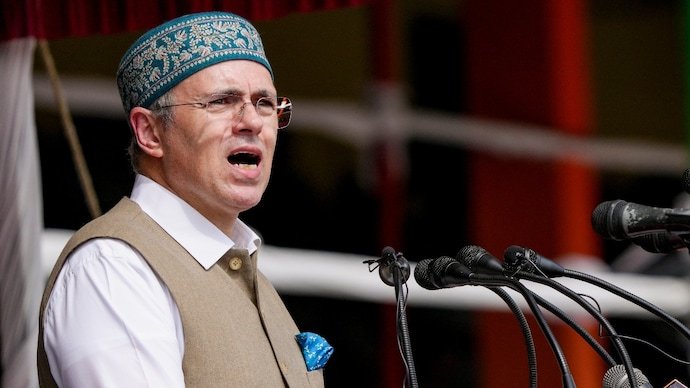
Jammu and Kashmir Chief Minister Omar Abdullah on Thursday described Pakistan’s protest against recent remarks by US Ambassador to India Sergio Gor as a matter between Washington and Islamabad, signalling that his government does not intend to become involved in the diplomatic exchange.
Pakistan had summoned US Chargé d’Affaires Natalie Baker after Gor, during his visit to Jammu and Kashmir, described the region as an important part of India. Gor also indicated that the United States could reconsider its travel advisories for Jammu and Kashmir in light of measures taken to improve security in the region.
Asked about Pakistan’s response, Abdullah said the issue was now between the two countries concerned. He also avoided directly joining the congress in its criticism of third-party involvement in matters concerning Jammu and Kashmir.
Rather than prolonging the political dispute, Abdullah used his interaction with reporters in Srinagar to discuss issues closer to the administration’s immediate agenda, including the Kashmir International Film Festival, the development of AIIMS, plans for a law university and the proposed expansion of private higher education institutions in Jammu and Kashmir.
Omar Abdullah stays out of Pakistan-US diplomatic dispute
The latest disagreement began after Sergio Gor’s visit to Jammu and Kashmir, where his comments on the region prompted a diplomatic reaction from Pakistan.
Pakistan summoned the US chargé d’affaires and lodged what it described as a strong demarche over Gor’s remarks. The development added another layer to the long-running diplomatic sensitivity surrounding Jammu and Kashmir, an issue over which India and Pakistan have sharply differing positions.
Abdullah, however, declined to treat Pakistan’s protest as an issue requiring intervention by the Jammu and Kashmir government.
He said the remarks had already been made and that the subsequent discussion was between the United States and Pakistan. His position effectively separates the Union Territory’s domestic Governance priorities from the diplomatic exchange taking place between Washington and Islamabad.
For Abdullah, the immediate issue is not about responding to Pakistan’s protest but about continuing the administration’s work in Jammu and Kashmir.
What did Sergio Gor say?
During his Jammu and Kashmir visit, US Ambassador to India Sergio Gor described Jammu and Kashmir as an important part of India. He also referred to efforts by the central government and the Abdullah administration to improve safety in the region.
Gor indicated that Washington could reconsider its travel advisories concerning Jammu and Kashmir if the security situation continues to improve. Such remarks carry significance because travel advisories can influence how foreign visitors, businesses and organisations assess a destination.
Pakistan objected to the ambassador’s comments and summoned the US diplomatic representative in Islamabad.
Abdullah’s response was notably restrained. Instead of offering a detailed political rebuttal, he treated the dispute as a matter for the countries directly involved.
Abdullah avoids confrontation with Congress
The chief minister was also asked about the Congress party’s response to the issue. Abdullah chose not to enter into a public argument with the party.
He acknowledged that Congress, as a political party and the largest opposition party, was entitled to express its own position. But he made it clear that he did not intend to participate in a war of words over the matter.
The response is politically significant because Jammu and Kashmir’s political landscape includes competing views on the role of external actors in discussions surrounding the region. Abdullah’s decision to avoid escalating the disagreement allows his administration to keep attention on governance rather than becoming drawn into another political confrontation.
It also reflects a distinction between expressing a political position and making it the focus of the government’s public agenda.
Kashmir International Film Festival to focus on local talent
Abdullah also discussed the upcoming Kashmir International Film Festival, making clear that the event is not primarily intended to attract famous Bollywood or Hollywood personalities.
According to the chief minister, the larger objective is to expose audiences in Jammu and Kashmir to different forms and styles of cinema. While the presence of Bollywood personalities would be welcome, he said the festival should not be judged simply by the number of celebrities attending.
This approach places greater emphasis on developing the region’s own creative ecosystem.
Abdullah said the festival would include workshops covering areas such as direction, cinematography, editing and music. The stated objective is to develop a pool of local professionals who can participate in film productions taking place in Jammu and Kashmir.
That could have a practical economic benefit. Film production requires technicians and specialists across a wide range of functions, from camera operations and editing to sound, music and production management. If local young people develop these skills, filmmakers would have access to a trained workforce within the region rather than having to bring every technical professional from elsewhere.
Why the film industry matters for Jammu and Kashmir
The film strategy outlined by Abdullah goes beyond tourism promotion.
A successful local film ecosystem could potentially connect cultural activity with employment and skills development. Workshops can provide practical training, while increased filming activity can create opportunities for technicians, hospitality businesses, transport providers and other local services.
The administration’s stated goal is therefore to make film production more locally sustainable rather than treating celebrity appearances as the primary measure of success.
For Jammu and Kashmir, this is particularly relevant because the region has long attracted filmmakers because of its landscapes and distinctive cultural settings. Building local technical capacity could help ensure that a larger share of the economic activity associated with productions remains within the region.
AIIMS construction remains another major focus
Healthcare infrastructure was another subject Abdullah addressed during his interaction with reporters.
Speaking about the AIIMS project in the region, he said construction work was progressing and that the health minister was periodically reviewing the project. Abdullah also referred to an earlier inspection during which he was assured that one block would become operational during the year.
The initial operationalisation is expected to involve outpatient department services and other basic treatments, according to the chief minister.
For residents, the significance of a major medical institution extends beyond the physical construction of a campus. Large public healthcare facilities can become important centres for specialist treatment, medical education and healthcare-related employment when they become fully operational.
Abdullah’s comments suggest that the immediate administrative priority is to maintain momentum toward opening at least part of the facility rather than waiting for the entire project to be completed.
Law university plans move closer to formal approval
Education infrastructure was another area highlighted by the chief minister.
Abdullah said discussions over the location of a law university were progressing and that the relevant file appeared to be close to completion. He indicated that formal approval was the remaining step before the project could move forward.
A dedicated law university would add another specialised higher-education option in Jammu and Kashmir. Such an institution could support legal education and create a local academic environment for students interested in law and related fields.
Abdullah also indicated that one or two private universities were interested in establishing institutions in Jammu and Kashmir. He said the coming weeks could bring positive developments, including foundation stone-laying ceremonies and the beginning of construction work.
The expansion of private universities, if it materialises, would add capacity to the region’s higher-education sector and could create new opportunities for students who might otherwise leave the region for specialised courses.
Development agenda shifts focus from diplomacy to governance
Abdullah’s comments are notable because they came against the backdrop of a politically sensitive international dispute. Yet much of his interaction focused on domestic development rather than foreign-policy rhetoric.
The contrast is important. Jammu and Kashmir frequently attracts international attention because of its political and security history, but the day-to-day priorities of its administration include healthcare, education, employment, investment and tourism.
The projects discussed by Abdullah touch several of these areas.
- Healthcare: The AIIMS project is expected to expand access to major medical services.
- Education: A proposed law university and private universities could increase higher-education capacity.
- Employment: Film-related training could help create a locally skilled workforce.
- Tourism and culture: A film festival could promote Jammu and Kashmir as a destination for creative activity as well as tourism.
Together, these initiatives point toward an economic strategy that seeks to make the region more attractive for institutions, investment and skilled employment.
Why the Pakistan-US row matters for Jammu and Kashmir
The diplomatic dispute cannot be viewed separately from the broader international sensitivity surrounding Jammu and Kashmir. Pakistan continues to challenge India’s position on the region, while India maintains that Jammu and Kashmir is an integral part of the country and rejects external intervention in the matter.
Against that backdrop, statements by senior representatives of major countries can attract immediate diplomatic attention.
Gor’s remarks were significant because they came during a visit to Jammu and Kashmir and touched directly on how Washington views the region. Pakistan’s subsequent diplomatic protest showed that Islamabad continues to closely monitor international statements relating to Jammu and Kashmir.
Abdullah’s response, however, was to avoid becoming a participant in the dispute.
That approach allows the Union Territory’s administration to maintain its focus on issues over which it has a more direct role, including development and public services.
What happens next in Jammu and Kashmir?
The effectiveness of the initiatives discussed by Abdullah will ultimately depend on implementation rather than announcements.
For the AIIMS project, the immediate milestone is whether the promised block becomes operational within the indicated timeframe. The impact of the facility will become clearer as services expand and patients begin using the institution.
For higher education, the next steps involve formal approval, site selection where necessary and the start of construction. Private universities will similarly need to move from stated interest to actual project execution.
The film festival presents a different opportunity. Its long-term value will depend less on celebrity attendance and more on whether workshops, productions and industry connections create lasting opportunities for local professionals.
The diplomatic situation surrounding Jammu and Kashmir will continue to evolve separately. Abdullah’s latest comments suggest that he does not intend to allow the Pakistan-US disagreement to dominate the administration’s public agenda.
Omar Abdullah’s message: development remains the priority
Omar Abdullah’s response to the latest Kashmir-related diplomatic dispute was deliberately limited: Pakistan’s protest belongs to the Pakistan-US relationship, while political parties in India are free to articulate their own positions.
His larger message was directed toward development within Jammu and Kashmir.
From AIIMS and higher education to film production and local employment, the projects he highlighted represent areas where progress can have a direct effect on residents. Whether these plans deliver their intended results will depend on how quickly they move from policy discussions and construction to functioning institutions and sustained economic activity.
For now, Abdullah appears determined to keep the administration focused on that domestic agenda rather than becoming drawn into another round of political and diplomatic confrontation over Kashmir.
For breaking news and live news updates, like us on Facebook or follow us on Twitter and Instagram. Read more on Latest India on thefoxdaily.com.






COMMENTS 0