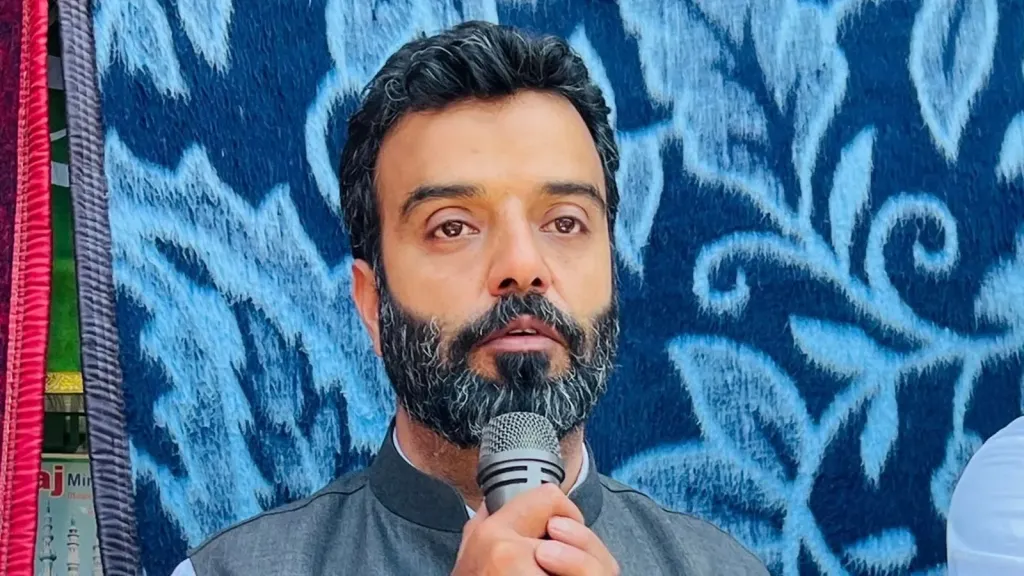
Aga Ruhullah Mehdi’s resignation from the National Conference marks a significant political rupture within one of Jammu and Kashmir’s oldest regional parties. The Srinagar MP announced his departure in Budgam on Tuesday, signing a two-page resignation letter before thousands of supporters and declaring that he was freeing himself from the party.
He also emailed his resignation from the Srinagar Parliamentary constituency to Lok Sabha Speaker Om Birla, making the announcement more than a public expression of disagreement with the party leadership.
In an emotionally charged address at Behisht-e-Zehra park, Ruhullah accused Chief Minister Omar Abdullah of using his political credibility to secure public support during the elections before abandoning the commitments that had brought voters to the National Conference. He also criticised party president Farooq Abdullah over the party’s position on Article 370 and its promises concerning the constitutional rights of Jammu and Kashmir.
The timing and symbolism of the resignation added another dimension to the announcement. Ruhullah chose November 3, the death anniversary of his father, Aga Syed Mehdi, who was assassinated in a suspected militant attack in Budgam in 2000. After signing the document, he handed it to Muhammad Ashraf Mattoo, the father of Tufail Mattoo, a 17-year-old killed in alleged police firing in 2010 when Omar Abdullah was chief minister.
His departure raises questions about the National Conference’s internal unity, the credibility of its election commitments and the political direction of Jammu and Kashmir following the restoration of an elected government.
Why Aga Ruhullah Mehdi Resigned From the National Conference
Ruhullah’s decision was not the result of a single disagreement. His public statements indicate that the separation had developed over several months, with differences over the party’s ideological position, reservation policies, constitutional guarantees and the implementation of promises made during the Assembly election campaign.
At the centre of his criticism is the gap between what the National Conference promised voters and what its government has delivered since taking office.
During his Budgam address, Ruhullah specifically mentioned three commitments that he believed represented the party’s political fight:
- Rationalisation of reservation: Reviewing the reservation framework affecting opportunities in education and government employment.
- 200 units of free electricity: Delivering the electricity-related promise made during the election campaign.
- Restoration of constitutional guarantees: Continuing the political struggle over the constitutional protections previously enjoyed by Jammu and Kashmir.
Ruhullah argued that these commitments were not ordinary election announcements. They represented the expectations of people who had supported the National Conference because they believed the party would stand firmly behind its stated political positions.
His resignation therefore carries a message beyond party membership. He is questioning whether the National Conference has remained faithful to the political commitments that helped it regain public support.
The Meaning Behind Ruhullah’s ‘You Used Me’ Accusation Against Omar Abdullah
One of the strongest moments in Ruhullah’s speech was his direct accusation against Omar Abdullah. He claimed that the chief minister had used his political standing and the trust people placed in him to strengthen the National Conference’s electoral campaign.
Ruhullah had supported the party during the 2024 elections and campaigned for several candidates, including Omar Abdullah, who contested the Budgam Assembly constituency as a second seat.
His involvement was politically significant because he had considerable influence in Budgam and was also a prominent Shia religious leader. His support helped connect the party with voters who viewed him as someone willing to defend their political and constitutional interests.
However, Ruhullah now believes that the trust he carried into the election campaign was not respected after the party formed the government.
Addressing Omar Abdullah, he said the chief minister had disappointed Kashmiris by approaching Prime Minister Narendra Modi and Union Home Minister Amit Shah with shawls after winning the Assembly election.
He questioned the political symbolism of those interactions, arguing that the party’s approach after forming the government did not reflect the stronger position it had presented to voters during the campaign.
His statement, “You lied and misled the people, you used me. My people had faith on me,” captures the personal dimension of the disagreement.
For Ruhullah, the dispute is not simply about disagreements between politicians. It concerns the credibility he believes he built among voters and the responsibility he feels towards people who supported him because of his association with the National Conference.
Article 370 Became the Biggest Ideological Fault Line
The restoration of constitutional guarantees, particularly the political issue surrounding Article 370, has remained central to Ruhullah’s criticism of the National Conference.
He accused Farooq Abdullah of misleading the people of Jammu and Kashmir about the party’s commitment to restoring the constitutional position that existed before August 2019.
Ruhullah questioned why the party had adopted a more cautious position after the elections when its campaign had presented the restoration of constitutional guarantees as an important political objective.
He challenged the party’s argument that those responsible for removing the constitutional guarantees would not be the people who could restore them.
His question was straightforward: if the National Conference believed that the BJP-led government at the Centre would not reverse the changes, why had the party not communicated the limitations of its political position more clearly during the election campaign?
This disagreement highlights a difficult political reality for regional parties in Jammu and Kashmir. They can campaign on demands involving constitutional restoration, autonomy and political rights, but the ability to implement such demands depends on decisions that may lie beyond the authority of the elected government in the Union Territory.
That distinction between political promises and institutional powers is particularly important in understanding the dispute.
The National Conference can maintain its demand for the restoration of constitutional guarantees, but the party cannot independently reverse decisions taken by the Union government. This creates a difficult situation for its leadership: maintaining a strong political position while governing within the existing constitutional framework.
Ruhullah’s criticism suggests that he does not believe the party has adequately explained this difference to voters.
How the Rift Between Ruhullah and the National Conference Developed
Although the resignation became public on Tuesday, the disagreement between Ruhullah and the party had been visible since December 2024.
December 2024: Support for Reservation Protesters
The differences became public when Ruhullah joined students protesting against what they described as inadequate representation for the open-merit category in education and government employment in Jammu and Kashmir.
In December 2024, he stood alongside the protesting students outside the chief minister’s residence on Gupkar Road.
His decision was politically important because the protest placed him in a position of publicly challenging an issue that had become contentious for the National Conference government.
Rather than limiting his disagreement to internal party discussions, Ruhullah associated himself with students demanding changes to the reservation framework.
Growing Distance From Party Activities
After the protest, his relationship with the party leadership appeared to deteriorate further.
Ruhullah was no longer seen participating in the National Conference’s internal meetings. Meanwhile, party MLAs remained absent from administrative meetings concerning his constituency, according to the supplied account.
These developments suggested that the disagreement had moved beyond differences over a particular policy and was affecting his working relationship with the party organisation.
Ruhullah increasingly questioned whether the National Conference was departing from its ideological commitments and abandoning the principles it had historically represented.
November 3: Resignation Becomes Public
The final announcement came during his public gathering in Budgam. By signing the resignation letter in front of thousands of supporters, Ruhullah transformed a political disagreement into a formal break with the party.
His decision to email the resignation to the Lok Sabha Speaker also signalled his intention to relinquish his parliamentary position rather than simply leave the National Conference while continuing as an MP.
Why Budgam Holds Special Political Significance for Ruhullah
Budgam is more than a political constituency for Ruhullah. It is closely connected to his family history, political beginnings and public identity.
His entry into electoral politics followed the assassination of his father, Aga Syed Mehdi, in a suspected militant attack in Budgam on November 3, 2000.
Ruhullah contested the 2002 Assembly election from Budgam after his father’s death and went on to represent the constituency across three tenures.
His political journey was therefore built around a constituency where his family already had a significant public presence.
His influence in the area also extended beyond electoral politics. His position as a Shia religious leader gave him an important connection with sections of the local population.
That combination of political experience and community influence helped explain why the National Conference selected him to contest the Srinagar parliamentary seat in 2024.
From Budgam MLA to Srinagar MP
Ruhullah successfully contested the 2024 Lok Sabha election from Srinagar, marking his first victory in a parliamentary election.
The seat had previously been represented and contested by senior National Conference leader Farooq Abdullah. Ruhullah received the opportunity after Farooq Abdullah decided against contesting again.
Following his victory, Ruhullah became part of the National Conference’s manifesto committee alongside senior party leaders.
The manifesto subsequently became one of the major sources of disagreement between him and the party leadership.
This is an important detail because Ruhullah was not an outsider criticising the National Conference’s promises. He had been directly involved in the process through which the party’s election commitments were developed.
His involvement in the manifesto committee also gave him a political basis to question whether the government was following the commitments associated with its election programme.
Why Ruhullah Handed His Resignation to Tufail Mattoo’s Father
One of the most striking elements of the Budgam gathering was Ruhullah’s decision to hand over his signed resignation letter to Muhammad Ashraf Mattoo, the father of Tufail Mattoo.
Tufail was 17 years old when he was killed in alleged police firing in 2010, during Omar Abdullah’s tenure as chief minister.
The gesture connected Ruhullah’s criticism of the present National Conference leadership with a painful episode in Kashmir’s recent political history.
By choosing Tufail’s father as the recipient of the document, Ruhullah appeared to underline his argument that political accountability should extend beyond election campaigns and government formation.
The gesture also carried a direct political message to Omar Abdullah, whose government was in power when the teenager was killed.
Rather than handing the document to a party functionary or another political leader, Ruhullah chose a family member of a teenager whose death remains associated with questions about police action and political responsibility in Kashmir.
The symbolism reinforced the central theme of his speech: that the dignity, rights and expectations of ordinary people should remain more important than political arrangements.
Ruhullah’s Message to the BJP, RSS and Central Government
Although much of his speech focused on the National Conference and Omar Abdullah, Ruhullah also directed strong criticism towards the BJP, RSS and the central government.
He argued that the people of Jammu, Kashmir and Ladakh would no longer compromise on their dignity and constitutional protections.
His remarks suggested that his disagreement with the National Conference should not be interpreted as a shift towards the political position of the BJP.
He maintained that constitutional protections were a matter of rights and dignity rather than political concessions that could be granted or withdrawn according to the preferences of the government at the Centre.
He also addressed the central government with a broader message: the people of Jammu and Kashmir would engage with it on their own terms rather than simply accept the political agenda set by New Delhi.
His Hindi and Urdu statement, “Kashmir apni sharton pe baat karenge, tumhare alfazon mein baat nahin karega,” reflected his insistence that Kashmir’s political voice should not be dictated by others.
He also questioned whether a BJP government in Jammu and Kashmir would be fundamentally different from the current political arrangement under the National Conference.
This question is significant because Ruhullah’s criticism is directed at the broader political system, not exclusively at one party. His argument is that changing the party in power does not necessarily guarantee the restoration of political rights or constitutional protections.
Omar Abdullah’s Z-Morh Tunnel Remarks Also Became Part of the Dispute
Ruhullah also referred to Omar Abdullah’s remarks during the inauguration of the Z-Morh tunnel at Sonamarg in January 2025.
During the event, Omar Abdullah addressed Prime Minister Narendra Modi and remarked that the weather had supported the occasion, with no clouds in the sky.
Ruhullah repeated the statement during his Budgam address and used it to question the chief minister’s understanding of Kashmir’s local conditions and traditions.
He referred to Chillai Kalan, the harshest period of winter in Kashmir, and argued that the absence of clouds during that period could be viewed locally as a bad omen.
The reference was more than a disagreement over a weather-related comment. Ruhullah used it to challenge what he portrayed as a disconnect between the chief minister’s public messaging and the experiences and cultural understanding of ordinary Kashmiris.
By bringing the remark into his resignation speech, he reinforced his broader accusation that the National Conference leadership had become disconnected from the people whose political expectations had helped bring it to power.
What Ruhullah’s Resignation Means for the National Conference
Ruhullah’s departure presents a political challenge for the National Conference because it exposes differences between the party leadership and a prominent elected representative who had played an important role in its 2024 election campaign.
His exit is particularly significant because he was involved in the manifesto committee and had campaigned for senior party candidates, including Omar Abdullah.
When a politician who helped communicate a party’s election promises later publicly questions their implementation, the disagreement can affect the party’s credibility among voters.
The National Conference must now contend with questions about how it intends to maintain its political commitments while managing the limitations of governing Jammu and Kashmir under the existing constitutional arrangement.
The dispute also highlights the challenge of balancing ideological consistency with the practical responsibilities of government.
For regional parties, maintaining public trust often depends on demonstrating that election promises remain relevant after the campaign ends. Ruhullah’s criticism places that responsibility directly before the National Conference leadership.
Could the Disagreement Affect the Party’s Support Base?
It is too early to determine how much electoral impact Ruhullah’s resignation will have. However, his political background gives the departure significance beyond an ordinary party exit.
He has represented Budgam across three Assembly tenures and won the Srinagar parliamentary election in 2024. His standing among sections of the electorate, particularly in central Kashmir, makes his criticism politically relevant.
His position as a Shia religious leader also gives his political departure a wider community dimension.
Whether this translates into a larger political shift will depend on his future activities, the response of the National Conference leadership and whether other dissatisfied party members associate themselves with his position.
Ruhullah Wants to Find a New Generation of Political Leaders
Ruhullah did not limit his Budgam speech to announcing his departure. He also outlined what he wants to pursue next.
Before signing his resignation, he said he wanted to identify honest young people with compassion who were willing to enter politics and fight for the rights and dignity of their communities.
His statement suggests that he is considering a broader political effort focused on developing new leadership rather than immediately joining another political organisation.
However, he did not announce a new party or provide a formal organisational structure for such an initiative in the supplied remarks.
The emphasis on young people is significant because it indicates that he sees the current political disagreement as part of a larger problem involving representation, accountability and public trust.
His proposed search for new political leaders could eventually become an important part of his post-resignation political strategy. Whether it develops into a formal political movement remains uncertain.
What Happens Next After Aga Ruhullah Mehdi’s Resignation?
Ruhullah’s announcement creates two separate political questions: what happens to his parliamentary position and what direction his political career takes after ending his 24-year association with the National Conference.
He has emailed his resignation from the Srinagar Parliamentary constituency to Lok Sabha Speaker Om Birla. The formal status and next steps concerning his parliamentary membership will depend on the applicable parliamentary process and the Speaker’s handling of the resignation.
His political future is less certain. His speech indicates an interest in identifying new young leaders and continuing to raise issues involving constitutional protections, political dignity and public accountability.
For the National Conference, the immediate challenge is to address the allegations made by a former senior member who was closely involved in its recent electoral campaign.
The larger political question concerns whether the party can maintain its ideological identity while managing the practical limitations of its government.
For voters in Jammu and Kashmir, the dispute also provides a reminder that election promises, particularly those involving constitutional changes and relations with the Centre, need to be assessed alongside the actual powers available to an elected government.
Ruhullah’s resignation may therefore prove important not simply because a prominent MP has left the National Conference, but because it has brought an internal disagreement into the public domain. His accusation that he was used by Omar Abdullah places political trust and accountability at the centre of the debate over Jammu and Kashmir’s future.
For breaking news and live news updates, like us on Facebook or follow us on Twitter and Instagram. Read more on Latest India on thefoxdaily.com.





COMMENTS 0