Pakistan has long responded to periods of strategic uncertainty by looking beyond its borders for stronger partners. The latest effort has brought Islamabad closer to two influential powers in the Muslim world: Saudi Arabia and Türkiye.
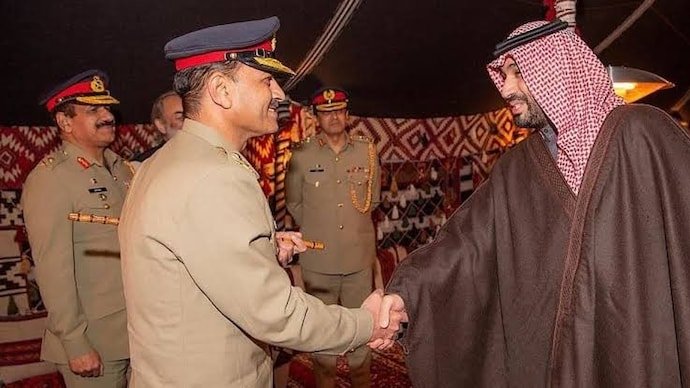
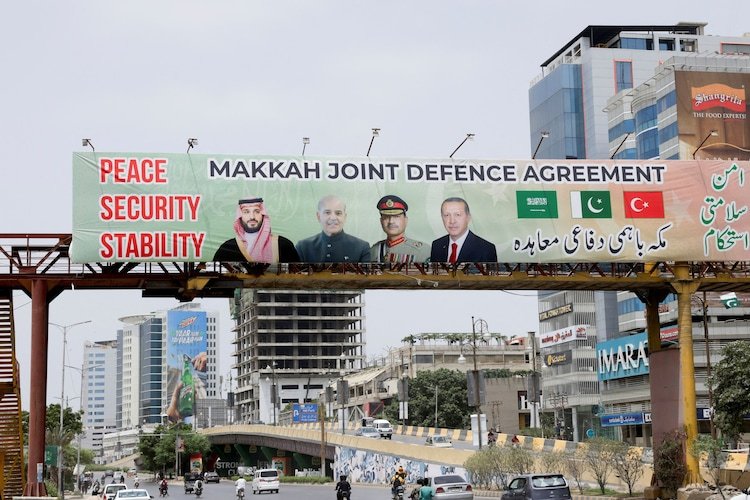
On August 7, Pakistan Prime Minister Shehbaz Sharif, Saudi Crown Prince Mohammed bin Salman and Turkish President Recep Tayyip Erdogan signed the Mecca Joint Defence Agreement. The arrangement gives the three countries a new framework for security cooperation and places Pakistan at the centre of a relationship that could have consequences far beyond the immediate military sphere.
For Pakistan’s military leadership, particularly Field Marshal Asim Munir, the agreement represents more than another diplomatic photograph. It fits into a broader effort to rebuild Islamabad’s strategic options after a period in which its traditional security assumptions have come under pressure.
The agreement also reflects a changing West Asian environment. Saudi Arabia is reassessing the reliability of the regional security architecture built around the United States, while Pakistan is seeking partners, investment and diplomatic support at a time of economic and security difficulties.
Pakistan’s search for strategic depth has a long history
The idea of Pakistan seeking “strategic depth” is not new. Successive governments and military leaders have looked for relationships that could compensate for the country’s geographic, economic and military vulnerabilities.
One of the most consequential examples came after the 1971 war, when East Pakistan separated from Pakistan and became Bangladesh. In January 1972, President Zulfikar Ali Bhutto travelled to Iran, Saudi Arabia and Libya as Pakistan began laying the groundwork for its nuclear programme.
Those relationships eventually became important to Pakistan’s broader strategic development. Saudi Arabia and Libya provided financial support, while China became a crucial partner in the development of Pakistan’s nuclear capabilities.
The lesson for Islamabad was straightforward: relationships with wealthy regional states and major powers could provide resources and strategic room for manoeuvre that Pakistan could not generate alone.
More than five decades later, the circumstances are different, but the underlying calculation remains familiar. Pakistan continues to need external economic support while confronting a difficult security environment and a complicated relationship with India.
Why the Mecca agreement matters to Saudi Arabia
The agreement cannot be understood only through Pakistan’s interests. Saudi Arabia has its own reasons for strengthening security relationships outside its traditional dependence on Washington.
The Middle East has undergone a profound security transformation. Iran’s regional influence, repeated conflicts and attacks involving state and non-state actors have demonstrated the difficulty of maintaining a predictable security environment.
Saudi Arabia has spent years investing in its own military capabilities while simultaneously attempting to diversify its international partnerships. Its expanding relationships with countries such as China, Russia, Türkiye and Pakistan reflect a broader strategy of avoiding excessive dependence on any single external power.
That does not mean Riyadh is abandoning its relationship with the United States. Rather, the Saudi approach increasingly resembles strategic hedging: maintain established alliances while developing additional options.
The Mecca agreement fits naturally into that approach.
Türkiye brings another layer to the partnership
Türkiye’s participation gives the arrangement a different dimension. Ankara is a significant military power with an increasingly sophisticated defence industry and considerable diplomatic influence across the Middle East and wider Muslim world.
Pakistan and Türkiye have also maintained close political and defence ties for years. Cooperation between their armed forces and defence industries has expanded across areas including naval systems, aircraft and other military technologies.
For Islamabad, deeper Turkish cooperation potentially offers access to Technology and defence expertise. For Ankara, closer coordination with Pakistan provides another avenue for expanding its strategic influence while strengthening ties with Saudi Arabia.
The result is a partnership in which each country brings something different. Saudi Arabia has financial resources and considerable diplomatic influence. Türkiye offers military-industrial capabilities and geopolitical reach. Pakistan contributes a large military establishment, nuclear-armed status and longstanding defence relationships across the Muslim world.
Operation Sindoor changed Pakistan’s calculations
The agreement also needs to be viewed against the backdrop of the India-Pakistan confrontation following the Pahalgam terror attack and India’s subsequent Operation Sindoor.
The episode was a major test of Pakistan’s long-standing security assumptions. For decades, Islamabad’s possession of nuclear weapons has existed alongside its support for militant groups and its calculation that India’s response would be constrained by the risk of escalation.
Operation Sindoor challenged that assumption. India demonstrated that it was prepared to use military force in response to a major terror attack while maintaining its position that nuclear weapons should not prevent conventional retaliation.
That shift matters because Pakistan’s strategic model has historically depended not only on military capabilities but also on the expectation that escalation risks would limit India’s choices.
If that expectation weakens, Pakistan needs other forms of deterrence and diplomatic protection. This helps explain why Islamabad has intensified its international outreach.
Asim Munir’s diplomatic outreach
Field Marshal Asim Munir has emerged as a central figure in that effort. His international travel and engagement with major political leaders have expanded the Pakistani military’s role in foreign policy.
Munir’s approach has been particularly visible in his dealings with the United States during Donald Trump‘s presidency. Rather than treating Washington only as a traditional security partner, Islamabad has attempted to frame Pakistan as a country capable of delivering value on several fronts.
Those efforts have included discussions involving regional Diplomacy, economic opportunities and potential cooperation in areas such as critical minerals and strategic resources.
The relationship with Trump is also inherently transactional. That makes it useful for Pakistan but potentially unpredictable.
Islamabad therefore has an incentive to build relationships that do not depend entirely on Washington. The Mecca agreement can be interpreted as part of that diversification.
Why this could be Munir’s Plan B
The most significant feature of the agreement may be what it says about Pakistan’s strategy beyond its relationship with the United States.
Munir’s outreach to Washington provides one route. The Saudi-Turkish partnership provides another.
That is important because Pakistan cannot assume that any individual American administration will remain equally interested in Islamabad. US foreign policy priorities can shift rapidly, particularly when Washington’s attention is focused on China, Iran, Ukraine, the Middle East or domestic political concerns.
A stronger relationship with Saudi Arabia and Türkiye gives Pakistan additional diplomatic depth.
For Islamabad, the benefits could extend beyond defence. Saudi investment and financial assistance could help ease economic pressure, while Turkish defence cooperation could strengthen Pakistan’s military capabilities.
The political optics are equally important. Pakistan is being presented as an equal participant alongside two countries with substantially greater economic resources and significant regional influence.
That provides a diplomatic narrative at a time when Islamabad faces serious internal challenges, particularly in Balochistan and Khyber-Pakhtunkhwa.
Is this really an ‘Islamic NATO’?
The agreement has been described as resembling an “Islamic NATO” because of its collective-defence language. But the comparison should be treated cautiously.
NATO is a highly institutionalised military alliance with decades of integrated planning, permanent structures, common command arrangements and extensive interoperability among its members.
The Mecca agreement is not equivalent to that system.
The key question is what the three governments would actually do if one member faced a major military crisis. A statement of collective defence does not automatically mean that Saudi or Turkish forces would enter a conflict involving Pakistan, or that Pakistan would intervene militarily in a Saudi or Turkish confrontation.
Domestic politics, geography, military priorities and relations with other major powers would all influence any response.
The agreement therefore appears more useful as a framework for strategic coordination than as a guarantee of automatic military intervention.
Could Saudi money and Turkish technology strengthen Pakistan?
Economic and military cooperation could become the practical core of the agreement.
Pakistan’s economic vulnerability is well established within the country’s broader political debate. External financing has repeatedly played an important role in helping Islamabad manage pressure on its foreign-exchange position and public finances.
Saudi Arabia has previously provided financial support to Pakistan, making Riyadh an important economic partner as well as a political one.
Defence cooperation with Türkiye offers a different potential advantage. Pakistan has already developed substantial military ties with Ankara, and deeper cooperation could support the Pakistani defence industry’s efforts to acquire or jointly develop advanced systems.
But neither benefit is automatic.
Saudi financial support would depend on Riyadh’s economic and political calculations, while defence cooperation would depend on specific contracts, technology-transfer arrangements and financing. The agreement creates an opportunity; it does not by itself guarantee either cash or weapons.
The India factor remains central
India is likely to remain one of the most important considerations behind Pakistan’s security planning.
Islamabad has historically sought international partners partly because of the enormous conventional imbalance between India and Pakistan. The nuclear balance reduced the likelihood of a full-scale conventional war but did not eliminate the possibility of limited military confrontation.
The post-Pahalgam environment has made that calculation more complicated.
India’s willingness to respond militarily to terrorism means Pakistan now has to consider not only the direct consequences of supporting militant organisations but also the possibility that diplomatic pressure may not prevent an Indian military response.
This creates a difficult choice for Islamabad. Stronger partnerships could increase its diplomatic protection, but using those partnerships as a shield for another confrontation could also test the limits of Saudi and Turkish support.
The biggest question is what Pakistan does next
The Mecca agreement gives Pakistan additional strategic options, but its real value will depend on how Islamabad uses them.
If the agreement becomes a platform for economic investment, defence cooperation and diplomatic coordination, it could mark a meaningful expansion of Pakistan’s international partnerships.
If, however, Islamabad interprets the new relationships primarily as protection against the consequences of future confrontations with India, the arrangement could become much more dangerous.
Saudi Arabia and Türkiye have their own interests. Neither has an obvious incentive to become permanently entangled in a Pakistan-India confrontation. Their willingness to support Pakistan diplomatically may therefore have limits.
That distinction is critical. A diplomatic partnership can increase a country’s room for manoeuvre, but it does not eliminate the risks created by its own policy choices.
What the Mecca deal means for Pakistan
For Munir, the agreement represents a significant diplomatic achievement. Pakistan has secured a formal strategic relationship involving two influential countries at a moment when the international security environment is becoming more fragmented.
For Saudi Arabia, it provides another layer of defence diplomacy at a time when the Gulf states are seeking greater strategic autonomy.
For Türkiye, it strengthens its position at the intersection of South Asian, Middle Eastern and Islamic diplomacy.
For Pakistan, however, the most important benefit may be diversification. Islamabad is no longer looking toward a single external power for economic assistance, diplomatic backing or security cooperation. It is building several overlapping relationships.
That is the real significance of Munir’s post-Mecca strategy.
Pakistan’s search for strategic depth has entered a new phase. The country is attempting to turn relationships with Saudi Arabia, Türkiye and the United States into complementary pillars rather than relying overwhelmingly on one partner.
Whether that strategy succeeds will depend less on the symbolism of agreements and more on what follows them: investment, defence cooperation, diplomatic coordination and, above all, restraint during future crises.
The Mecca agreement may give Islamabad a stronger hand. It does not, by itself, tell us how that hand will be played.
For breaking news and live news updates, like us on Facebook or follow us on Twitter and Instagram. Read more on Latest World on thefoxdaily.com.



COMMENTS 0