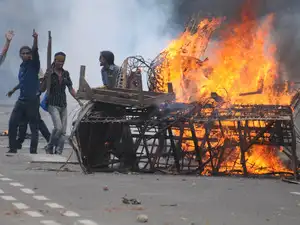
Political Violence in Bangladesh has intensified, with nearly 30 houses reportedly set on fire in Narail district amid attacks targeting people associated with ousted Prime Minister Sheikh Hasina’s Awami League. The incidents have heightened tensions in the country, where protests, retaliatory attacks and unrest have raised fresh concerns about public safety and political stability.
Supporters of the Bangladesh Nationalist Party (BNP) have been accused of targeting properties linked to Awami League leaders and activists following recent killings. Local security forces have deployed additional personnel in an effort to contain the violence and restore order.
Why Were Awami League Leaders’ Houses Targeted in Narail?
The attacks took place on Friday, November 20, in Bendar Char village and neighbouring areas of Kalia upazila in Narail district. The properties reportedly belonged to local Awami League leaders and activists, including former Narail-1 lawmaker BM Kabirul Haque Mukti and former Kalia municipality mayor Fakir Mushfiqur Rahman Liton.
Several shops in the area were also reportedly vandalised, looted and set on fire. The violence continued from the afternoon into the night, leaving numerous families facing damage to their homes and property.
According to local fire service officials, firefighters received information about fires at around 4 pm but could not immediately reach the affected village. Trees had reportedly been felled and placed across roads at several locations, obstructing access. Fire service personnel eventually reached the area at around 8 pm.
Humayun Kabir, station officer of the Kalia Fire Service, estimated that around 20 to 30 houses had caught fire. As several houses contained multiple residential structures, the total number of damaged buildings could be higher.
Local administrative officials provided a lower estimate of the number of houses vandalised, while subsequent reporting by local media indicated that more than 40 houses may have been affected across Bendar Char and adjoining areas. The precise extent of the damage remains disputed.
Two BNP Leaders Were Killed Before the Arson Attacks
The violence in Narail followed the killing of two leaders associated with BNP-affiliated organisations on November 18. The victims were Sheikh Shahin and Sohel Mollah, who reportedly died after an attack on a BNP motorcycle procession in Kalia.
The procession had been organised amid allegations of attacks, crude bomb explosions and arson attributed to Awami League activists. The two men sustained critical injuries during the confrontation and later died while receiving treatment.
The killings heightened tensions between supporters of the two political groups. The subsequent attacks on houses belonging to Awami League leaders and activists appeared to be linked to anger over the deaths, although responsibility for the arson and vandalism has been disputed.
Local residents accused people associated with the BNP of carrying out the attacks. The BNP, however, rejected the allegations. SM Wahiduzzaman, general secretary of the Kalia upazila BNP, described claims that party activists had attacked and burned homes as baseless.
Police said that relatives and supporters of the two slain BNP leaders had gathered in Bendar Char following the killings and attacked properties belonging to Awami League members allegedly involved in the violence. The allegations against those individuals remain matters for investigation.
Police Deploy Additional Personnel as Situation Comes Under Control
Local police responded after receiving information about the attacks and visited the affected areas. Narail Superintendent of Police Mohammad Al Mamun Sikder said police had brought the situation under control and additional personnel had been deployed to prevent further violence.
The police chief also disputed some of the claims circulating on social media about the incident. In particular, district police rejected reports that Hindu families in Bendar Char had been targeted, saying there were no Hindu settlements in the village and that no Hindu households or businesses had been attacked.
Authorities also accused some social media accounts of circulating old and AI-generated videos to misrepresent the situation. The police statements came amid competing accounts of the violence, making it important to distinguish confirmed damage from unverified claims shared online.
Police also reported the arrest of two suspects in connection with the November 18 killings of the BNP-affiliated leaders. Investigations into the deaths and the subsequent attacks on properties are important to establishing individual responsibility and preventing further retaliatory violence.
Bangladesh Faces Wider Political Unrest Ahead of Hasina’s Proposed Return
The Narail incident is part of a broader period of political tension in Bangladesh. Sheikh Hasina, who was removed from power in August 2024 following a mass uprising, has been living in India. She has indicated that she intends to return to Bangladesh in December, despite the legal proceedings and political challenges she faces.
Her proposed return has become a major point of contention between supporters of the Awami League and the country’s current political leadership. The Awami League, whose activities were banned by the interim administration in May 2025, has continued to have supporters and networks across the country.
In recent weeks, protests and calls for a nationwide shutdown have been accompanied by reports of crude bomb explosions, roadblocks, attacks on public property and clashes between rival political groups. The unrest has affected several districts, adding to concerns about security ahead of the next phase of the country’s political transition.
The BNP and its allies have accused Hasina’s supporters of attempting to destabilise the country. Awami League supporters, meanwhile, have alleged persecution and attacks against party members. These competing accusations have contributed to an increasingly tense political environment.
Muhammad Yunus’ House and Grameen Bank Branches Also Targeted
Separate incidents involving properties associated with Nobel Peace Prize laureate Muhammad Yunus have added to concerns about the spread of violence. Yunus, who previously led Bangladesh’s interim administration, has faced hostility from sections of the Awami League following Hasina’s removal from office.
On November 19, a fire was reported at his ancestral home in Chattogram. Police said flames were spotted in an unused ground-floor room that was being used for storage. A police patrol noticed the fire and extinguished it. No casualties were reported, and authorities had not established who was responsible.
Grameen Bank, the microfinance institution founded by Yunus, has also reported attacks on its branches. Reports from the period described arson incidents and damage at multiple locations. The bank said dozens of its branches had been attacked between November 10 and 19, although the reported number varied across accounts.
These incidents should be distinguished from the attacks in Narail. There is no established evidence that the fire at Yunus’ house, the attacks on Grameen Bank branches and the arson targeting Awami League leaders’ homes were part of a single coordinated operation.
Why the Latest Violence Matters for Bangladesh
The attacks highlight the risks of retaliatory violence in a politically divided country. The killing of two BNP-affiliated leaders was followed by attacks on properties associated with the Awami League, creating a cycle in which political grievances can quickly turn into threats to ordinary residents and their homes.
Such incidents also raise questions about the protection of political minorities, the ability of local authorities to prevent mob attacks and the enforcement of law against individuals responsible for violence, regardless of their political affiliations.
For families whose homes have been damaged, the immediate concern is safety, shelter and the recovery of their belongings. For the authorities, the challenge is to investigate the killings and arson attacks impartially, identify those responsible and prevent further reprisals.
With Sheikh Hasina’s proposed return approaching and political tensions continuing across several districts, the government’s handling of these incidents could have wider implications for public confidence and stability. The priority remains ensuring that political disputes are addressed through lawful processes rather than violence against individuals, families and property.
For breaking news and live news updates, like us on Facebook or follow us on Twitter and Instagram. Read more on Latest World on thefoxdaily.com.






COMMENTS 0