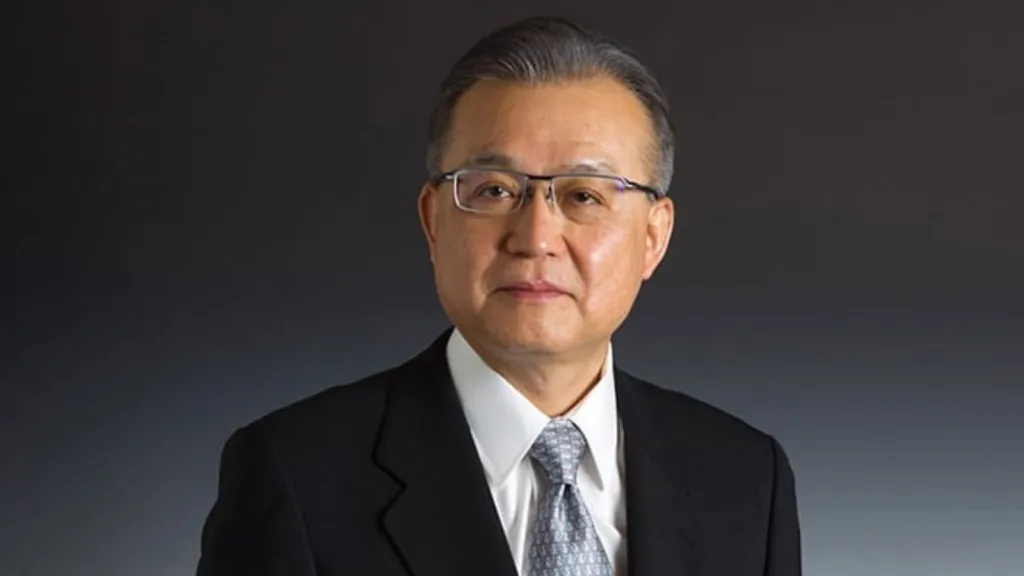
India must demonstrate that two different types of bullet trains, along with their respective signalling systems, can operate safely on the same high-speed rail corridor before deciding on the technology to adopt, Masafumi Shukuri, chairman of the Japan Transport and Tourism Research Institute (JTTRI) and the International High-Speed Rail Association (IHRA), has said.
Shukuri stressed that passenger safety and reliability must remain the highest priorities as India prepares to open the first section of the Mumbai-Ahmedabad High-Speed Rail (MAHSR) project in 2027. Initially scheduled for completion in 2022, the project has faced delays, while India plans to begin operations on a priority section using domestically manufactured rolling stock.
In an interview with The Indian Express on the sidelines of the Kautilya Economic Conclave earlier this month, Shukuri said there was no precedent for operating two different high-speed rail systems on the same line. He emphasised that the safety of such an arrangement would need to be demonstrated before it could be considered.
India Must Prove Safety of Different Bullet Train Systems
Asked whether a high-speed rail corridor could safely accommodate two different types of rolling stock and signalling systems, Shukuri said he was unaware of any previous case in which such an arrangement had been implemented.
He argued that operating trains travelling at speeds of around 300 kmph while uncertainty remains over the compatibility of their systems would be unacceptable. According to him, the safety of the proposed arrangement must be established through adequate testing and verification.
“At the end of the day, how do we know that a system is safe? It has to be proven,” Shukuri said.
He added that one of the systems would eventually need to be adopted rather than allowing both to operate on the same corridor. However, he declined to say whether India should choose domestically manufactured trains or Japanese rolling stock, noting that the decision rests with the parties involved and the governments of India and Japan.
Shukuri said the priority should be ensuring that passengers can travel at high speeds without worrying about safety or reliability. The choice of trains and signalling technology, he indicated, must be considered alongside the broader requirements of operating a high-speed railway.
Mumbai-Ahmedabad Bullet Train Project Targets 2027 Opening
India’s first bullet train corridor, connecting Mumbai and Ahmedabad, is expected to begin operations on a priority section in 2027. The project represents the country’s first major undertaking to develop a high-speed rail network on this scale.
Shukuri said India had intended from the beginning to develop several high-speed rail corridors, with the Mumbai-Ahmedabad route serving as the first project in a wider expansion plan. He acknowledged India’s decision to prioritise an initial section using domestically manufactured trains and said Japan had extended full cooperation.
India announced seven additional high-speed rail projects in February, signalling its broader ambitions for high-speed connectivity. Shukuri said discussions were continuing over the use of Japanese rolling stock and signalling systems on the Mumbai-Ahmedabad corridor.
He also highlighted a joint declaration following a summit-level meeting between Japanese Prime Minister Takaichi and Indian Prime Minister Narendra Modi in July. The declaration specifically mentioned the introduction of Japan’s E10 series, a new generation of bullet trains currently under development and expected to be introduced in Japan in the early 2030s.
The future role of Japanese technology in India’s high-speed rail network will depend on ongoing discussions and decisions concerning the corridor’s technical requirements and operating arrangements.
Safety Depends on the Entire Railway System
Shukuri said building a high-speed railway requires much more than purchasing trains and installing signalling equipment. A safe and reliable service depends on the integration of infrastructure, tracks, rolling stock, signalling, maintenance, workforce training and management.
He described this approach as the “Total Systems Approach”, under which every component of a railway is treated as part of one integrated system. According to him, high-speed rail operations cannot meet their objectives unless all these elements work together effectively.
Training is particularly important, he said, because employees must possess the necessary skills and technical knowledge before services begin. Sufficient testing and trials are also essential to verify the performance of the trains and the complete system before commissioning.
Shukuri highlighted crash avoidance as a fundamental principle of high-speed rail operations. The objective must be to prevent accidents while ensuring that passengers can rely on the railway’s safety and performance.
He added that India’s initial priority section should be viewed as only the beginning of a much larger undertaking. Continued attention to technical integration, skilled personnel, maintenance and operational management will be necessary as the network develops.
Shukuri Defends the Project Timeline
Responding to questions about delays in the Mumbai-Ahmedabad project, Shukuri said he did not believe the timeline should automatically be considered unreasonable given the scale and complexity of the undertaking.
The project was agreed upon by Indian Prime Minister Narendra Modi and former Japanese Prime Minister Shinzo Abe in December 2015. Shukuri said the IHRA had been involved in discussions with Indian stakeholders since its establishment in 2014, even before the project was formally announced by the two leaders.
He pointed out that the corridor covers approximately 500 kilometres and represents India’s first high-speed railway project. Constructing such infrastructure requires substantial planning and coordination, making it unrealistic to expect completion within only a few years.
Shukuri noted that even Japan, despite decades of experience in high-speed rail construction and operations, would not necessarily be able to complete a 500-kilometre high-speed railway in less than 10 years under present-day conditions.
He also cited disruptions caused by the Covid-19 pandemic and delays in land acquisition as factors that affected progress. Despite these challenges, he said the project was advancing strongly.
Shukuri declined to comment directly on remarks reportedly made by former Japanese minister Hideki Makihara, who had attributed delays to problems on the Indian side, saying he had not personally read the former minister’s exact comments.
Station Development Is Key to High-Speed Rail Benefits
Beyond railway construction and operations, Shukuri emphasised the importance of developing areas around stations and along high-speed rail corridors. He said building the railway alone would not be sufficient to realise its full economic benefits.
The IHRA has consistently advocated station-area development as an essential part of high-speed rail planning. Shukuri welcomed India’s attention to this aspect of the project and said substantial construction activity was taking place around stations.
Developing surrounding areas can help cities and businesses benefit from improved connectivity, making high-speed rail an important part of broader regional development rather than simply a transport service.
China’s High-Speed Rail Network and Japan’s Net-Zero Goals
Commenting on China’s high-speed rail network, which has exceeded 50,000 kilometres, Shukuri said the scale of a country’s railway infrastructure ultimately reflects its government’s policy decisions and assessment of national requirements.
Japan, by comparison, is approaching a high-speed rail network of 4,000 kilometres. Shukuri said the difference in scale should be understood in the context of each country’s priorities and the purposes for which its rail network is being developed.
He also discussed Japan’s plans to increase ethanol blending in fuel as part of its wider climate strategy. While he said he did not have precise information on how the specific blending policy had been formulated, he noted that Japan aims to achieve net-zero emissions by 2050.
According to Shukuri, ethanol blending is one of several measures intended to support that objective, with policies designed to make the transition as practical as possible. He said public concerns about ethanol blending and related vehicle problems had not been particularly prominent in Japan.
He added that the Japanese government had introduced subsidies to help limit the impact of rising crude oil prices on petrol costs. Japan is also moving towards electric and hybrid vehicles as part of its broader efforts to reduce emissions.
For India’s bullet train programme, Shukuri’s central message remains that long-term success will depend on proven safety, compatible technology and an integrated operating system. As the Mumbai-Ahmedabad corridor approaches its planned initial opening, decisions on rolling stock and signalling will be crucial to ensuring that high-speed services meet the reliability and safety standards expected by passengers.
For breaking news and live news updates, like us on Facebook or follow us on Twitter and Instagram. Read more on Latest Business on thefoxdaily.com.






COMMENTS 0