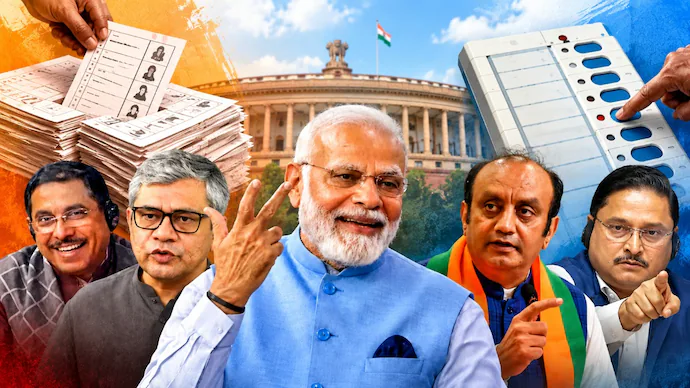
The Bharatiya Janata Party (BJP) has targeted the Congress after the party failed to win a seat in the latest Legislative Council elections across four states, where voting was conducted using ballot papers. The results have given the BJP an opportunity to challenge Congress allegations of electoral irregularities and its repeated demands for replacing Electronic Voting Machines (EVMs) with paper ballots.
The elections covered 28 Legislative Council seats across Karnataka, Uttar Pradesh, Bihar and Maharashtra. By Wednesday evening, the Congress had failed to secure any of the seats declared, while the BJP-Janata Dal (Secular) alliance won all four seats in Karnataka, a state governed by the Congress.
Prime Minister Narendra Modi joined the BJP’s criticism, drawing attention to the use of ballot papers in the elections and asking how many seats the Congress had won. Other BJP leaders also used the results to argue that the party’s electoral difficulties could not be explained solely by the voting system.
PM Modi Takes a Dig at Congress Over Ballot-Paper Results
Prime Minister Narendra Modi took a swipe at the Congress in an unusual post on X, highlighting that ballot papers were used in the 28 Legislative Council seats contested across four states.
“Guess how many seats Congress won?” Modi asked, accompanying his post with a yellow smiley face wearing a monocle.
Union Railway Minister Ashwini Vaishnaw also referred to the Karnataka results during an unrelated press conference, saying the BJP had won all four seats despite the use of ballot papers.
The BJP has used the results to counter Congress allegations that EVMs are responsible for the party’s electoral defeats. However, the Legislative Council elections involve a limited electorate of registered graduates and teachers, making them different from general elections involving the wider electorate.
How Congress Performed in the Ballot-Paper MLC Elections
The Congress suffered setbacks across the four states covered by the Legislative Council elections. The results highlighted the party’s difficulties in these constituencies, although they do not independently establish the reasons behind its performance.
Karnataka: BJP-JD(S) Alliance Wins All Four Seats
The most significant setback for the Congress came in Karnataka, where the BJP-JD(S) alliance won all four Legislative Council seats despite the Congress being in power in the state.
The BJP retained three seats, while the JD(S) won the Bengaluru Teachers’ constituency from the Congress. JD(S) candidate AP Ranganath defeated sitting Congress MLC Puttanna by 908 votes.
Ranganath secured 10,810 votes, compared with Puttanna’s 9,902. The defeat came despite the Congress deploying senior leaders, including Chief Minister DK Shivakumar and other ministers, to campaign in the constituencies.
Bihar: Jan Suraaj Defeats Former Congress State President
In Bihar, the Congress suffered another setback when Prashant Kishor’s Jan Suraaj Party defeated former state Congress president Madan Mohan Jha in the Darbhanga Teachers’ constituency.
The victory marked Jan Suraaj’s entry into the Bihar Legislative Council. The result added to the Congress’s disappointing performance in the ballot-paper elections and provided another talking point for its political opponents.
Uttar Pradesh and Maharashtra
In Uttar Pradesh, the BJP and Samajwadi Party registered victories, while the Congress failed to make a breakthrough. Maharashtra also contributed to the party’s poor showing in the results and trends available on Tuesday evening.
Although the elections covered 28 seats across the four states, the Congress’s failure to win a seat became the main focus of the BJP’s criticism.
BJP Leaders Use Results to Challenge Congress’s EVM Claims
The BJP quickly turned the ballot-paper results into a political argument against the Congress’s allegations of “vote chori” and EVM manipulation.
The BJP said on X, “Ballot paper or EVM, the people’s choice remains clear!”
The Karnataka BJP also mocked the ruling Congress in the state after the alliance won all four seats. Its post questioned what the party would blame for its defeat when the elections had been conducted using ballot papers.
Union Minister Pralhad Joshi summarised the BJP’s argument with the statement: “Button or Ballot: Result is the same.”
He accused the Congress of repeatedly questioning democratic institutions and blaming the electoral system when results went against it. Joshi wrote that the Congress often expressed concerns about EVMs, but the outcome remained the same even when ballot papers were used.
Union Minister Hardeep Singh Puri also criticised the Congress, arguing that the ballot-paper results challenged its allegations about the electoral process. He said the party had failed to win seats and accused it of blaming factors other than its own political performance.
BJP spokesperson Sudhanshu Trivedi argued that the party’s difficulties were not caused by EVMs, voter lists or ballot papers. He said the Congress should focus on winning public support rather than blaming the voting method for its defeats.
Assam BJP chief Dilip Saikia also highlighted the Congress’s failure to win a seat, pointing out that the elections were conducted entirely using ballot papers and involved registered graduates and teachers.
These statements reflect the BJP’s political response to the results. The outcome of the MLC elections does not, by itself, settle broader questions about electoral procedures or the credibility of allegations made by either party.
What Has Been Congress’s Stand on EVMs?
The Congress has repeatedly questioned EVMs and called for changes to India’s voting system. However, its position has evolved over the years, moving from a demand to return to paper ballots towards proposals for greater verification of electronic voting results.
2018: Congress Calls for a Return to Ballot Papers
In March 2018, the Congress formally adopted a resolution at its plenary session in Delhi seeking a return to paper ballots.
The resolution stated that the Election Commission should revert to the earlier practice of using ballot papers to ensure the credibility of the electoral process. The demand came amid opposition concerns that EVMs could be manipulated, allegations that the Election Commission rejected while defending the reliability of the machines.
2024: Congress Seeks Greater VVPAT Verification
By the 2024 Lok Sabha elections, the Congress had adopted a more nuanced position. Its manifesto proposed retaining EVMs while allowing voters to handle Voter Verifiable Paper Audit Trail (VVPAT) slips and deposit them in ballot boxes. It also called for verification of electronic vote tallies against paper records.
In April 2024, the Supreme Court rejected petitions seeking a return to ballot papers and mandatory 100% verification of EVM results against VVPAT slips.
After the 2024 Maharashtra Assembly Election
Following the Congress’s defeat in the November 2024 Maharashtra Assembly elections, party president Mallikarjun Kharge again called for a return to ballot papers.
However, the Congress Working Committee’s November 2024 meeting did not explicitly demand the removal of EVMs. Instead, it called for a broader campaign against alleged irregularities in the electoral process, including discrepancies in voter lists.
Congress leader Pawan Khera explained the party’s position by saying that the issue was not limited to EVMs but concerned the entire electoral process.
Do Ballot-Paper MLC Results Settle the EVM Debate?
The MLC election results have provided the BJP with an opportunity to challenge the Congress’s repeated criticism of EVMs. The party’s failure to win a seat in the declared results, despite the use of ballot papers, has become a central part of the BJP’s political response.
However, these elections are relatively small contests involving specific groups of registered voters, including graduates and teachers. Their outcomes cannot be directly compared with Lok Sabha or Assembly elections, which involve much larger and more diverse electorates.
The results also do not independently establish why the Congress lost. Candidate selection, campaign strategy, organisational strength and voter mobilisation are among the factors that can influence electoral performance, but the supplied information does not establish which factors determined the outcomes in these constituencies.
Likewise, defeats in ballot-paper elections do not, by themselves, prove or disprove every allegation concerning EVMs or other aspects of the electoral process. The results have intensified the political debate, but broader claims about electoral integrity require evidence beyond the outcome of these contests.
For the BJP, the message is straightforward: changing the voting method does not necessarily change electoral outcomes. For the Congress, the results present a political challenge as it continues to raise concerns about voting procedures while facing electoral setbacks in contests conducted using paper ballots.
Key Points
- The Congress failed to win a seat in the declared results of 28 MLC constituencies across Karnataka, Uttar Pradesh, Bihar and Maharashtra.
- The BJP-JD(S) alliance swept all four Legislative Council seats in Congress-governed Karnataka, including a defeat for sitting Congress MLC Puttanna.
- Prime Minister Narendra Modi and other BJP leaders used the ballot-paper results to challenge Congress allegations of EVM manipulation.
- The Congress’s position has evolved from demanding a return to ballot papers in 2018 to seeking greater verification of electronic votes and broader electoral reforms.
FAQs
Why is the BJP mocking the Congress over the MLC election results?
The BJP is highlighting the Congress’s failure to win a seat in the declared results of the ballot-paper MLC elections. It argues that the results challenge the Congress’s claims that EVMs are responsible for its electoral defeats.
How many MLC seats were contested across the four states?
The elections covered 28 Legislative Council seats across Karnataka, Uttar Pradesh, Bihar and Maharashtra. Voting took place on October 23, with counting beginning on Monday and continuing in some constituencies through Tuesday.
What happened in the Karnataka MLC elections?
The BJP-JD(S) alliance won all four seats in Karnataka. The BJP retained three, while JD(S) candidate AP Ranganath defeated sitting Congress MLC Puttanna in the Bengaluru Teachers’ constituency by 908 votes.
Has the Congress always demanded the removal of EVMs?
The Congress formally called for a return to ballot papers in a 2018 resolution. By the 2024 Lok Sabha elections, it was proposing to retain EVMs while strengthening VVPAT verification. Its subsequent statements have also focused on broader concerns about the electoral process.
Do the ballot-paper results prove that allegations about EVMs are false?
No single set of MLC election results can settle every question about EVMs or electoral integrity. The results show how the parties performed in these specific constituencies, but broader allegations require separate evidence and cannot be conclusively established or dismissed from these outcomes alone.
For breaking news and live news updates, like us on Facebook or follow us on Twitter and Instagram. Read more on Latest India on thefoxdaily.com.





COMMENTS 0