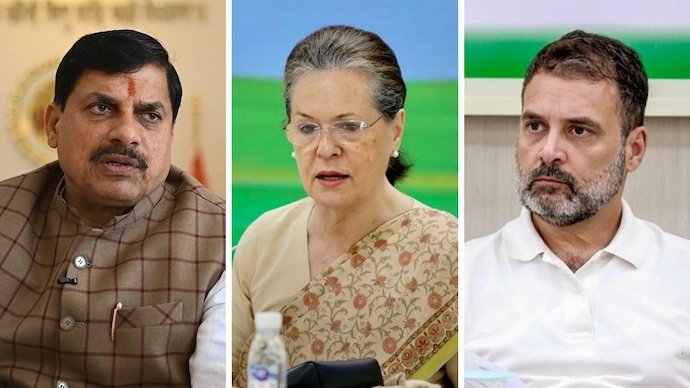
Madhya Pradesh Chief Minister Mohan Yadav has accused congress leaders Sonia Gandhi and Rahul Gandhi of insulting the national song Vande Mataram and demanded that they apologise to the country.
Yadav’s remarks came a day after a political controversy erupted at the Congress headquarters in New Delhi over the rendition of Vande Mataram during the party’s Independence Day programme on August 15. The BJP alleged that Sonia Gandhi, Rahul Gandhi and Congress president Mallikarjun Kharge showed disrespect toward the national song, while the Congress denied that Sonia Gandhi had objected to its full rendition.
The dispute has added a fresh layer to the ongoing political contest between the BJP and Congress over national symbols, patriotism and the legacy of India’s freedom movement. It also comes shortly after Parliament passed legislation extending statutory protection against intentional insult or obstruction involving Vande Mataram.
What Mohan Yadav alleged about Vande Mataram
Yadav claimed that the singing of Vande Mataram was disrupted during the Congress event and that the national song was consequently “insulted”. He argued that the song holds a special place in India’s freedom struggle because of its association with the sacrifices made by freedom fighters.
He called on Sonia Gandhi and Rahul Gandhi to acknowledge what he described as a mistake and apologise to the nation. Yadav also linked the controversy to the significance of Vande Mataram in India’s independence movement.
“Vande Mataram was the slogan and song that freedom fighters sang while sacrificing their lives for the country’s freedom,” Yadav said, describing any insult to the song as condemnable.
His comments followed allegations by several BJP leaders that senior Congress figures showed “utter disrespect” during the Independence Day programme. BJP leaders also alleged that Sonia Gandhi objected when the complete version of Vande Mataram was being sung. The Congress has rejected that interpretation of the incident.
What happened at the Congress Independence Day event?
The controversy centres on the Congress’s Independence Day celebration at its headquarters in New Delhi on Saturday.
A video from the event became the basis for BJP criticism, with party leaders arguing that Sonia Gandhi appeared uncomfortable or attempted to signal that the rendition should stop when the song continued beyond the opening stanzas. BJP leaders also criticised Rahul Gandhi and Mallikarjun Kharge over their conduct during the rendition.
The Congress, however, offered a different explanation. The party said Sonia Gandhi was not attempting to stop Vande Mataram and was instead asking for a chair for Kharge, WHO had been standing for some time during the programme.
That disagreement is central to the political controversy. The BJP has interpreted the visible gestures during the song as disrespect, while the Congress has said the gestures have been misinterpreted and do not demonstrate opposition to Vande Mataram.
As a result, the available evidence establishes that a dispute occurred during the rendition, but the competing political interpretations of the gestures remain sharply contested.
Why Vande Mataram is politically significant
Vande Mataram occupies a distinctive position in India’s national history. Written by Bankim Chandra Chattopadhyay, the song became closely associated with the freedom movement and was used as a rallying cry during the struggle against British rule.
Yadav specifically referred to its historical role and its connection with the sacrifices of freedom fighters. He also highlighted the song’s popularity through the film Anand Math, which helped bring its historical association with the freedom struggle to a wider audience.
For decades, Vande Mataram has remained an important part of India’s public and political Culture. It is formally recognised as the country’s National Song, while Jana Gana Mana is the National Anthem.
The distinction between the two has historically been important. Both carry national significance, but they have had different constitutional, ceremonial and statutory contexts.
Vande Mataram now has stronger legal protection
The latest political dispute comes at a particularly significant moment because Parliament recently approved an amendment extending legal protection under the Prevention of Insults to National Honour Act, 1971 to Vande Mataram.
The Prevention of Insults to National Honour (Amendment) Bill, 2026 was introduced in the Rajya Sabha in July with the objective of giving the national song statutory protection comparable to that already provided to the national anthem. Rajya Sabha passed the Bill on July 29, according to parliamentary reporting.
The amended framework extends provisions concerning intentional prevention of the singing of the national anthem or disturbance of an assembly engaged in singing it to the national song. Such offences can attract imprisonment of up to three years, a fine, or both.
President Droupadi Murmu subsequently gave assent to the legislation, bringing the amendment into effect, according to reports published earlier this month.
This legal development gives the latest political dispute additional significance. However, the existence of the new law does not mean that every disagreement, gesture or political allegation automatically constitutes a criminal offence. The law concerns specified acts of intentional insult or obstruction, and any potential legal case would require the relevant facts and statutory requirements to be established.
Why the full version of Vande Mataram has become a political issue
The controversy also reflects a renewed political debate over which portions of Vande Mataram should be performed at official and public events.
The song contains multiple stanzas, but only selected portions have traditionally been used for formal national occasions. The government’s recent protocol changes have placed greater emphasis on the song as part of national ceremonies, including its inclusion in this year’s Independence Day programme at the Red Fort.
The decision to feature Vande Mataram prominently during the 2026 Independence Day celebrations was itself significant. The song was sung before the National Anthem at the Red Fort, giving it a more prominent place in the official ceremony.
That backdrop helps explain why the Congress event has generated such a strong political response. The dispute is not occurring in isolation but amid a wider national discussion about the historical and ceremonial status of Vande Mataram.
BJP and Congress offer competing accounts
The BJP has made the incident a political issue, arguing that the conduct of senior Congress leaders amounted to disrespect toward an important national symbol.
BJP leaders have cited video footage from the event and alleged that Sonia Gandhi appeared to object to the continuation of the full rendition. The party has demanded an apology from the Congress leadership.
The Congress has rejected the allegation and said the gestures seen during the programme have been taken out of context. Its explanation is that Sonia Gandhi was concerned about Kharge standing and was seeking a chair for him, rather than trying to stop Vande Mataram.
This difference is important because the political accusations are not the same as an established factual finding. Yadav has made a strong allegation, but the Congress disputes the underlying interpretation.
Yadav invokes the freedom struggle
Yadav’s argument is rooted heavily in the historical symbolism of Vande Mataram. By referring to freedom fighters who sang the song during India’s struggle for independence, he framed the controversy as an issue of respect for the country’s national heritage rather than simply a disagreement between political parties.
He said the song had become widely recognised through Anand Math and emphasised its association with the sacrifices made during the freedom movement.
His demand for an apology therefore goes beyond the immediate incident. Yadav is seeking an acknowledgement from the Congress leadership that, in his view, the conduct at the event crossed a line of respect owed to a national symbol.
What the new law could mean for future controversies
The legal change concerning Vande Mataram could make future disputes over intentional obstruction or insult more consequential. Previously, the statutory provisions of the Prevention of Insults to National Honour Act primarily addressed the National Anthem, along with the national flag and Constitution. The 2026 amendment extends relevant protection to the National Song.
That does not eliminate the need to distinguish between deliberate obstruction and ordinary political disagreement or accidental conduct.
The wording of the law focuses on specific forms of conduct. Consequently, if an incident were ever referred for legal action, authorities would need to establish whether the relevant behaviour falls within the statutory provisions and whether the required element of intentionality is present.
That distinction could become increasingly important as Vande Mataram is featured more prominently at public functions and political events.
How the controversy could affect Congress-BJP politics
The dispute gives the BJP another opportunity to challenge the Congress on questions of nationalism and its approach to national symbols. For the Congress, the immediate task is to counter an allegation that could resonate strongly with voters because of the emotional and historical importance attached to Vande Mataram.
The political impact is likely to depend partly on how the two parties continue to frame the incident. The BJP is presenting it as evidence of disrespect, while the Congress is treating the allegation as a politically motivated interpretation of an event at which it says there was no attempt to stop the song.
The controversy also fits into a broader pattern in Indian Politics in which national symbols, patriotic songs and historical figures become subjects of intense political debate. Such disputes can quickly move beyond the original event and become part of larger arguments about national identity and political legitimacy.
What is confirmed and what remains disputed?
| Issue | Current position |
|---|---|
| Mohan Yadav’s statement | He accused Sonia Gandhi and Rahul Gandhi of insulting Vande Mataram and demanded an apology. |
| BJP’s allegation | The BJP accused Sonia Gandhi, Rahul Gandhi and Mallikarjun Kharge of disrespect during the Congress Independence Day event. |
| Congress response | The Congress denied that Sonia Gandhi objected to the song and said she was seeking a chair for Kharge. |
| Vande Mataram’s legal status | A 2026 amendment extended statutory protection under the Prevention of Insults to National Honour Act to the national song. |
| Penalty under the amended provisions | Specified offences can carry imprisonment of up to three years, a fine, or both. |
| Legal finding against the Congress leaders | No such finding has been established by the allegations described in this controversy. |
What happens next in the Vande Mataram row?
The immediate political battle is likely to continue as the BJP presses its demand for an apology and the Congress maintains that the allegations are unfounded.
The controversy could also receive greater attention because of the recent legal changes surrounding Vande Mataram. The new statutory protection has elevated the consequences of deliberate obstruction or insult, but whether any particular incident falls within the law would depend on the evidence and circumstances.
For now, the dispute remains primarily political. Yadav has accused Sonia Gandhi and Rahul Gandhi of insulting the national song, while the Congress has denied the central allegation concerning the event.
Vande Mataram row adds fresh tension between BJP and Congress
Mohan Yadav’s demand for an apology has intensified a controversy that began at the Congress’s Independence Day programme and quickly became a national political issue.
The BJP says senior Congress leaders showed disrespect toward Vande Mataram, while the Congress argues that Sonia Gandhi’s actions were misinterpreted and that she was asking for a chair for Mallikarjun Kharge rather than objecting to the song.
The timing makes the dispute especially sensitive. Vande Mataram has just received stronger statutory protection, and the song occupied a prominent place in India’s 80th Independence Day celebrations.
Whether the controversy remains a political exchange or develops into a broader legal debate will depend on how the incident is interpreted and whether any formal complaint or proceeding follows. For now, the central issue remains contested: the BJP and Yadav describe the incident as an insult to the national song, while the Congress rejects that characterization.
For breaking news and live news updates, like us on Facebook or follow us on Twitter and Instagram. Read more on Latest India on thefoxdaily.com.






COMMENTS 0