- What Exactly Happened?
- Understanding the Anti-Defection Law: The Basics
- The Merger Clause: A Legal Loophole or Legitimate Protection?
- Legal Experts Divided: Two Competing Interpretations
- Key Legal Question: What Does “House” Really Mean?
- Comparison with Past Cases: Why This Is Different
- Who Decides Their Fate?
- Political Impact: A Major Blow to AAP
- A Deeper Insight: Is the Anti-Defection Law Being Outpaced?
- Possible Outcomes: What Happens Next?
- Prediction: A Landmark Case in the Making
- Conclusion: Law, Politics, and Interpretation Collide
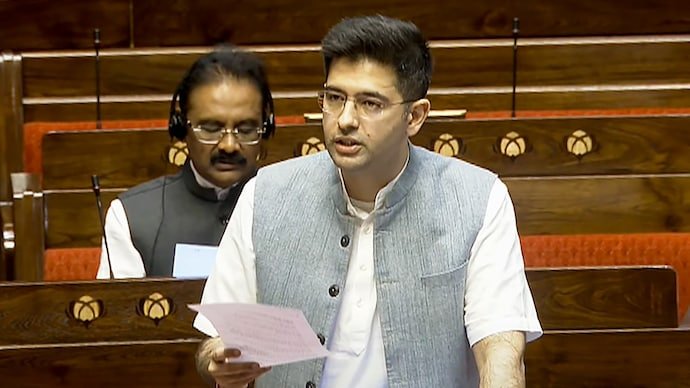
A dramatic political development has triggered a complex constitutional debate: will Raghav Chadha, Swati Maliwal, and five other Rajya Sabha MPs lose their seats after announcing a merger with the BJP? The move has not only shaken the Aam Aadmi Party (AAP) but also reignited discussion around India’s anti-defection law one of the most debated provisions in parliamentary democracy.
At the heart of the controversy lies a technical but crucial question: does the decision of two-thirds of a party’s MPs in one House qualify as a legal “merger” or is it simply defection in disguise?
What Exactly Happened?
Seven out of ten AAP Rajya Sabha MPs have reportedly decided to merge with the BJP, claiming they meet the two-thirds threshold required under the law. Alongside this, they have also announced their resignation from the AAP.
This dual move resignation plus merger has intensified the debate. While politically explosive, its legal validity depends entirely on how the Constitution interprets such actions.
Understanding the Anti-Defection Law: The Basics
India’s anti-defection law is laid out in the Tenth Schedule of the Constitution. It was introduced to curb political defections driven by opportunism rather than ideology.
In simple terms, the law says:
- If a legislator voluntarily gives up membership of their party → they can be disqualified
- If they vote against party directions → they risk disqualification
However, there is a critical exception the merger clause.
The Merger Clause: A Legal Loophole or Legitimate Protection?
Clause 4 of the Tenth Schedule provides protection from disqualification if a “merger” takes place. But this is where things get tricky.
The law states that:
- If at least two-thirds of the members of a legislature party agree to merge with another party,
- Then it is deemed to be a valid merger,
- And those members are protected from disqualification.
This “deeming provision” is at the center of the current controversy.
Legal Experts Divided: Two Competing Interpretations
View 1: MPs Are Protected (Merger Is Valid)
Some legal experts argue that the MPs are on solid ground. Their reasoning is straightforward:
- The Constitution clearly refers to “two-thirds of members of the House”
- The Rajya Sabha is a separate House with its own legislature party
- If 7 out of 10 MPs agree, the threshold is met
Under this interpretation, the merger is valid even if the original political party (AAP) does not approve it.
This view treats the legislature party inside parliament as the key unit not the broader party organization.
View 2: Disqualification Still Applies
Other experts strongly disagree, raising important counterpoints:
- A merger should involve the original political party, not just MPs in one House
- Parliament has two Houses (Lok Sabha + Rajya Sabha), raising questions about whether numbers should be counted collectively
- Simply resigning and joining another party may still count as defection
This interpretation suggests that the MPs may not be protected and could face disqualification.
Key Legal Question: What Does “House” Really Mean?
One of the most debated aspects is the interpretation of the word “House” in the Constitution.
| Interpretation | Meaning | Outcome |
|---|---|---|
| Narrow View | House = Rajya Sabha only | Merger valid if 2/3 MPs agree |
| Broad View | House = Entire Parliament | Merger invalid without wider support |
This single interpretational difference could determine the fate of all seven MPs.
Comparison with Past Cases: Why This Is Different
The situation is being compared to past political splits, such as the Shiv Sena crisis. However, there is a key distinction:
- In earlier cases, factions claimed to be the “real” party
- Here, MPs are not claiming control of AAP, but instead opting to merge elsewhere
This difference could play a decisive role in how the law is applied.
Who Decides Their Fate?
Ultimately, the decision will not be made in public debate but through a constitutional process.
The authority to decide disqualification lies with the Chairman of the Rajya Sabha. This means:
- AAP can file disqualification petitions
- The Chairman will examine legal arguments
- A final ruling will determine whether MPs retain their seats
This process could take time and may even be challenged in courts later.
Political Impact: A Major Blow to AAP
Beyond legalities, the political implications are significant:
- AAP loses a majority of its Rajya Sabha presence
- Its national expansion strategy takes a hit
- The BJP potentially strengthens its position in the Upper House
This is not just a legal battle it’s a power shift in Indian Politics.
A Deeper Insight: Is the Anti-Defection Law Being Outpaced?
This episode highlights a broader issue: the anti-defection law, designed in the 1980s, is increasingly being tested by modern political strategies.
Originally meant to prevent “Aaya Ram, Gaya Ram” politics, the law now faces challenges such as:
- Technical interpretations of merger clauses
- Strategic resignations before switching sides
- Fragmentation within legislature parties
The big question: Is the law still effective, or has it become vulnerable to legal maneuvering?
Possible Outcomes: What Happens Next?
Scenario 1: MPs Retain Seats
If the merger is accepted, the MPs will continue as Rajya Sabha members under their new political alignment.
Scenario 2: Disqualification
If rejected, they could lose their seats and face by-Elections or re-nomination battles.
Scenario 3: Legal Battle Escalates
Any decision could be challenged in court, leading to a prolonged constitutional dispute.
Prediction: A Landmark Case in the Making
This case has the potential to become a landmark ruling in Indian constitutional law. It could:
- Clarify the meaning of “merger” under the Tenth Schedule
- Define whether Parliament should be treated as one unit or two Houses
- Set precedent for future political realignments
Whatever the outcome, it will likely influence how parties and lawmakers navigate defections in the years ahead.
Conclusion: Law, Politics, and Interpretation Collide
The fate of Raghav Chadha and the six other MPs rests on a nuanced reading of constitutional language. What appears to be a straightforward political switch is, in reality, a complex legal puzzle.
At stake is not just the future of seven MPs, but the credibility and clarity of India’s anti-defection framework.
In the end, this is more than a Political Controversy it’s a test of how robust India’s democratic safeguards truly are.
For breaking news and live news updates, like us on Facebook or follow us on Twitter and Instagram. Read more on Latest India on thefoxdaily.com.






COMMENTS 0