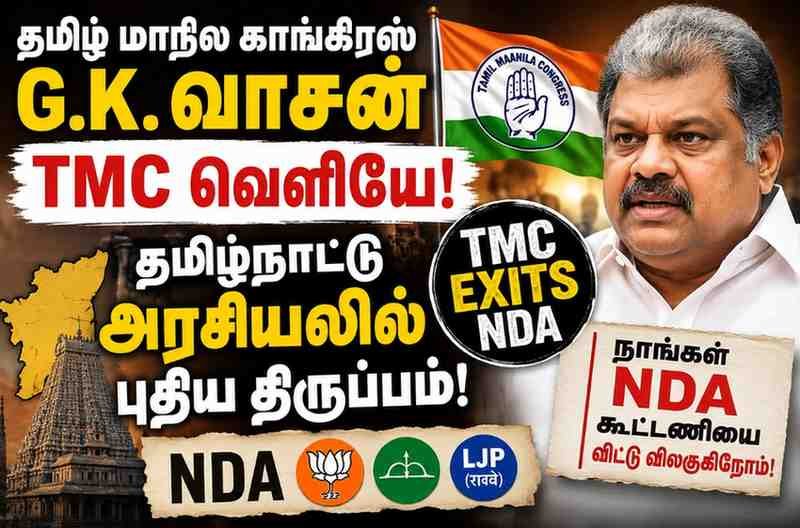
In a significant development in Tamil Nadu politics, the Tamil Maanila Congress (Moopanar), led by G.K. Vasan, has officially announced its exit from the National Democratic Alliance (NDA). The decision, taken after the party’s executive committee meeting, marks the end of an alliance that had linked the regional party with the BJP-led coalition at the national level.
While the immediate electoral implications remain unclear, the move has sparked fresh discussions about alliance politics in Tamil Nadu, where regional parties continue to dominate the political landscape and coalition equations often prove decisive.
The Announcement by G.K. Vasan
G.K. Vasan made the announcement following a meeting of the party’s executive committee. The Tamil Maanila Congress (TMC), founded by his father G.K. Moopanar, has historically maintained an identity distinct from larger national parties, often aligning with different political formations depending on prevailing circumstances.
The withdrawal from the NDA represents another important chapter in the party’s evolving political journey.
The Legacy of Tamil Maanila Congress
The Tamil Maanila Congress was established in 1996 by the late G.K. Moopanar after a split from the Congress. The party quickly emerged as an influential force in Tamil Nadu politics and played an important role in coalition governments and electoral alliances.
Over the years, TMC has allied with various political formations, reflecting the fluid nature of Tamil Nadu’s alliance-driven politics.
The party’s ideology has generally emphasized:
- Regional interests.
- Secular principles.
- Federalism.
- Development-oriented politics.
- Coalition-building.
Why Alliance Politics Matters in Tamil Nadu
Tamil Nadu has long been characterized by coalition politics, with regional parties exerting considerable influence.
Unlike many states where national parties dominate, Tamil Nadu’s political landscape revolves around strategic alliances that can significantly affect electoral outcomes.
Factors influencing alliances include:
- Seat-sharing arrangements.
- Ideological compatibility.
- Regional priorities.
- Leadership equations.
- Changing voter expectations.
Because of this, even smaller parties can play an outsized role in determining political narratives.
What the Exit Means for the NDA
The departure of Tamil Maanila Congress may not dramatically alter the numerical strength of the NDA nationally, but it carries symbolic significance in Tamil Nadu, where coalition partners contribute to broader political messaging and organizational outreach.
The exit could:
- Alter future alliance negotiations.
- Open new possibilities for regional alignments.
- Influence seat-sharing discussions.
- Trigger recalibrations among other parties.
- Strengthen independent positioning by TMC.
Comparison: Tamil Nadu’s Major Political Blocs
| Political Formation | Primary Strength | Alliance Strategy |
|---|---|---|
| DMK-led Front | Strong regional base | Broad coalition politics |
| AIADMK-led Camp | Traditional support network | Flexible partnerships |
| BJP-led NDA | National influence | Expansion through allies |
| Regional Smaller Parties | Localized influence | Strategic alliances |
An Insight Competitors Often Miss: Tamil Nadu Politics Is Built on Relationships, Not Just Numbers
Election arithmetic alone rarely explains Tamil Nadu politics. Personal relationships between leaders, historical alliances, ideological positioning, and regional sentiments often influence decisions as much as vote shares.
The exit of TMC from the NDA highlights how coalition politics in the state remains dynamic rather than fixed.
For regional parties, preserving identity and negotiating leverage can be as important as immediate electoral gains.
The Historical Pattern of Alliance Shifts
Tamil Nadu has witnessed numerous alliance changes over the decades.
Political parties have frequently shifted alignments based on:
- Changing national scenarios.
- State-level priorities.
- Electoral calculations.
- Leadership changes.
- Public sentiment.
Such realignments are often viewed as part of the state’s political culture rather than exceptional events.
What Options Lie Ahead for TMC?
Following its exit from the NDA, Tamil Maanila Congress could pursue several paths:
- Contest independently.
- Seek new alliances.
- Strengthen organizational presence.
- Focus on issue-based politics.
- Reposition itself ahead of future elections.
The party’s next steps are likely to be closely watched by political observers and rival formations.
Prediction: Coalition Politics in Tamil Nadu Will Become Even More Fluid
As Tamil Nadu approaches future electoral contests, alliance configurations are expected to remain highly flexible. Regional parties are likely to prioritize strategic autonomy while national parties continue seeking stronger footholds in the state.
The TMC’s departure from the NDA may be one episode in a broader phase of political recalibration that could redefine coalition equations in the coming years.
Conclusion
The decision by G.K. Vasan and the Tamil Maanila Congress to exit the National Democratic Alliance marks an important development in Tamil Nadu’s ever-evolving political landscape. Although its immediate electoral impact remains uncertain, the move underscores the continuing importance of regional parties and coalition politics in the state.
In Tamil Nadu, alliances are rarely permanent and political equations are constantly shaped by changing priorities and relationships. As parties prepare for future contests, the exit of the Tamil Maanila Congress from the NDA serves as a reminder that in Indian politics, today’s alignment may become tomorrow’s new beginning.
For breaking news and live news updates, like us on Facebook or follow us on Twitter and Instagram. Read more on Latest Entertainment on thefoxdaily.com.






COMMENTS 0