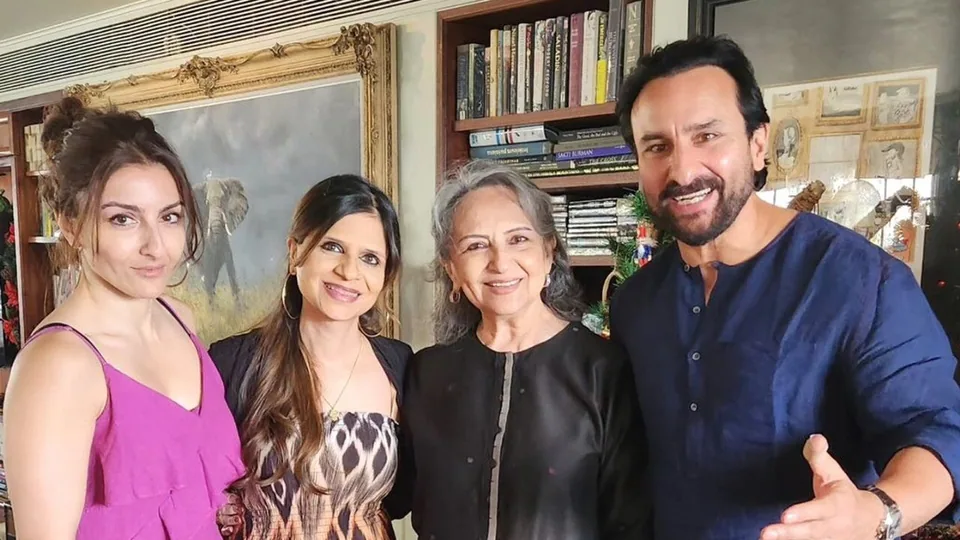
readers want to understand Saba Pataudi’s comments about her religious upbringing, Sharmila Tagore‘s role in guiding her children, and how religion was handled inside their interfaith family.
Primary keyword: Saba Pataudi religion and upbringing
Related semantic keywords: Sharmila Tagore religion, Saba Pataudi Islam, Saif Ali Khan family, interfaith marriage in India, Pataudi family, Sharmila Tagore children, Muslim upbringing, interfaith families, religious identity, secular parenting
Saba Pataudi’s comments about her childhood have opened a window into an aspect of the Pataudi family’s story that is often overshadowed by cinema, royalty and celebrity: the question of how faith was understood inside an interfaith household.
In discussing her upbringing, Saba spoke about the role her mother, actor Sharmila Tagore, played in guiding the children toward Islam. Her recollection is notable not simply because of the family’s public profile, but because it illustrates a more complicated reality than the labels often attached to celebrity families.
Saba’s account describes a home in which religion was not presented as a competition between two identities. Instead, she has recalled that her parents did not impose religion on their children and that her mother guided them within the Islamic tradition. She also made a striking observation about her childhood: there was no temple or Hindu religious practice in the household she experienced.
That distinction matters. An interfaith marriage does not automatically mean that children grow up practising every tradition equally. Families make different choices. Some celebrate multiple religions, some follow one faith, while others leave religious identity largely to the individual. Saba’s recollection provides an example of the third dimension of this conversation: an interfaith family in which the parents’ different backgrounds did not necessarily translate into a mixed set of formal religious practices at home.
What Saba Pataudi said about her religious upbringing
Saba’s remarks centre on a simple but important idea: her parents did not force religion upon their children.
At the same time, she explained that her mother played a role in helping the children understand and practise Islam. This creates an important distinction between religious guidance and religious imposition.
Parents can introduce children to a faith through traditions, prayers, festivals, stories and family practices without necessarily turning belief into an ultimatum. Conversely, a child can be raised within a particular religious tradition while eventually developing an individual relationship with faith.
Saba’s recollection suggests that this balance was part of the family environment she experienced.
“There was no temple or Hindu religion that we practised,” Saba said while describing her upbringing.
The comment is significant because public discussions about interfaith families frequently assume that both religions must be practised equally inside the home. Real families are rarely that straightforward.
Why Sharmila Tagore’s role is central to the story
Sharmila Tagore occupies a distinctive position in Indian popular culture. She became one of Hindi cinema’s most recognised actors and later married Mansoor Ali Khan Pataudi, the former captain of the Indian cricket team and a prominent member of the Pataudi family.
The marriage brought together two highly visible cultural backgrounds. Tagore came from a Bengali Hindu family, while Pataudi belonged to a Muslim family with a long aristocratic history.
For their children, including Saif Ali Khan and Saba Pataudi, that meant growing up at the intersection of multiple cultural influences.
Yet an important part of Saba’s recollection is that her mother’s personal background did not automatically determine the religious practices of the household.
That offers a useful insight into how family identity actually works. A parent’s birth religion, the religion practised at home, cultural heritage and a child’s eventual personal beliefs are related, but they are not necessarily identical.
The difference between heritage and religious practice
This is where the Pataudi family’s story becomes more interesting than a conventional celebrity-news headline.
Sharmila Tagore’s Bengali heritage remains an important part of her identity and public biography. But cultural heritage does not have to dictate every aspect of family life.
Someone can inherit a language, cuisine, surname, regional culture or family history without practising the religion associated with that heritage. Likewise, children in an interfaith family can have exposure to more than one cultural tradition while following one religious framework.
Saba’s account highlights precisely this distinction.
It also helps explain why simplistic labels such as “Hindu-Muslim family” can fail to describe the everyday experience of an interfaith household. Such a family may contain several cultural histories but still develop a particular religious routine.
A closer look at the Pataudi family’s interfaith background
The marriage of Sharmila Tagore and Mansoor Ali Khan Pataudi became one of India’s best-known interfaith celebrity marriages.
They married in 1969 and had three children: Saif Ali Khan, Saba Ali Khan and Soha Ali Khan.
The family later became prominent across several fields. Saif established himself as a major Bollywood actor, Soha pursued acting and television work, while Saba became known for her work in jewellery design and for her public interest in preserving and documenting family history.
The family’s visibility means that their personal choices have often been examined through the lens of celebrity culture. But Saba’s remarks move the discussion away from public speculation and toward the family’s own recollection of its upbringing.
Interfaith marriage does not mean identical religious practice
One of the most useful lessons from Saba Pataudi’s account is that there is no single formula for raising children in an interfaith marriage.
Consider three broad approaches that families may take:
| Approach | How it may work | Potential characteristic |
|---|---|---|
| Dual-practice household | Children are introduced to and participate in traditions from both faiths. | Emphasis on shared cultural exposure |
| One-faith household | Parents choose one religious tradition as the primary practice for children. | Greater religious consistency at home |
| Low-religion household | Parents minimise formal religious practice and allow children to decide later. | Greater emphasis on individual choice |
These approaches can overlap, and real families often evolve between them. Saba’s description appears to fit an environment where Islam was the religious tradition practised at home while her parents did not impose religion in the way people might commonly imagine.
Why the “no imposition” point deserves more attention
The phrase “they never imposed any religion” is arguably more revealing than the celebrity angle surrounding the story.
Religious upbringing is often discussed as though parents have only two choices: strict instruction or complete religious neutrality. In practice, there is a much wider spectrum.
Parents can teach religious traditions while encouraging questions. They can explain why a family prays, why particular festivals are observed and what religious texts mean without demanding that children reproduce every belief exactly as the parents understand it.
That distinction becomes especially relevant in interfaith families, where children may naturally encounter questions about identity from relatives, classmates and wider society.
Saba’s comments therefore provide a useful case study in how religious identity can be inherited, taught and personally interpreted at the same time.
Sharmila Tagore’s conversion and the importance of context
Sharmila Tagore converted to Islam before her marriage to Mansoor Ali Khan Pataudi and adopted the name Begum Ayesha Sultana, according to longstanding accounts of her personal life.
However, reducing her life story to a conversion would miss the broader context.
Tagore’s public identity has always contained several layers: Bengali cultural heritage, a celebrated film career, marriage into the Pataudi family and her later role as a mother and public figure. These identities did not necessarily cancel each other out.
This is an important point when discussing religion in India. Religious identity can coexist with regional, linguistic, professional and family identities. A person does not become culturally invisible simply because their religious practice changes.
What Saba’s account tells us about children in interfaith families
Children growing up in interfaith households may develop a particularly nuanced understanding of identity.
They can encounter different customs through grandparents, relatives and social circles even when the household formally follows one religion. That can create familiarity with multiple traditions without requiring the child to practise all of them.
The Pataudi family provides a high-profile example of this complexity.
Saba’s account also challenges the assumption that children from famous interfaith families necessarily grow up in an environment designed to showcase religious harmony. Sometimes the reality is much more ordinary: parents make practical decisions about how to raise their children, and those decisions become part of the family’s private culture.
Why the story matters beyond Bollywood
The wider significance of Saba Pataudi’s remarks lies in how they contribute to a much larger conversation about family and identity in India.
Interfaith relationships are often discussed in political or social terms. Celebrity families, meanwhile, are frequently treated as entertainment stories. Saba’s recollection sits between those two worlds.
It demonstrates that religious identity can be a family matter rather than merely a public label.
For many families, questions such as which festivals children celebrate, which religious customs they learn and whether they are encouraged to choose their own beliefs are negotiated privately. The Pataudi story offers a rare glimpse into that process without necessarily fitting the simplistic categories that public debate often prefers.
The overlooked lesson: identity is not always a 50-50 equation
A common misunderstanding about interfaith families is the expectation that cultural and religious representation must be perfectly symmetrical.
But family life does not work like a scoreboard.
An interfaith household may have two religious backgrounds but one dominant religious practice. Another family may celebrate festivals from both traditions. A third may deliberately avoid formal religious instruction. None of these arrangements automatically tells us how strongly an individual child will identify with a religion as an adult.
This is perhaps the most valuable insight to draw from Saba’s recollection.
Interfaith identity is not necessarily about dividing religion into equal portions; it can be about giving family members enough space to understand where they come from while developing their own relationship with belief.
A timeline of the family’s religious and cultural story
- 1969: Sharmila Tagore and Mansoor Ali Khan Pataudi married, bringing together prominent Bengali and Pataudi family backgrounds.
- Following years: The couple raised three children: Saif Ali Khan, Saba Ali Khan and Soha Ali Khan.
- Childhood years: Saba has recalled an upbringing in which Islam was the religious tradition practised at home, while her parents did not impose religion on their children.
- Later adulthood: The siblings developed individual careers and public identities while remaining connected to both sides of their family heritage.
- Recent reflections: Saba’s comments have renewed interest in how the family handled religion, identity and cultural inheritance.
Saba Pataudi, Saif Ali Khan and Soha Ali Khan: three public identities
Another interesting aspect of the family is that the three siblings have not built identical public personas.
Saif Ali Khan became an actor and one of Hindi cinema’s most recognisable personalities. Soha Ali Khan also entered acting and became a public figure in her own right. Saba took a different professional path and has been closely associated with jewellery and the preservation of family heritage.
The contrast is relevant because it demonstrates how children raised under the same roof can develop different relationships with family identity.
Shared upbringing does not produce identical adults.
That is particularly important when discussing religion. A family can provide a common foundation without dictating exactly how every child will interpret that foundation later in life.
What competitors often miss about this story
Much of the attention surrounding celebrity comments about religion tends to focus on the most provocative sentence. That approach can obscure the deeper story.
The more meaningful issue here is not simply whether the Pataudi children practised Hinduism or Islam. It is how parents navigate religion when their own backgrounds are different.
Saba’s recollection suggests a model in which the household had a clear religious practice but did not frame faith as something that had to be aggressively imposed.
That distinction can be especially valuable for understanding modern Indian families, where religious, regional and linguistic identities frequently overlap.
What this could mean for the next generation
The significance of Saba’s comments may extend beyond her own childhood.
As Indian families become increasingly diverse in terms of marriage, geography and cultural exposure, questions about religious upbringing are likely to become more visible. The challenge for parents is often less about choosing a label and more about deciding how children should encounter that label.
The Pataudi example suggests that religious education and personal freedom do not necessarily have to be opposites.
A child can be taught about a tradition, participate in it and still be encouraged to think independently.
That does not guarantee that every family will reach the same outcome. Nor should one celebrity family’s experience be treated as a universal model. But it offers a useful example of how an interfaith marriage can evolve into a family culture that is more specific than the parents’ original backgrounds might suggest.
Frequently asked questions about Saba Pataudi’s religious upbringing
What did Saba Pataudi say about her religious upbringing?
Saba Pataudi said that her parents did not impose religion on their children and explained that her mother, Sharmila Tagore, guided them in Islam. She also recalled that there was no temple or Hindu religious practice in the household.
Was Sharmila Tagore born into a Hindu family?
Yes. Sharmila Tagore was born into a Bengali Hindu family and later converted to Islam before her marriage to Mansoor Ali Khan Pataudi.
Who are Sharmila Tagore’s children?
Sharmila Tagore and Mansoor Ali Khan Pataudi have three children: Saif Ali Khan, Saba Ali Khan and Soha Ali Khan.
Was the Pataudi household an interfaith family?
Yes. Sharmila Tagore came from a Hindu Bengali background, while Mansoor Ali Khan Pataudi was Muslim. Their marriage therefore brought together two different religious and cultural backgrounds.
Did Saba Pataudi say her parents forced religion on their children?
No. Her comments specifically emphasised that her parents did not impose religion on them, while also explaining that Sharmila Tagore guided the children in Islam.
Did Saba Pataudi practise Hinduism while growing up?
According to Saba’s recollection, Hindu religious practice was not part of the household environment in which she was raised.
What makes Saba Pataudi’s comments significant?
Her comments offer insight into how an interfaith family can have a particular religious practice at home without necessarily treating religion as something that must be imposed on children.
What broader lesson does the Pataudi family’s story offer?
The story shows that interfaith families do not follow one universal model. Some practise multiple traditions, some follow one faith and others leave religious decisions more open-ended. The important factor is how families navigate identity, tradition and individual choice.
Conclusion: Saba Pataudi’s story is ultimately about choice
Saba Pataudi’s reflections on her religious upbringing offer more than another glimpse into the private life of a famous Bollywood family.
They reveal how complicated the idea of religious identity can become inside an interfaith household. Sharmila Tagore’s Hindu Bengali heritage, her later Islamic identity, Mansoor Ali Khan Pataudi’s Muslim background and the children’s individual lives all form parts of a much larger family story.
The most important takeaway is not that one religious tradition replaced another. It is that family identity can be shaped deliberately and that religious guidance does not necessarily have to mean coercion.
As conversations around interfaith families continue to evolve, stories such as Saba’s may become increasingly relevant. They remind us that behind public labels are ordinary family decisions: what children are taught, what traditions are practised, what questions are welcomed and, ultimately, how much freedom individuals are given to define themselves.
For the Pataudi family, that story began with an interfaith marriage but developed into something more nuanced: a household with its own religious practice, multiple cultural inheritances and children who eventually built distinct identities of their own.
For breaking news and live news updates, like us on Facebook or follow us on Twitter and Instagram. Read more on Latest Entertainment on thefoxdaily.com.

COMMENTS 0