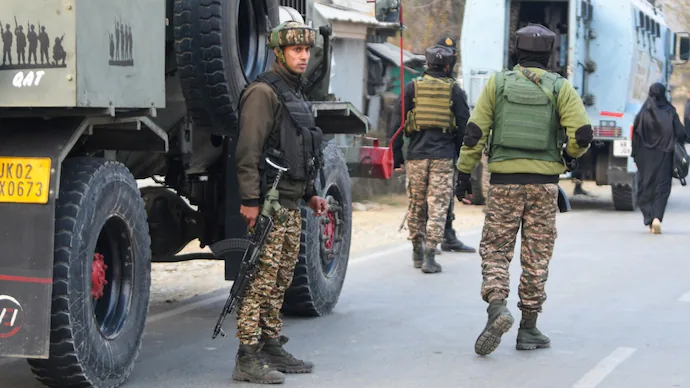
Two attacks in Jammu and Kashmir on November 11 and 12 have renewed concerns about the security situation in the region, challenging the perception that militancy has been substantially contained. While three Central Reserve Police Force (CRPF) personnel were injured in a shooting in south Kashmir’s Kulgam district, two Special Police Officers (SPOs) were found dead in the forested areas of Kishtwar in the Chenab Valley.
The incidents came after a period of relative calm and just days after Kashmir Zone Inspector General of Police Sujit Kumar said on November 5 that only one active local militant remained in the Kashmir Valley.
The timing has prompted questions about whether the attacks represent isolated attempts by remaining militant groups to demonstrate their presence or point to a wider effort to revive insurgency in the region. Investigations are continuing, and security forces have launched operations to identify and track down those responsible.
Although the two incidents occurred within a short period, their apparent methods and locations suggest different operational challenges. The Kulgam attack involved a quick assault on a security checkpoint, while the killings in Kishtwar appear to have taken place in difficult forest terrain where surveillance and communication are more challenging.
Different attack patterns point to separate operational challenges
The Kulgam and Kishtwar incidents appear to reflect different methods used by militant groups operating in Jammu and Kashmir. Security assessments have suggested that the attacks may involve separate local modules rather than a single, coordinated command structure operating across both regions.
In Kulgam, the assault followed a hit-and-run pattern. Armed attackers reportedly emerged from a cluster of trees near the security checkpoint, opened fire on CRPF personnel and escaped before security forces could establish contact with them.
The checkpoint was located close to the national highway, making the attack particularly concerning from a security perspective. The attackers appeared to have identified a vulnerable moment and used the surrounding terrain to withdraw quickly.
In Kishtwar, the circumstances were different. The two SPOs were attached to the Jammu and Kashmir Police’s Special Operations Group and were travelling between a police camp and a temporary operating base of the Army’s 17 Rashtriya Rifles in the Marwah area when they went missing.
Their bullet-riddled bodies were subsequently recovered from the forested Dachhan area. Their service weapons were also missing, strengthening suspicions of militant involvement.
The Chenab Valley’s mountainous terrain presents a distinct challenge for security forces. Dense forests, difficult access routes and limited mobile connectivity can make surveillance and rapid deployment more complicated.
Militant groups operating in these areas have previously targeted isolated security personnel and vulnerable positions in higher reaches. Such locations can provide opportunities to carry out ambushes before security forces can respond.
Chenab Valley has witnessed earlier encounters with militants
The Dachhan-Marwah and Chatroo areas of Kishtwar have experienced several encounters between security forces and militants in recent years. Their forested terrain has made them difficult areas to monitor continuously.
In January 2026, security agencies launched a special operation in Chatroo after receiving intelligence about militant activity. An Army personnel was killed and several soldiers were injured during a gunfight.
Security forces subsequently pursued the group. One militant was killed on February 4, while three others were killed in a separate encounter on February 22, according to the account provided in the source report.
The latest killings have renewed attention on the possibility that small militant groups continue to operate in the Chenab Valley despite sustained counterterrorism operations.
Security sources have also pointed to the possible role of overground workers (OGWs), who can allegedly provide militants with information, shelter, transport or other logistical assistance. Although sustained security operations have weakened such networks, their potential presence remains a concern.
In previous operations, security forces have detained people suspected of helping militant groups with intelligence and logistical support. Investigators are examining whether similar support networks played a role in the latest incidents.
Foreign militants and local facilitators remain a security concern
The Kulgam attack has highlighted a challenge that security agencies have repeatedly identified: a decline in local militant recruitment does not necessarily mean that the threat has disappeared.
Small groups of foreign militants can continue to operate with the assistance of local contacts, even when the number of locally recruited fighters is very low. Such groups may move between locations, avoid prolonged engagements and select targets where security arrangements are comparatively vulnerable.
Police have identified Mohammed Lateef Bhat as the only active local militant in the Kashmir Valley, while acknowledging the presence of foreign militants whose exact number is difficult to establish because of their movement between locations.
Security agencies suspect that Bhat may have been involved in the Kulgam attack alongside one or two foreign militants. However, this remains an investigative suspicion, and responsibility for the attack has not been conclusively established.
His alleged links to earlier attacks have increased the importance of tracking the local networks that may help foreign militants operate in south Kashmir.
The distinction between local recruitment and foreign militant activity is important when assessing the security situation. A reduction in the number of locally recruited militants can indicate progress, but it does not automatically eliminate the operational capacity of groups that retain cross-border links and local support.
Security gains since 2019 remain significant, but vulnerabilities persist
The latest incidents have raised questions about the durability of the security improvements recorded in Jammu and Kashmir since 2019. Security agencies have pointed to a sharp decline in local militant recruitment, fewer encounters in several areas and improvements in force protection as important developments.
The CRPF has also reported a significant operational milestone, recording zero operational fatalities for 12 consecutive months for the first time in nearly five decades. The achievement has been attributed to improvements in equipment, planning, medical evacuation and operational procedures across different theatres, including Jammu and Kashmir.
However, the Kulgam and Kishtwar attacks demonstrate that even a stronger security grid cannot guarantee that every attempted strike will be prevented.
Militant groups can still exploit gaps in surveillance, difficult terrain and the movement patterns of security personnel. A small number of armed individuals may also be capable of carrying out targeted attacks without maintaining a large or permanently organised network.
The challenge for security agencies is therefore not limited to identifying how many militants remain active. It also involves tracking their movements, disrupting logistical support and protecting personnel operating in remote or vulnerable locations.
Former Army commander says attacks often follow reconnaissance
Lieutenant General (retd) D.S. Hooda, former General Officer Commanding-in-Chief of the Army’s Northern Command, said terrorist attacks generally follow extensive reconnaissance, with attackers looking for specific opportunities to target vulnerable positions.
Speaking to India Today, Hooda said he was uncertain whether the Kulgam and Kishtwar incidents were coordinated. Their close timing alone, he indicated, was not enough to establish that they were part of a single operation.
He also explained that militant tactics have changed as the number of active terrorists has declined. Earlier suicide attacks and larger operations have increasingly given way to hit-and-run assaults and ambushes designed to limit the attackers’ own exposure.
According to Hooda, such tactics allow small groups to demonstrate their presence while attempting to avoid prolonged engagements with security forces.
He cautioned that the reduced number of militants should not lead to an assumption that high-profile attacks are no longer possible.
“I don’t rule out high-profile attacks at all. Multiple [terror] groups still seek to prove their presence and show that Terrorism remains active in Kashmir,” he said.
Hooda added that the violence graph had declined significantly since 2019, but stressed the importance of assessing the situation over a longer period rather than expecting militancy to disappear completely.
Former military officer links attack to Pakistan’s internal situation
Lieutenant General (retd) K.J.S. Dhillon, who served in Kashmir in 2019 when the region’s special status was revoked and it was reorganised as a Union Territory, described the Kulgam attack as a desperate act by Pakistan.
Dhillon argued that Islamabad has historically used the Kashmir issue to divert attention from domestic challenges and create instability in the region. He suggested that the latest attack was intended to disrupt the consolidation of peace and affect preparations for the winter tourism season.
These remarks represent Dhillon’s assessment of the possible motivation behind the attack. Investigators have yet to establish the attackers’ identities, operational instructions or any direct links to external handlers.
The possibility of cross-border support remains an important part of the security investigation, particularly because foreign militants are suspected of operating alongside local facilitators.
Former J&K police chief says security grid remains robust
Former Jammu and Kashmir Director General of Police S.P. Vaid said the Kulgam attack was concerning because it occurred after a considerable gap in similar assaults, while the same locality had witnessed violence only a few months earlier.
He said the incident indicated the presence and movement of militants in south Kashmir, but maintained that the region’s security arrangements remained robust.
Vaid expressed confidence that the attackers would be tracked down and said the overall ground situation had improved considerably, particularly because local militant recruitment had fallen.
His assessment reflects the distinction between an improvement in the broader security environment and the continued possibility of individual attacks. Even when recruitment declines, the presence of a small number of armed groups can require sustained intelligence and security operations.
Farooq Abdullah renews call for India-Pakistan dialogue
The attacks have also revived the political debate over how India and Pakistan should address the continuing security challenges in Jammu and Kashmir.
National Conference president and former Jammu and Kashmir Chief Minister Farooq Abdullah said terrorism should not intimidate people. At the same time, he called for dialogue between the two countries, arguing that bullets and military confrontation could not resolve political disputes.
Abdullah’s remarks reflected the continuing divide over the role of diplomacy in addressing the Kashmir conflict. While security agencies focus on preventing attacks and dismantling militant networks, political leaders have differing views on whether engagement with Pakistan should form part of a longer-term solution.
The latest attacks have once again brought these competing approaches into focus, particularly as the region attempts to maintain stability and protect civilian activity.
Winter movement could create additional security challenges
The timing of the attacks is significant because winter traditionally changes movement patterns in Kashmir’s mountainous areas.
As temperatures fall and heavy snowfall begins in higher elevations, movement through forest routes and mountain passes becomes increasingly difficult. Militants operating in upper reaches may move towards lower-altitude areas before snow restricts access.
This seasonal pattern can create additional challenges for security forces, which must monitor large areas while accounting for changes in terrain, weather and accessibility.
Small and mobile militant groups may attempt to use forest cover and difficult routes to avoid detection. Maintaining surveillance across these areas requires coordination between the Army, Jammu and Kashmir Police, CRPF and other security agencies.
The situation in Kishtwar is particularly challenging because of its mountainous geography and extensive forest cover. Operations in such terrain can take time, especially when security forces have to search large areas with limited road access.
In south Kashmir, the priority is to identify those responsible for the Kulgam checkpoint attack and establish whether they received assistance from local contacts. Security forces have continued search operations as investigators examine the circumstances surrounding the shooting.
Why the latest attacks matter for Jammu and Kashmir’s security outlook
The Kulgam and Kishtwar incidents do not, by themselves, establish that militancy is returning to the levels seen in earlier years. Nor has evidence emerged proving that the two attacks were part of a centrally coordinated operation.
However, they demonstrate that a smaller militant presence can still pose a serious threat, particularly when attackers have access to local intelligence, logistical assistance and difficult terrain.
The attacks also underline the difference between reducing militant recruitment and eliminating the networks that support armed activity. Security gains can be substantial while vulnerabilities remain in remote areas, along transport routes and around isolated security positions.
For security agencies, the immediate priorities are to identify the attackers, recover the missing service weapons, investigate possible overground support networks and strengthen protection at vulnerable locations.
The wider challenge will be maintaining the improvements achieved in recent years without underestimating the ability of small militant groups to exploit temporary gaps in the security system.
As winter approaches, the coming weeks will test the ability of security forces to monitor forested regions, protect personnel and prevent further attacks. The latest incidents serve as a reminder that the reduction of violence is an important security achievement, but sustaining peace requires continuous vigilance, effective intelligence and a long-term approach.
For breaking news and live news updates, like us on Facebook or follow us on Twitter and Instagram. Read more on Latest India on thefoxdaily.com.






COMMENTS 0