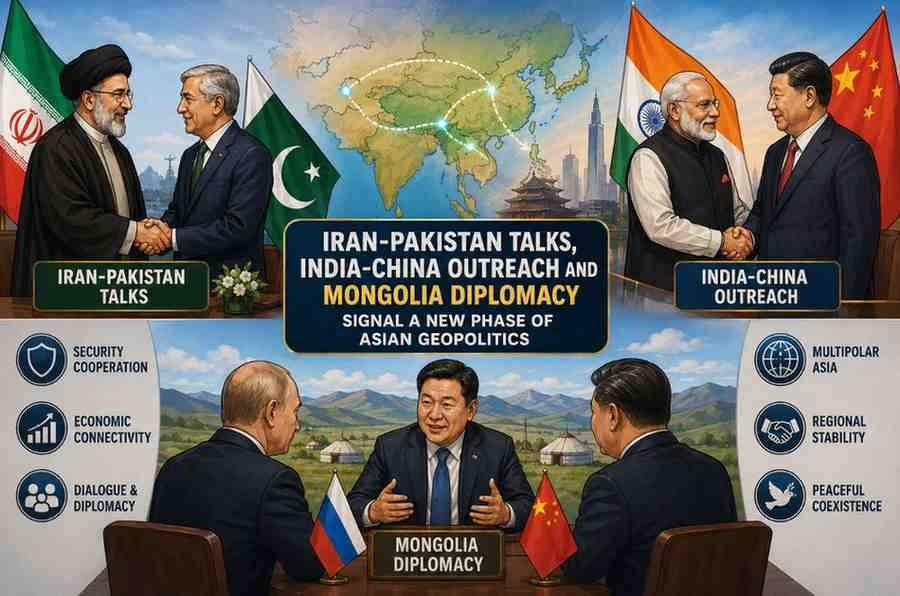
From Islamabad to New Delhi, Beijing and Ulaanbaatar, a series of high-level diplomatic engagements underscored an increasingly interconnected geopolitical landscape across Asia. While each meeting focused on bilateral interests, together they revealed a broader trend: regional powers are intensifying diplomatic outreach amid growing global uncertainty, economic competition and evolving security concerns.
Iranian President Masoud Pezeshkian’s visit to Pakistan, Chinese Foreign Minister Wang Yi’s message to India, and External Affairs Minister S. Jaishankar’s engagement in Mongolia all pointed toward a wider diplomatic realignment taking shape across the continent. At the same time, political developments in Bangladesh, Britain and the United States highlighted how domestic politics and international relations are becoming increasingly intertwined.
What appeared on the surface to be a collection of separate diplomatic events actually offers valuable insight into the future direction of regional cooperation, strategic partnerships and power dynamics in Asia.
Why Regional Diplomacy Is Accelerating Across Asia
The geopolitical environment in 2026 is markedly different from that of a decade ago. Rising competition between major powers, shifting trade routes, Energy Security concerns and technological rivalries have pushed countries to diversify partnerships and strengthen diplomatic channels.
Rather than relying solely on traditional alliances, many governments are pursuing multi-directional foreign policies that allow them to engage multiple partners simultaneously.
This approach is particularly visible across Asia, where countries increasingly seek to balance economic interests, security needs and strategic autonomy.
The latest diplomatic engagements reflect this broader trend.
Iran and Pakistan Seek Greater Strategic Coordination
One of the most closely watched meetings of the day was between Iranian President Masoud Pezeshkian and Pakistan’s leadership in Islamabad.
The relationship between Iran and Pakistan has historically been shaped by geography, energy cooperation, border security concerns and regional politics. Both countries share a lengthy border and face common challenges related to trade connectivity, terrorism and regional stability.
The latest discussions focused on strengthening bilateral cooperation while also addressing wider regional developments.
Several key areas continue to define the relationship:
- Border security cooperation
- Counterterrorism efforts
- Energy trade opportunities
- Regional connectivity projects
- Economic integration initiatives
- Peace and stability in neighboring regions
The talks gained additional significance because they occurred amid broader diplomatic efforts involving the United States and Iran. Pakistan has increasingly positioned itself as a country capable of maintaining dialogue with multiple stakeholders across competing geopolitical blocs.
This balancing strategy allows Islamabad to maintain relevance in regional diplomacy while avoiding overdependence on any single partner.
China’s Message to India Reflects a Carefully Managed Relationship
Another significant development came from Chinese Foreign Minister Wang Yi’s remarks regarding India-China relations.
His call for mutual respect of “core interests” highlights one of the most important diplomatic relationships in Asia.
India and China are not only neighboring powers but also two of the world’s largest economies and populations. Their relationship influences trade, regional security, global supply chains and the broader balance of power in the Indo-Pacific.
Since tensions along the Line of Actual Control in recent years, both sides have sought mechanisms to stabilize ties while continuing dialogue on unresolved issues.
Key areas shaping the relationship include:
- Border management
- Trade and investment
- Regional security
- Multilateral cooperation
- Technology competition
- Global South leadership
Wang’s remarks suggest Beijing wants to continue the process of managing disagreements while preventing them from overwhelming broader bilateral relations.
For India, maintaining stable relations with China remains important even as New Delhi expands partnerships with other global powers.
India-Mongolia Relations Continue Expanding Beyond Traditional Cooperation
External Affairs Minister S. Jaishankar’s discussions in Mongolia received less international attention but may prove strategically important in the long run.
India and Mongolia share what both governments describe as a “spiritual partnership” rooted in historical cultural connections. However, recent years have seen the relationship expand into practical economic and strategic areas.
The latest talks focused on sectors that are becoming increasingly important for global economic competitiveness.
Among them were:
- Critical Minerals and mining
- Energy cooperation
- Technology partnerships
- Human resource development
- Infrastructure opportunities
- Educational exchanges
Mongolia’s significance is growing because of its substantial mineral resources, which are essential for clean energy technologies, electronics manufacturing and industrial development.
As countries seek to diversify supply chains and secure access to critical resources, partnerships with resource-rich nations are becoming strategically valuable.
A Broader Shift Toward Pragmatic Diplomacy
One common theme connecting the day’s diplomatic activity is pragmatism.
Governments increasingly appear focused on practical cooperation rather than ideological alignment.
This trend reflects the reality that modern challenges such as economic growth, energy security, climate adaptation and technological development require collaboration even among countries with significant political differences.
Regional diplomacy is becoming less about choosing sides and more about managing relationships.
Countries are pursuing multiple partnerships simultaneously to maximize economic opportunities while minimizing strategic vulnerabilities.
This flexible approach has become particularly visible across Asia, where economic interdependence often coexists with geopolitical competition.
How Pakistan Fits Into Emerging Regional Dynamics
Pakistan’s diplomatic positioning deserves particular attention because it increasingly finds itself at the intersection of several important regional developments.
Its relationships with China, Iran, Gulf countries, the United States and neighboring South Asian states give Islamabad a unique role in regional diplomacy.
Recent initiatives suggest Pakistan is attempting to leverage this position to increase its influence on issues ranging from regional connectivity to conflict mediation.
The country’s leadership has repeatedly emphasized economic diplomacy as a cornerstone of its foreign policy strategy.
By strengthening ties with multiple partners simultaneously, Pakistan hopes to attract investment, expand trade and improve regional stability.
The Global Context: Why These Talks Matter Beyond Asia
The significance of these diplomatic engagements extends beyond the region itself.
Asia now accounts for a substantial share of global economic growth, manufacturing output and energy consumption. As a result, developments involving major Asian countries increasingly affect international markets and global Governance.
Investors, policymakers and multinational corporations closely monitor diplomatic trends because they can influence:
- Trade routes
- Supply chains
- Energy markets
- Investment flows
- Commodity prices
- Technology ecosystems
When major regional powers engage constructively, the benefits often extend to broader economic stability.
Political Developments Elsewhere Added to the Diplomatic Backdrop
While diplomacy dominated headlines in Asia, political developments in other parts of the world provided additional context.
Britain’s continued debate over Brexit a decade after the historic referendum highlights how major political decisions can reshape national trajectories for years.
Meanwhile, developments in Bangladesh reflected ongoing political tensions surrounding the country’s future direction and democratic landscape.
In the United States, discussions involving lawmakers, foreign policy and international partnerships demonstrated how domestic politics increasingly influence diplomatic relationships.
Together, these events illustrate the interconnected nature of modern politics, where domestic developments often carry international implications.
| Country | Key Diplomatic Focus | Strategic Significance |
|---|---|---|
| Iran | Regional engagement and peace initiatives | Middle East stability and energy security |
| Pakistan | Balancing multiple strategic partnerships | Regional connectivity and mediation |
| China | Managing relations with neighboring powers | Regional influence and economic leadership |
| India | Expanding strategic partnerships | Economic growth and geopolitical influence |
| Mongolia | Resource and technology cooperation | Critical minerals and supply chains |
An Important Insight Competitors Often Miss
Much reporting on diplomatic meetings tends to focus on official statements and ceremonial aspects. However, the more important story often lies beneath the headlines.
The most significant takeaway from this day of diplomacy is not any single announcement but the pattern emerging across the region.
Countries are increasingly investing in dialogue mechanisms even when disagreements remain unresolved.
This suggests governments recognize that long-term stability depends not on eliminating differences but on managing them effectively.
In an era marked by geopolitical competition, the willingness to maintain communication channels may be one of the most valuable strategic assets available.
What Could Happen Next?
Several developments are likely to shape the next phase of regional diplomacy.
India and China are expected to continue confidence-building efforts aimed at reducing tensions and expanding practical cooperation where possible.
Iran and Pakistan may pursue deeper economic engagement, particularly in energy and connectivity projects.
India’s outreach to Mongolia could accelerate cooperation in sectors linked to critical minerals and emerging technologies.
At the same time, broader geopolitical competition involving major powers will continue influencing regional calculations.
The challenge for policymakers will be balancing national interests with the need for regional stability and economic growth.
Conclusion
The diplomatic activity witnessed across Pakistan, China and Mongolia reflects more than a routine day of international meetings. It highlights a broader shift toward pragmatic engagement, strategic diversification and dialogue-driven diplomacy across Asia.
Iran’s outreach to Pakistan, China’s message to India and India’s expanding partnership with Mongolia each represent different aspects of an evolving regional order. Together, they reveal how governments are adapting to a world characterized by economic interdependence, geopolitical competition and growing uncertainty.
While challenges remain, the willingness of regional powers to maintain communication, pursue cooperation and explore new partnerships suggests that diplomacy continues to play a central role in shaping Asia’s future. In a rapidly changing geopolitical environment, these conversations may ultimately prove more consequential than the headlines they generated.
For breaking news and live news updates, like us on Facebook or follow us on Twitter and Instagram. Read more on Latest World on thefoxdaily.com.






COMMENTS 0