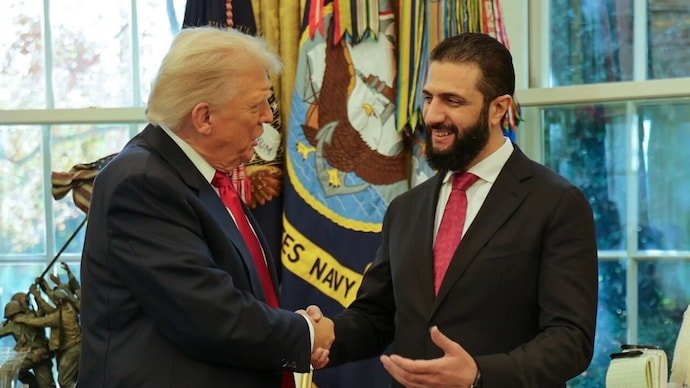
In a region where military responses often dominate political headlines, Syria may have just delivered one of the most unexpected messages in recent years: not every crisis needs another war.
A diplomatic exchange involving U.S. President Donald Trump and Syrian President Ahmed al-Sharaa has sparked intense debate across West Asia. At the center of the discussion is Hezbollah, the Iran-backed Lebanese group that remains one of the most influential non-state military forces in the Middle East.
Trump’s suggestion that Syria could potentially play a larger role in dealing with Hezbollah was interpreted by many observers as an invitation for Damascus to take a tougher stance against the group. Instead, Syria responded with something rarely heard in discussions surrounding Lebanon’s security crisis an emphasis on dialogue, economic cooperation, and political solutions.
The exchange may ultimately prove more significant than it initially appeared because it offers fresh clues about how post-Assad Syria intends to position itself in a rapidly changing Middle East.
What Triggered the Controversy?
The debate began after Trump expressed frustration with the prolonged conflict involving Hezbollah and the broader instability affecting Lebanon and the region.
While discussing possible solutions, Trump suggested that Syria could potentially take over responsibility for dealing with Hezbollah. His comments generated immediate speculation among analysts and regional media.
Several questions quickly emerged:
- Was Washington encouraging Syria to confront Hezbollah militarily?
- Did the United States want Damascus to replace Israel as the primary pressure point against the group?
- Could Syria become a new security actor inside Lebanon?
- Was this part of a broader regional realignment?
The uncertainty surrounding Trump’s remarks fueled intense debate throughout diplomatic circles.
Then Syria provided a surprisingly clear answer.
Damascus Says No to Another War
President Ahmed al-Sharaa rejected the idea that military intervention would solve Lebanon’s problems.
Instead of discussing troop deployments, military operations, or confrontations with Hezbollah, he focused on economic recovery, regional cooperation, and political stability.
His message was straightforward: Lebanon’s future should not be determined through more bombing campaigns or armed conflict.
That response carries particular weight because Syria has historically been deeply involved in Lebanese affairs. For decades, Syrian influence shaped Lebanon’s political and security landscape. As a result, any statement from Damascus regarding Lebanon attracts significant regional attention.
Rather than reviving old patterns of intervention, Syria’s leadership appears eager to project a different image one centered on Diplomacy rather than force.
Why Syria’s Position Is So Surprising
The reaction from Damascus surprised many observers because of Syria’s long and complicated relationship with Hezbollah.
For years, Hezbollah and the government of former Syrian President Bashar al-Assad operated as strategic allies. During the Syrian civil war, Hezbollah fighters played a critical role in supporting Assad’s government against opposition forces.
The alliance was built on several shared interests:
- Close ties with Iran
- Opposition to Israel
- Regional security coordination
- Mutual military support
- Shared strategic objectives in the Levant
Given that History, many analysts expected any new Syrian leadership to either maintain strong alignment with Hezbollah or move aggressively against it.
Instead, Ahmed al-Sharaa appears to be pursuing a third path.
A Shift From Military Influence to Diplomatic Influence
One of the most important takeaways from al-Sharaa’s comments is the possibility that Syria is redefining how it wants to exercise regional influence.
Historically, influence in the Middle East was often measured through military power, proxy networks, and security alliances.
However, Syria today faces very different realities.
After years of conflict, economic disruption, Sanctions, Infrastructure damage, and population displacement, rebuilding the country has become a strategic priority.
Under those circumstances, economic stability may offer greater benefits than military adventures.
Al-Sharaa repeatedly emphasized:
- Economic cooperation with Lebanon
- Support for state institutions
- Regional stability
- Political dialogue
- Mutual interests
This suggests Damascus may increasingly seek influence through reconstruction, trade, diplomacy, and regional partnerships rather than through armed involvement.
The Real Message to Hezbollah
While Syria rejected military confrontation, that does not necessarily mean unconditional support for Hezbollah.
In fact, al-Sharaa acknowledged that Hezbollah remains a complex issue.
What stood out was his willingness to leave open the possibility of dialogue.
Rather than treating Hezbollah solely as a military threat, Syria appears willing to engage politically if doing so advances both Syrian and Lebanese interests.
This approach reflects a broader trend emerging across parts of the Middle East, where governments increasingly prioritize stability and economic growth over ideological confrontation.
For Hezbollah, Syria’s stance sends a mixed message.
Damascus is not preparing for direct conflict, but it is also signaling that future relations may be shaped by practical considerations rather than historical alliances alone.
What It Means for Lebanon
Lebanon remains trapped in one of the most challenging periods in its modern history.
Economic difficulties, political fragmentation, security concerns, and regional tensions continue to strain the country.
Against that backdrop, the prospect of another external military actor entering the conflict would likely raise serious concerns.
Syria’s rejection of military involvement therefore provides a degree of reassurance.
Instead of adding another front to an already fragile environment, Damascus is signaling support for de-escalation.
Whether that approach succeeds depends on multiple factors, including Hezbollah’s actions, Israeli policy, Iranian influence, and broader regional developments.
Nevertheless, Syria’s position reduces immediate fears of a widening conflict involving Lebanese territory.
The Bigger Regional Picture
The Middle East is currently undergoing significant geopolitical transformation.
Several major trends are reshaping regional calculations:
- Growing emphasis on economic development
- Efforts to reduce regional conflicts
- Expansion of cross-border investment projects
- New diplomatic partnerships
- Competition for influence through trade and infrastructure
Countries that once prioritized military competition are increasingly exploring diplomatic alternatives.
Syria’s latest position appears consistent with this broader shift.
Instead of presenting itself as a battlefield actor, Damascus is attempting to portray itself as a stakeholder in regional stability.
That transition may not happen overnight, but the messaging is becoming increasingly visible.
Could This Change Syria’s International Standing?
Potentially, yes.
International perceptions of Syria have been shaped for years by conflict, instability, and geopolitical rivalries.
If Damascus consistently promotes diplomatic engagement, economic cooperation, and conflict reduction, it could gradually improve its regional and international position.
Governments seeking stability in West Asia may view such an approach more favorably than renewed military activism.
However, credibility will ultimately depend on actions rather than statements.
Regional powers will closely watch whether Syria follows through on its diplomatic rhetoric and whether it can balance relations with multiple competing actors.
Comparison: Trump’s Security Approach vs Syria’s Diplomatic Approach
| Issue | Trump’s Position | Syria’s Response |
|---|---|---|
| Hezbollah Challenge | Stronger pressure and action | Dialogue and political engagement |
| Lebanon Stability | Security-focused solution | Institution-building and diplomacy |
| Regional Influence | Strategic intervention | Economic cooperation |
| Conflict Resolution | Deterrence and leverage | Negotiation and consensus |
| Long-Term Goal | Contain threats quickly | Build sustainable stability |
What Happens Next?
The immediate impact of the exchange may be largely symbolic, but symbols matter in international Politics.
Syria has publicly rejected becoming a new military player in Lebanon’s crisis. That alone alters assumptions that many regional observers had made following Trump’s remarks.
The next phase will depend on developments involving Lebanon, Hezbollah, Israel, Iran, and ongoing diplomatic efforts across the region.
If Syria continues emphasizing diplomacy and economic integration, it could gradually emerge as a different kind of regional actor than the one many have known over the past decade.
Conclusion
When Donald Trump floated the idea of Syria taking a more active role against Hezbollah, many expected discussions about military action, regional confrontation, or strategic escalation. Instead, Damascus responded with a message centered on diplomacy, economic cooperation, and political solutions.
President Ahmed al-Sharaa’s remarks suggest that Syria may be redefining its priorities in a post-conflict era. Rather than seeking influence through military involvement, the country’s leadership appears increasingly focused on stability, reconstruction, and pragmatic regional engagement.
Whether this approach succeeds remains uncertain. Yet the significance of the moment lies in the contrast itself. At a time when conflict often dominates regional politics, Syria chose to answer a military proposition with a diplomatic one. That decision may ultimately reveal more about the future direction of the Middle East than the original proposal ever did.
For breaking news and live news updates, like us on Facebook or follow us on Twitter and Instagram. Read more on Latest World on thefoxdaily.com.




COMMENTS 0