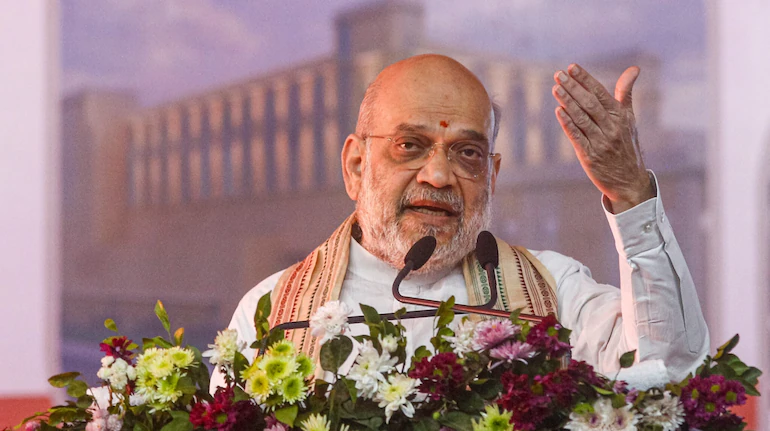
Union Home Minister Amit Shah has called for a nationwide effort to make India free from drugs by December 31, 2029, describing the goal as a major step towards building the developed nation envisioned by Prime Minister Narendra Modi. Addressing the Run for Unity in New Delhi on October 31, Shah urged citizens to participate in the campaign against drug abuse and the illegal narcotics trade, placing the initiative at the centre of the government’s next major national objective.
Shah made the appeal on the 151st birth anniversary of Sardar Vallabhbhai Patel, which is observed as Rashtriya Ekta Diwas, or National Unity Day. He said India had achieved several significant milestones during the Modi government’s tenure, including the abrogation of Article 370, the campaign against Naxalism and the introduction of a unified indirect tax system. He argued that eliminating the drug menace should now become another defining national achievement.
The Home Minister also linked the proposed drug-free India campaign to the country’s younger generation, saying that protecting young people from addiction was essential to India’s future. His remarks brought together two themes of the National Unity Day observances: national integration and the need for collective action against challenges affecting society.
Amit Shah Calls for Drug-Free India by December 31, 2029
Addressing participants at the Run for Unity in New Delhi, Shah appealed to people across the country to support the government’s target of eliminating the drug menace by the end of 2029.
“Today, on the birth anniversary of Sardar Patel, I appeal to the people across the nation regarding the goal we have set: to make the country completely free from drugs by December 31, 2029,” he said.
Shah described a ‘Nasha-Mukt Bharat’, or drug-free India, as a necessary foundation for achieving the broader vision of ‘Viksit Bharat’. The government’s development ambition extends to 2047, when India will mark 100 years of Independence. According to the Home Minister, economic growth and national development must be accompanied by efforts to protect citizens from substance abuse.
“The vision of a ‘Viksit Bharat’, as envisioned by the Prime Minister, begins with the creation of a ‘Nasha-Mukt Bharat’,” Shah said.
He further described the proposed campaign as an achievement that would have a lasting impact on young people and future generations. In his remarks, Shah placed the fight against drugs alongside major policy and security decisions taken during the Modi government’s years in office.
The December 2029 deadline is not a new announcement. The Centre has already outlined a three-year strategy through its Vision Document 2026-2029, which was launched by Shah in June 2026. The document sets out targets, timelines, monitoring arrangements and action points for tackling drug trafficking, reducing demand and expanding treatment and rehabilitation services.
What the Nasha Mukt Bharat 2029 Roadmap Includes
The government’s anti-drug strategy goes beyond arrests and the seizure of narcotics. It combines enforcement measures with prevention, public awareness, treatment and rehabilitation, recognising that drug abuse involves both an illegal supply network and a public health challenge.
According to information released by the Ministry of Social Justice and Empowerment, the Nasha Mukt Bharat Abhiyaan has reached more than 35 crore people through its awareness and outreach activities. This includes over 13.94 crore young people and 10.86 crore women. More than 32 lakh educational institutions have also been covered by the campaign’s outreach efforts.
The scale of the programme reflects the government’s emphasis on taking anti-drug awareness beyond law enforcement agencies and into schools, colleges, communities and families. Educational institutions are expected to play an important role in identifying risks, spreading awareness and encouraging young people to avoid substance abuse.
The Vision Document 2026-2029 identifies prevention, enforcement, treatment and rehabilitation, and coordination among government agencies as important parts of the wider effort. It also envisages expanding treatment capacity, strengthening facilities for vulnerable groups and developing a network of volunteers known as Nasha Mukt Bharat Mitras.
One of the central challenges is that drug abuse cannot be addressed through seizures alone. Enforcement agencies must investigate the networks responsible for production, transportation, financing and distribution, while health and social welfare institutions need to support people affected by addiction.
Why the Drug Menace Is a Major National Challenge
Drug abuse affects more than the individuals who consume narcotics. It can place pressure on families, increase financial hardship, disrupt education and employment, and create wider public health and social problems. Addiction can also make it difficult for affected people to maintain stable relationships and participate fully in economic and community life.
For young people, the consequences can be particularly serious. Substance abuse may interfere with education, physical health, career development and long-term opportunities. This is why Shah repeatedly connected the drug-free India target with the future of the country’s youth.
India’s geographical position also presents enforcement challenges. Its location between regions associated with the production and trafficking of narcotics makes cross-border cooperation, intelligence sharing and stronger surveillance important parts of the response. Trafficking networks can operate across multiple states and countries, making it difficult for a single agency or state government to tackle the problem independently.
The growth of synthetic drugs, online communication platforms and digital financial transactions has added further complexity. Traffickers can use technology and informal distribution channels to conceal activities, move money and coordinate operations. Tackling these networks requires investigators to follow financial and digital evidence as well as physical shipments.
Shah has previously called for a shift from a seizure-focused approach towards dismantling the wider networks behind the drug trade. That means investigating the people who finance trafficking operations, identifying suppliers and distributors, and pursuing cases through the judicial system.
Government Lists Article 370 Abrogation and Naxalism as Major Milestones
During his address, Shah highlighted several decisions and developments that he said had marked important achievements during Prime Minister Narendra Modi’s tenure. These included the abrogation of Article 370, efforts to eliminate Naxalism and the implementation of a unified indirect tax system.
He said these developments demonstrated the government’s ability to address long-standing national challenges and argued that the drug-free India campaign should become another major achievement.
Referring to Article 370, Shah said its abrogation had firmly integrated Jammu and Kashmir with the rest of India. The constitutional provision had granted the former state a special status within the Indian Union. The Centre revoked that arrangement in August 2019 and reorganised the former state into the Union Territories of Jammu and Kashmir and Ladakh.
The decision marked a major constitutional and administrative change. It was followed by changes to the region’s governance structure and the extension of a range of central laws and policies. The move has remained politically and legally significant, with supporters describing it as strengthening national integration and critics raising concerns about federalism, political representation and civil liberties.
Shah also cited the government’s campaign against Naxalism, referring to the March 31, 2026 deadline associated with the Centre’s objective of ending the threat posed by Left-Wing Extremism. The government has described the reduction of armed Naxalite activity as a major internal security achievement.
However, the end of large-scale armed activity does not automatically mean that every challenge associated with Naxalism has disappeared. Security operations, rehabilitation, governance, development and the restoration of public services remain important in areas that have experienced prolonged violence. Sustained peace depends on more than the weakening of armed groups; it also requires institutions and economic opportunities to reach affected communities.
One Nation, One Tax: Shah Highlights GST as Another Achievement
Another milestone mentioned by the Home Minister was the introduction of a unified indirect tax system, commonly described as ‘One Nation, One Tax’. The Goods and Services Tax, or GST, was introduced on July 1, 2017, replacing a range of central and state indirect taxes with a common framework.
Before GST, businesses often had to deal with multiple indirect tax systems across different stages of production, transportation and sale. The introduction of the new regime was intended to create a more integrated national market, reduce tax-related barriers between states and simplify the indirect taxation structure.
GST is administered through a federal framework in which the Centre and states share responsibilities. The GST Council, comprising representatives of the Union and state governments, makes recommendations on important aspects of the system, including tax rates and policy changes.
The reform has also faced implementation challenges, including compliance requirements, technical difficulties and concerns raised by businesses about the tax structure. Nevertheless, Shah cited it as an example of a major policy change that reshaped India’s indirect taxation system.
By placing GST alongside Article 370 and the government’s anti-Naxalism campaign, Shah presented the proposed drug-free India target as part of a broader series of national objectives pursued during the Modi administration.
Shah Praises Sardar Vallabhbhai Patel’s Role in India’s Integration
The Home Minister’s appeal for a drug-free India came during the annual observance of Rashtriya Ekta Diwas, which commemorates the birth anniversary of Sardar Vallabhbhai Patel. Paying tribute to India’s first Deputy Prime Minister and Home Minister, Shah credited him with bringing hundreds of princely states together in the years following Independence.
Shah said Patel had achieved the political integration of India in just 1,218 days after Independence, overcoming predictions by international observers that the country would eventually break apart.
“At the time we attained independence, political pundits across the globe predicted that India would fall apart. Yet, in the 1,218 days following independence, Sardar Patel accomplished what everyone had deemed impossible,” Shah said.
He added that Patel had achieved in slightly more than three years what many believed would be difficult even for a group of leaders to accomplish during their lifetimes.
Patel played a central role in integrating the princely states into the newly independent Indian Union. At the time of Independence in 1947, the subcontinent included hundreds of princely states that had to decide their political future as British paramountcy came to an end. Their integration involved negotiations, political agreements and, in some cases, military action.
Working with V. P. Menon and other officials, Patel helped secure the accession of princely states to India. His leadership was particularly important in addressing difficult questions involving Hyderabad, Junagadh and other territories. The process helped establish the territorial and administrative foundations of the modern Indian Union.
Shah described Patel as the architect of the map of an ‘Akhand Bharat’, saying his contribution extended beyond political consolidation to shaping India’s geographical identity.
“He was a great personality who not only transformed the nation’s history but also shaped its very geography,” Shah said.
He added that the India envisioned and built by Patel now stood before the world with pride. The Home Minister’s remarks placed Patel’s role in national integration at the centre of the day’s celebrations and connected his legacy with the government’s emphasis on unity and national development.
President Murmu, Vice President and Ministers Pay Tribute
Several senior national leaders paid floral tributes to Patel on his 151st birth anniversary. President Droupadi Murmu, Vice President C. P. Radhakrishnan, Union Home Minister Amit Shah and Union Minister Hardeep Singh Puri were among those who honoured the former Deputy Prime Minister.
Shah also flagged off the Run for Unity at the Major Dhyan Chand National Stadium in New Delhi. The event formed part of the National Unity Day observances, with participants coming together to promote the message of national integration and collective responsibility.
The annual event is organised to remember Patel’s contribution to India’s unity and to encourage citizens, particularly young people, to reflect on the importance of national solidarity.
Rashtriya Ekta Diwas is observed every year on October 31. The government instituted the observance in 2014, and it has since become an annual occasion for tributes, public events, unity pledges and the Run for Unity.
Why October 31 Is Observed as Rashtriya Ekta Diwas
October 31 marks the birth anniversary of Sardar Vallabhbhai Patel, who was born in 1875 in Nadiad, Gujarat. Widely known as the Iron Man of India, Patel was one of the leading figures of the freedom movement and played a decisive role in the political consolidation of the country after Independence.
As India’s first Deputy Prime Minister and Home Minister, he was responsible for a range of administrative and political challenges during the early years of the republic. The integration of princely states remains one of the most significant aspects of his public life.
Rashtriya Ekta Diwas was introduced to recognise that contribution and promote the values of unity, integrity and national security. Activities held on the day include public pledges, cultural programmes, educational initiatives and unity runs in different parts of the country.
The observance also provides an opportunity to highlight the role of public institutions, police forces and security personnel in maintaining national unity. In 2026, the celebrations have included a particular focus on the role of security forces in the campaign against armed Naxalism.
Modi’s Gujarat Visit and Events Around the Statue of Unity
The National Unity Day celebrations were also accompanied by events at Ekta Nagar in Gujarat, where the Statue of Unity stands as a memorial to Patel. Prime Minister Narendra Modi visited the Valley of Flowers near the statue during a two-day visit to the state on October 30 and 31.
During the visit, Modi also witnessed a theatrical presentation of Bankim Chandra Chattopadhyay’s iconic work ‘Anand Math’. The programme formed part of the cultural activities organised around the National Unity Day celebrations.
The 24-acre Valley of Flowers has been developed as a biodiversity conservation and eco-tourism attraction near the Statue of Unity. Information shared about the project states that the site features around 14 lakh plants belonging to 112 species.
The area around the statue has developed into a major tourism destination, with attractions intended to combine Patel’s historical legacy with environmental conservation and cultural activities. The annual celebrations bring together official ceremonies, public participation and programmes designed to highlight India’s diversity.
Can India Achieve the 2029 Drug-Free Target?
The December 31, 2029 deadline sets a clear political target, but achieving it will require sustained action across several areas. Drug trafficking and addiction are interconnected problems, and progress in one area does not necessarily mean that the wider challenge has been resolved.
Enforcement agencies will need to identify and dismantle trafficking networks, strengthen intelligence sharing and improve coordination between central and state authorities. Investigations into financial transactions and international connections will also be important because organised drug networks often operate across administrative and national boundaries.
At the same time, reducing demand requires awareness campaigns, early intervention, accessible treatment and long-term rehabilitation. People affected by addiction may need medical care, counselling and social support to recover and return to education, employment and family life.
Schools, colleges, local organisations and families can contribute by helping young people understand the risks of substance abuse and by identifying warning signs before addiction becomes more severe. Community participation will be particularly important in areas where drug use and trafficking have become persistent concerns.
The government’s own roadmap recognises the need to combine enforcement with prevention and rehabilitation. Its emphasis on expanding treatment facilities and involving educational institutions indicates that the campaign is intended to address both the supply of narcotics and the demand that sustains the illegal market.
However, the scale of the challenge means that the deadline will need to be assessed through measurable outcomes rather than announcements alone. Drug seizures, arrests and awareness figures provide information about enforcement and outreach, but they do not independently show whether addiction rates have fallen or whether treatment services are reaching those who need them.
Reliable data on drug use, treatment access, recovery and the disruption of trafficking networks will therefore be important in evaluating progress. Coordination among the Centre, state governments, law enforcement agencies, healthcare providers and communities will determine how effectively the programme is implemented.
From National Unity to a Drug-Free India
Shah’s October 31 address connected Patel’s legacy of political integration with the government’s current priorities on internal security, economic development and social welfare. By setting December 31, 2029 as the target for a drug-free India, he called for a national campaign that would involve government institutions as well as ordinary citizens.
His remarks also placed the anti-drug initiative alongside the abrogation of Article 370, the campaign against Naxalism and the GST system as major milestones cited by the government. These issues differ in their nature and implementation, but Shah presented them as examples of challenges the administration believes it has addressed during its tenure.
The success of the Nasha Mukt Bharat goal will ultimately depend on whether the government can translate its deadline into lasting reductions in drug trafficking and substance abuse. That will require effective enforcement, stronger treatment systems, public awareness and cooperation across states.
As India marked Patel’s 151st birth anniversary, the Home Minister’s message was that national unity must extend beyond political and geographical integration to include collective efforts to protect society. The 2029 deadline now gives the government’s drug-free India campaign a defined target, with its progress likely to be measured by the results achieved for communities, families and the country’s younger generation.
For breaking news and live news updates, like us on Facebook or follow us on Twitter and Instagram. Read more on Latest India on thefoxdaily.com.



COMMENTS 0