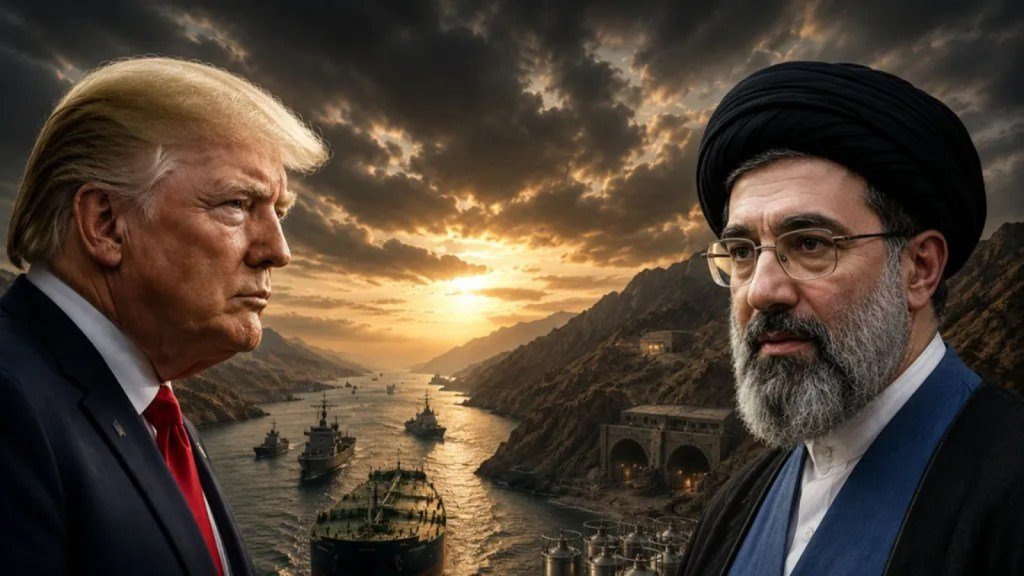
US President Donald Trump has warned Iran’s leadership that it faces severe economic consequences or further military escalation unless Tehran agrees to a deal with Washington, while also indicating that he remains open to diplomacy with Iranian President Masoud Pezeshkian.
The latest exchange came as the months-long US-Iran Conflict showed few signs of a breakthrough. Trump’s warning was followed by a strong response from Iran’s military, which said any fresh American attack would trigger sustained retaliation against US bases and interests in the region. Iranian officials also warned that countries supporting Washington could become involved in the conflict.
The confrontation has extended well beyond the two countries. Fighting and attacks involving Iran-backed forces have created additional pressure across the Middle East, while disruption around the Strait of Hormuz and restrictions on Iranian oil exports have contributed to wider energy-market instability.
Trump lays out three possible paths for Iran
Speaking to a Fox News reporter, Trump described what he presented as the choices available to Iran’s leaders. His message combined a demand for negotiations with threats of continued economic pressure and possible military escalation.
- Make a deal: Tehran could reach an agreement with Washington and pursue a diplomatic route out of the conflict.
- Face economic ruin: Iran could remain under pressure and suffer further economic deterioration.
- Risk the destruction of its leadership: Trump warned of a far more severe military outcome if the confrontation continues to escalate.
The comments represent another example of Trump using economic pressure and the threat of military force together in his approach to Tehran. They also underline the uncertainty surrounding the next stage of the conflict, with Washington continuing to demand concessions while Iran has resisted accepting terms it considers unfavorable.
Trump’s remarks were particularly significant because they were accompanied by an indication that diplomacy remains possible. With Pezeshkian expected in New York for the United Nations General Assembly, Trump said he would be willing to meet the Iranian president.
That combination of threats and an offer to meet creates a complicated diplomatic picture. Washington is maintaining pressure on Tehran while leaving open the possibility of direct discussions. For Iran, however, agreeing to talks would involve navigating demands from the United States while also demonstrating that it has not conceded under military or economic pressure.
Iran warns of retaliation against US and regional interests
Iran’s military responded to Trump’s warning with a direct threat of its own. The country’s central military command said any new attack would lead to sustained retaliation against American bases and interests in the region.
Iran also warned that US regional allies could be treated as parties to the conflict if they support an American military operation. The statement said Iranian authorities had information suggesting that another attack was being prepared, although the military did not publicly explain the source of that information.
The warning adds another layer of risk to an already complicated regional security environment. US military facilities and personnel are spread across several countries in the Middle East, while Washington maintains close security relationships with Gulf states and other regional partners.
Iranian Parliament Speaker Mohammad Baqer Qalibaf also indicated that Tehran would continue pursuing both military resistance and diplomacy. His position reflects the broader approach Iran has taken during the conflict: maintaining pressure on its adversaries while keeping negotiations available as a possible route toward an eventual settlement.
Why the US-Iran conflict has reached a stalemate
The conflict has continued for months without producing a durable settlement. Neither Washington nor Tehran has shown a willingness to accept the other side’s core demands, leaving diplomacy repeatedly vulnerable to renewed military escalation.
The war began with US and Israeli strikes on Iran on February 28. Since then, the confrontation has expanded from direct military exchanges into a wider struggle involving oil markets, maritime transportation, regional armed groups and economic sanctions.
A temporary ceasefire reached in June provided a potential path toward reducing the fighting, but the arrangement collapsed in July after disputes over its terms. Since then, efforts to restore the earlier understanding have failed to produce a lasting agreement.
The absence of a political settlement has allowed economic and military pressure to continue accumulating. Iran has faced severe damage to parts of its economy, while the wider conflict has affected global Energy Markets and commercial shipping.
The Strait of Hormuz has become a central pressure point
One of the most important elements of the conflict is the Strait of Hormuz, the narrow waterway connecting the Persian Gulf with the Gulf of Oman and the Arabian Sea.
The strait is strategically important because large volumes of energy supplies normally pass through it. Any prolonged disruption can affect oil and gas shipments far beyond the Middle East, creating consequences for fuel prices, transportation costs and inflation in countries that depend on imported energy.
Iran has continued to restrict shipping through the waterway. Tehran has said it will not reopen the Strait of Hormuz until the conditions surrounding the June ceasefire are addressed on terms acceptable to Iran.
That position has turned the strait into both a military and diplomatic bargaining point. For Iran, control over access to the waterway provides leverage at a time when its own oil exports are being restricted. For the United States and other countries dependent on uninterrupted maritime trade, keeping shipping routes open is a major strategic concern.
US blockade puts further pressure on Iran’s economy
Washington has also used maritime pressure to restrict Iran’s ability to sell oil and conduct international trade. A US blockade of Iranian ports has significantly complicated Tehran’s ability to export energy and maintain normal commercial activity.
Oil revenues are particularly important to Iran because energy exports are a major source of foreign currency. Restrictions on those exports can reduce government income, limit imports and increase pressure on an economy already dealing with inflation, currency weakness and the effects of prolonged conflict.
For the Trump administration, economic pressure is intended to increase the cost of continuing the confrontation and push Iran toward negotiations. Tehran, however, has treated the pressure as part of the conflict itself and has continued to demand changes to the conditions imposed by Washington.
The result is a cycle in which economic restrictions are followed by Iranian resistance, while continued resistance creates arguments in Washington for maintaining or increasing pressure.
Houthi attacks widen the regional conflict
The latest escalation also comes as Iran-backed Houthi forces in Yemen have opened another front in the wider regional confrontation.
Houthi missile and drone attacks on targets in Saudi Arabia, including attacks around Riyadh over the weekend, have increased concerns that the conflict could spread further across the Gulf and surrounding regions.
The Houthis have previously attacked shipping and regional targets during periods of heightened tension. Their involvement creates additional risks because the Red Sea and surrounding maritime routes are already strategically important to global trade.
Any sustained expansion of attacks on Saudi energy infrastructure, Gulf shipping or other critical facilities could create additional pressure on global energy supplies. It could also force the United States and its regional partners to devote more military resources to protecting shipping and infrastructure.
Trump’s diplomatic opening complicates the military message
Trump’s willingness to meet Pezeshkian is significant because it keeps direct diplomacy on the table despite his increasingly severe warnings.
The United Nations General Assembly provides a rare opportunity for senior American and Iranian officials to be in the same international setting. Whether that creates meaningful negotiations depends on whether both governments can identify terms that allow them to claim progress without appearing to surrender their core positions.
For Washington, a negotiated agreement could offer a way to reduce military risks and stabilize energy markets. For Tehran, diplomacy could provide a route toward easing economic pressure and restoring access to international trade, but only if the conditions are considered acceptable by Iranian leaders.
The challenge is that public threats can make compromise politically harder. When governments make strong declarations about military retaliation or economic punishment, backing away without a visible concession from the other side can become difficult.
Energy markets remain exposed to further escalation
The economic consequences of the conflict extend far beyond Iran and the United States. Global oil markets remain highly sensitive to developments around the Persian Gulf because of the region’s role in international energy supplies.
Restrictions around the Strait of Hormuz have already forced traders, governments and energy companies to reassess transportation risks. Even when physical supplies remain available, uncertainty can raise the cost of moving oil and increase the premium placed on future deliveries.
For consumers, prolonged disruption can eventually appear through higher fuel and transportation costs. Businesses can also face increased expenses for shipping, manufacturing and logistics, potentially adding to inflationary pressure.
The recent easing and volatility in oil prices demonstrate how quickly expectations can change. Signals of possible diplomacy can reduce fears of a wider war, while military threats or attacks on energy infrastructure can produce the opposite reaction.
What happens next for Washington and Tehran?
The immediate question is whether the latest exchange leads to another round of escalation or creates space for negotiations.
Trump has made clear that he wants Iran to make a deal, but his latest warning suggests that Washington intends to maintain substantial pressure if Tehran refuses. Iran, meanwhile, has signalled that it will continue resisting militarily while also keeping diplomacy available.
The most important obstacles remain the terms of any potential agreement, the future of the Strait of Hormuz, sanctions and oil exports, and the security commitments demanded by both sides.
The regional dimension makes the situation even more difficult. Houthi attacks, US military deployments, Gulf security concerns and disruptions to maritime trade mean that a confrontation between Washington and Tehran can rapidly produce consequences for countries that are not direct participants in the war.
For now, Trump’s latest message combines an offer to meet Iran’s president with one of his strongest warnings yet about the consequences of rejecting a deal. Iran’s response indicates that Tehran is not preparing to accept pressure without resistance. With the conflict still lacking a durable ceasefire and the Strait of Hormuz remaining a central point of contention, the possibility of diplomacy exists alongside a continuing risk of further escalation.
For breaking news and live news updates, like us on Facebook or follow us on Twitter and Instagram. Read more on Latest World on thefoxdaily.com.




COMMENTS 0