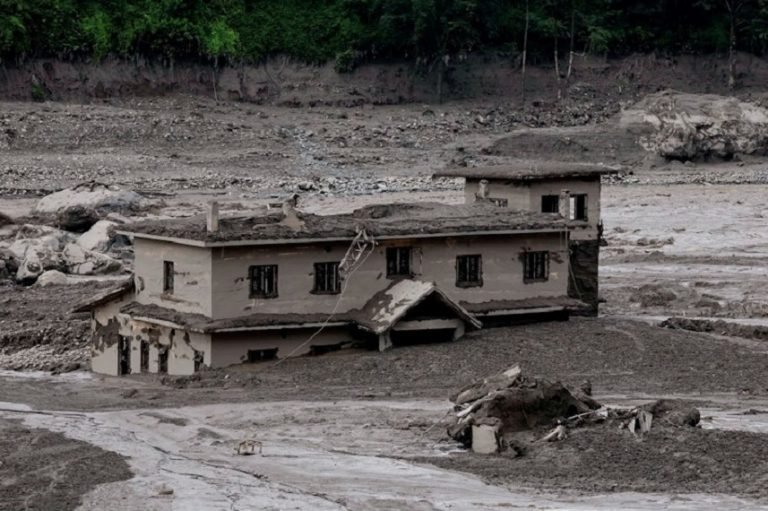
A devastating mudslide and flash flood near the China–Nepal border has triggered a large-scale emergency response in Tibet, with Chinese authorities reporting three deaths and 558 people missing in Gyirong County as rescue teams race to search damaged areas around the Gyirong border port.
The disaster began on Wednesday, August 26, when a mudslide originating on the Nepalese side of the border struck the area around Gyirong Port in China’s Xizang Autonomous Region. The resulting torrent of water, mud and debris caused extensive destruction, cut roads and disrupted access to one of the key crossing points between Nepal and Tibet.
The missing figure has changed rapidly as authorities have expanded their assessment of the affected area. An initial estimate released by Chinese authorities put the number missing at 265, but Chinese state broadcaster CCTV later reported that the figure had risen to 558. Of those reported missing in the latest Chinese tally, 260 were foreign nationals.
Two villagers have been rescued, while search teams continue to assess the scale of the damage. The situation remains fluid, and authorities are still working to verify casualty figures.
What happened at Gyirong Port?
The mudslide struck the border region on Wednesday morning after a large mass of mud and rock entered a river system and contributed to a powerful flash flood. The disaster affected both sides of the China-Nepal frontier, although the most severe downstream destruction was reported in Nepal.
On the Chinese side, the Gyirong Port area was hit by a wall of mud and water that damaged buildings, roads and other infrastructure. Video footage from the area showed people attempting to escape as fast-moving debris swept through the border zone.
Gyirong is located in Shigatse in southwestern Tibet and serves as an important land connection between China and Nepal. Because the area lies in steep Himalayan terrain, damage to roads and communications can make Rescue Operations significantly more difficult.
Chinese authorities have closed or restricted access to affected routes while emergency personnel work to clear debris and assess the condition of the surrounding area.
China expands search-and-rescue operation
China has responded with a broad emergency operation involving military personnel, firefighters, engineers, medical teams and other rescue workers.
A directing group from the People’s Liberation Army Western Theatre Command was sent to the affected region to coordinate military rescue operations. The command is responsible for China’s western areas, including the country’s border with India in Tibet.
The military-led response is intended to bring together different rescue capabilities rather than rely on a single agency. Aviation, transportation, engineering and medical units have been placed on standby or deployed to support the operation.
Rescue teams are working on several fronts, including clearing roads, assessing the disaster zone, searching for missing people and relocating residents from areas considered dangerous.
Chinese authorities have also mobilised emergency supplies and specialist rescue equipment. More than 1,000 rescuers have been involved in the wider response, with search teams using equipment such as drones and rescue dogs in difficult terrain.
Why the missing figure changed so quickly
The changing casualty figures illustrate one of the biggest challenges in responding to a disaster in a remote mountain border region.
The first Chinese estimate released on Wednesday evening reported three deaths and 265 missing people. As rescue authorities expanded their assessment and established contact with additional affected areas, the number of missing people rose to 558.
Such changes do not necessarily mean that hundreds of additional people disappeared after the initial report. In a disaster where communications have been damaged and roads are blocked, authorities may initially lack information about people who were in the affected area.
People can also be temporarily classified as missing when authorities cannot immediately establish whether they escaped, were evacuated or were trapped. As communications are restored and rescue teams reach isolated locations, casualty figures can change substantially.
The Chinese authorities have indicated that casualty figures are still being verified, meaning the latest number should be understood as part of an ongoing assessment rather than a final toll.
Foreign nationals among those missing
The presence of foreign nationals has added another international dimension to the emergency.
Chinese state media reported that 260 foreign nationals were among the 558 people missing in Gyirong. At the same time, authorities in Nepal were searching for hundreds of tourists and travellers who became unaccounted for after the flooding on the Nepalese side.
The wider border region is used by tourists, trekkers and pilgrims travelling through the Himalayan corridor. The route is particularly significant for people travelling toward religious and tourism destinations in Tibet, including areas associated with Mount Kailash and Lake Mansarovar.
The disaster therefore involves more than local residents. Governments and diplomatic missions are also trying to establish the whereabouts and safety of their nationals.
The Indian Embassy in China issued an advisory providing contact points for Indians who may have been stranded in the flood-affected Tibet-Nepal border area. The development is particularly important because Indian pilgrims regularly Travel through the broader region on journeys toward Mount Kailash and Lake Mansarovar.
Nepal has suffered an even wider disaster
The mudslide at Gyirong Port cannot be viewed as an isolated incident on the Chinese side of the border. The same disaster system produced catastrophic flooding downstream in Nepal.
Nepalese authorities reported at least 157 deaths by late Wednesday, with the overall toll rising further as rescue teams continued their work. Hundreds of tourists and other people were also reported missing.
The flood swept through settlements and valleys along rivers in northern and central Nepal, destroying homes, roads and bridges. Power infrastructure and other development projects were also damaged.
The disaster struck a region where narrow valleys can amplify the impact of sudden water surges. When large volumes of water, rock, mud and debris move through such terrain, the destruction can extend far beyond the location where the initial landslide occurred.
This explains why the consequences of a landslide on the upper reaches of a river can become catastrophic many kilometres downstream.
What triggered the flash flood?
Initial reports suggested that a large collapse of ice and rock in the Himalayan region triggered the destructive sequence. The United States Geological Survey later indicated that the event initially thought to have been an earthquake was instead associated with a glacial collapse.
The precise chain of events is important because the disaster appears to have involved more than ordinary monsoon flooding. A sudden release of water and debris from a high-altitude collapse can generate a much faster and more destructive flood than rainfall alone.
In this case, mud, rocks and water moved through river channels before reaching populated areas and infrastructure. The resulting surge gave people very little time to react.
The Himalayas are particularly vulnerable to this type of hazard because of their steep slopes, unstable geological formations, glaciers and rapidly changing high-altitude environments.
A second flood risk complicates rescue efforts
One of the most serious concerns for rescuers is that the disaster may not be over.
Authorities have identified a blocked water body or barrier lake upstream of the affected area. Such lakes can form when landslides, rocks or other debris obstruct a river. If the blockage fails suddenly, accumulated water can rush downstream and create another destructive flood.
Chinese authorities have therefore increased monitoring of the upstream area and are assessing the stability of the blockage.
This creates a difficult balance for rescue teams. They need to reach missing people quickly, but sending large numbers of personnel into an unstable valley could expose rescuers to another disaster.
The threat of additional landslides, unstable slopes and further flooding also makes road clearance and transportation more difficult.
Why Gyirong Port matters beyond the disaster
The destruction around Gyirong is significant because the crossing is part of an important China-Nepal trade and transport corridor.
Border crossings in the Himalayas are not simply points for people to travel between countries. They connect remote communities to supplies, markets, tourism routes and transportation networks.
When roads leading to a border crossing are destroyed, the consequences can continue long after floodwaters recede. Food, medicine, fuel and construction materials can become harder to transport into affected communities, while commercial traffic can be interrupted.
For Nepal, access through its northern border with China provides an alternative connection to international trade routes. For communities in Tibet, the crossing supports economic activity and movement in a region where geography already limits transportation options.
The immediate priority, however, remains finding survivors and preventing further loss of life.
Why rescue operations are unusually difficult
Mountain disasters create a combination of problems that can overwhelm conventional emergency-response systems.
Damaged roads: Mud and debris have cut or obstructed routes near the border, making it harder for heavy rescue equipment and supplies to reach affected areas.
Broken communications: Floods and landslides can damage power and communications infrastructure, leaving families unable to contact one another and complicating casualty verification.
Unstable terrain: Slopes weakened by water and landslides can collapse without warning, putting rescuers at risk.
Remote geography: The Himalayan landscape makes rapid movement of large rescue teams difficult, increasing reliance on helicopters, aircraft, drones and specialist equipment.
Secondary flooding: The possibility of an upstream barrier lake failing means some areas may remain dangerous even after the first flood has passed.
These factors explain why authorities are combining military aviation, engineering units, medical teams and specialised search personnel rather than relying solely on conventional road-based rescue operations.
Xi Jinping orders all-out rescue efforts
Chinese President Xi Jinping ordered authorities to make every effort to search for and rescue missing people after the disaster.
He also called for residents in danger to be evacuated and for injured people to receive timely medical care. His instructions emphasised monitoring, early warning and measures to prevent secondary disasters.
Chinese Premier Li Qiang separately called for an immediate verification of the number of missing and affected people and for comprehensive rescue and relief operations.
Vice Premier Zhang Guoqing was sent to the affected region to guide disaster-response operations, while government departments worked to coordinate rescue and relief measures.
The high-level response reflects both the scale of the emergency and the strategic importance of the border area.
What happens next in the Tibet-Nepal mudslide disaster?
The immediate priority is to determine how many people remain trapped or unaccounted for and reach locations that have been cut off by the flooding.
Rescuers must also assess the stability of roads, bridges, slopes and the upstream water blockage before expanding operations into high-risk areas.
The next major change in the casualty figures will depend heavily on the restoration of communications and access to isolated locations. Some people currently listed as missing may still be found alive, while the number of confirmed deaths could rise as search teams reach areas that remain inaccessible.
The disaster is also likely to intensify attention on early-warning systems in the Himalayan region. Sudden glacial collapses and debris flows can develop rapidly, leaving communities downstream with very little time to evacuate.
For now, the situation remains an active rescue emergency. With hundreds still unaccounted for on the Chinese side and a much larger number missing across the wider Nepal-Tibet disaster zone, the outcome will depend on how quickly rescuers can reach isolated areas while avoiding further hazards.
The tragedy at Gyirong also highlights a broader reality of life in the Himalayas: a disaster that begins with a collapse high in the mountains can quickly cross borders, overwhelm infrastructure and affect residents, tourists and pilgrims many kilometres away. The search for survivors therefore remains the immediate priority, while the full scale of the disaster may only become clear once access to the affected valleys and border corridor is restored.
For breaking news and live news updates, like us on Facebook or follow us on Twitter and Instagram. Read more on Latest World on thefoxdaily.com.





COMMENTS 0