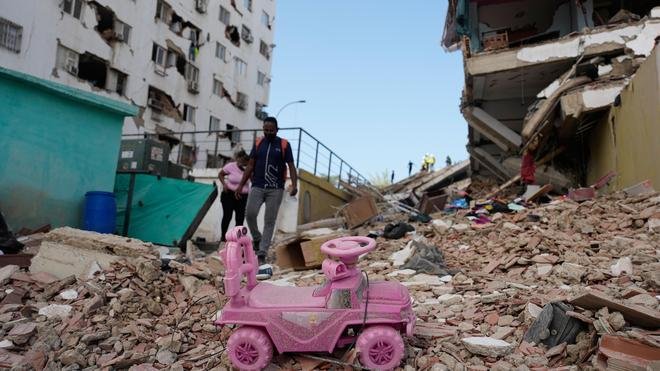
Venezuela is confronting an unprecedented humanitarian emergency after two powerful earthquakes devastated large parts of the country’s northern coast, leaving widespread destruction, thousands injured, and entire communities buried beneath collapsed buildings. As emergency responders continue searching for survivors, officials have confirmed that the death toll has climbed above 920, while more than 51,000 people have been reported missing and over 3,300 have sustained injuries.
The twin earthquakes, measuring 7.2 and 7.5 in magnitude, struck within a short interval, multiplying the destructive force across densely populated regions. The worst devastation has been reported in La Guaira state, where residential towers, public housing, hospitals, roads, and public infrastructure suffered catastrophic damage.
As rescue crews race against time, families are increasingly joining recovery efforts themselves, digging through concrete and twisted steel in hopes of finding loved ones alive. The coming days are expected to determine whether thousands trapped beneath the rubble can still be rescued.
What Happened in Venezuela?
The disaster unfolded when two powerful shallow earthquakes struck northern Venezuela in rapid succession. Unlike deeper seismic events, shallow earthquakes release energy much closer to the Earth’s surface, dramatically increasing the level of destruction experienced by buildings and infrastructure.
Because the second earthquake occurred shortly after the first, weakened structures that initially survived suffered complete collapse during the second shock. This “double-impact” phenomenon significantly increased casualties and complicated rescue operations.
Authorities quickly declared a national emergency as hospitals became overwhelmed, communication networks failed, and transportation routes were severely disrupted.
Why Shallow Earthquakes Are More Destructive
Although earthquake magnitude receives most public attention, depth is equally important.
Shallow earthquakes generally produce:
- Stronger ground shaking.
- Greater structural damage.
- Higher casualty rates.
- More infrastructure collapse.
- Greater risk to densely populated urban areas.
In Venezuela’s case, the combination of two major shallow earthquakes created an exceptionally destructive sequence that left thousands trapped beneath collapsed buildings.
The Scale of the Humanitarian Crisis
The disaster extends far beyond the confirmed fatalities.
According to emergency authorities, tens of thousands of people remain unaccounted for, although officials caution that missing-person databases may include duplicate reports or individuals temporarily unable to contact relatives due to damaged communication networks.
Millions of residents across affected regions continue experiencing disruptions to electricity, drinking water, healthcare, telecommunications, transportation, and Food supplies.
International humanitarian organizations warn that the true humanitarian impact will likely become clearer only after rescue operations transition into broader recovery assessments.
| Disaster Overview | Current Situation |
|---|---|
| Earthquake magnitudes | 7.2 and 7.5 |
| Confirmed deaths | More than 920 |
| Reported missing | Over 51,000 |
| People injured | More than 3,300 |
| Worst-hit area | La Guaira State |
Why the First 72 Hours Matter
Disaster specialists often describe the first 72 hours following a major earthquake as the “golden rescue window.”
During this period, trapped survivors have the greatest chance of being located before dehydration, injuries, exposure, or structural instability reduce survival rates.
Search teams rely on:
- Listening devices.
- Thermal imaging equipment.
- Rescue dogs.
- Heavy lifting machinery.
- Medical rapid-response teams.
Although rescues occasionally occur many days after earthquakes, survival becomes increasingly difficult as time passes.
Families Are Leading Their Own Rescue Efforts
One of the defining images emerging from Venezuela is that of ordinary citizens searching for loved ones with basic tools rather than professional equipment.
Residents have reportedly used hammers, drills, metal cutters, and even their bare hands to remove debris after rescue resources proved insufficient for the enormous scale of destruction.
These community-led efforts reflect both remarkable resilience and the overwhelming demands placed on emergency services during catastrophic disasters.
Restricted Access to La Guaira
Authorities have restricted access to La Guaira, the area suffering the greatest destruction, in an effort to improve rescue coordination.
Officials argue that uncontrolled traffic, crowds, and large numbers of private vehicles have slowed emergency operations.
Access permits have therefore been introduced to prioritize rescue teams, humanitarian organizations, medical personnel, and essential supplies.
While intended to improve efficiency, the restrictions have also created anxiety among families desperate to reach missing relatives.
International Rescue Teams Join the Response
The scale of the disaster has prompted an international humanitarian response.
Specialized rescue teams from multiple countries have deployed personnel, equipment, and medical resources to assist Venezuelan authorities.
International urban search-and-rescue teams typically bring:
- Structural engineers.
- Medical specialists.
- Canine search units.
- Portable hospitals.
- Heavy rescue equipment.
- Satellite communications.
Such expertise often proves critical during complex building collapses.
The Challenges Facing Emergency Responders
Rescue operations remain extremely difficult.
Emergency workers must navigate:
- Collapsed roads.
- Damaged bridges.
- Unstable buildings.
- Power outages.
- Fuel shortages.
- Communication failures.
- Large crowds searching for relatives.
Every aftershock also creates additional risks for rescue personnel working inside unstable structures.
Healthcare System Under Pressure
Hospitals across affected regions have experienced extraordinary pressure following the earthquakes.
Medical teams are treating crush injuries, fractures, head trauma, burns, dehydration, and psychological distress while simultaneously managing shortages of medicines, blood supplies, hospital beds, and medical equipment.
Temporary medical facilities have become essential for handling the growing number of patients requiring emergency care.
Why Urban Earthquakes Cause Higher Casualties
The concentration of people living in apartment buildings significantly increases casualty risks during powerful earthquakes.
High-rise structures, schools, hospitals, shopping centres, and transport hubs all contain large numbers of occupants when seismic events occur.
If buildings were not designed or retrofitted to modern seismic standards, structural collapse can become widespread, particularly during multiple strong earthquakes occurring within a short period.
The Economic Impact Could Last for Years
Beyond the immediate humanitarian emergency, Venezuela now faces an enormous economic reconstruction challenge.
Damage to housing, ports, airports, highways, schools, utilities, hospitals, and businesses is expected to require years of rebuilding.
Natural disasters of this scale often affect:
- Employment.
- Tourism.
- Trade.
- Agriculture.
- Supply chains.
- Public finances.
Reconstruction costs frequently exceed billions of dollars following major seismic events.
The Importance of International Humanitarian Aid
Large-scale disasters typically require international cooperation because no single country can always mobilize sufficient resources immediately.
Humanitarian assistance may include:
- Emergency food supplies.
- Clean drinking water.
- Shelter materials.
- Medical assistance.
- Engineering support.
- Temporary housing.
- Sanitation equipment.
Rapid coordination among governments, humanitarian organizations, and international agencies often determines how quickly affected communities begin recovering.
Lessons from Previous Major Earthquakes
| Challenge | Common Global Experience | Current Situation in Venezuela |
|---|---|---|
| Search window | First 72 hours most critical. | Rescuers continue racing against time. |
| Infrastructure | Roads and communications frequently fail. | Transport restrictions affecting operations. |
| Medical response | Hospitals become overwhelmed. | Thousands require treatment. |
| Recovery | Reconstruction often lasts years. | Long-term rebuilding expected. |
The Psychological Impact Often Lasts Longest
While rebuilding physical infrastructure receives significant attention, Mental health recovery remains equally important.
Earthquake survivors frequently experience grief, anxiety, trauma, sleep disturbances, and uncertainty about the future.
Children, older adults, and individuals WHO lost family members often require long-term psychological support alongside housing and financial assistance.
Experts increasingly recognize mental health services as a core component of disaster recovery rather than an optional addition.
Climate, Infrastructure, and Urban Planning
Although earthquakes cannot be prevented, their impact can often be reduced through resilient infrastructure, strict building codes, effective emergency planning, and public preparedness.
Countries located in seismically active regions increasingly invest in earthquake-resistant construction, early warning systems, emergency communication networks, and disaster-response training.
The scale of destruction in Venezuela is likely to renew discussions about urban resilience and long-term infrastructure modernization.
What Happens After Rescue Operations End?
Once emergency rescues conclude, attention shifts toward recovery.
The next phase generally includes:
- Damage assessments.
- Temporary housing.
- Infrastructure reconstruction.
- Economic recovery.
- School reopening.
- Healthcare restoration.
- Psychological support.
For disasters of this magnitude, full recovery often takes many years.
Future Outlook
Venezuela now faces one of the most significant humanitarian and reconstruction challenges in its recent History. With the confirmed death toll continuing to rise, thousands still missing, and rescue teams working against an increasingly narrow survival window, the immediate priority remains saving as many lives as possible.
Beyond the emergency response, the country must prepare for the far longer process of rebuilding homes, restoring infrastructure, supporting displaced families, and strengthening disaster preparedness. The tragedy also serves as a powerful reminder that resilient infrastructure, effective emergency planning, international cooperation, and rapid humanitarian assistance remain among the most important tools for reducing the human cost of major natural disasters. The coming weeks will determine not only how many more lives can be saved, but also how successfully Venezuela begins the long road toward recovery.
For breaking news and live news updates, like us on Facebook or follow us on Twitter and Instagram. Read more on Latest World on thefoxdaily.com.






COMMENTS 0