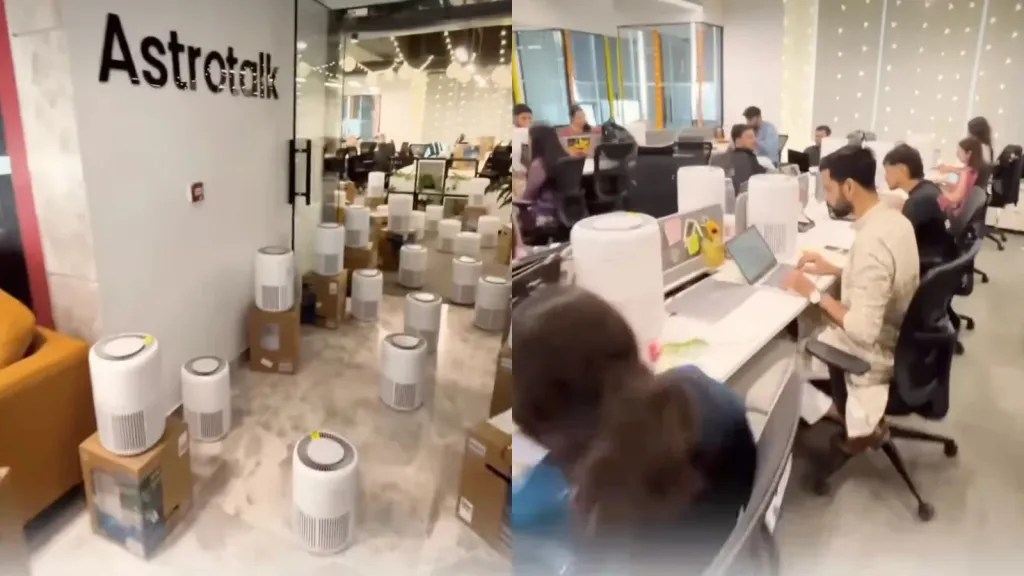
As Delhi and the National Capital Region (NCR) prepare for another winter of hazardous air pollution, an unusual Diwali initiative by a private company has attracted widespread attention on social media. AstroTalk, a Noida-based astrology platform, distributed 1,000 air purifiers among its employees, highlighting the growing importance of indoor air quality as pollution levels deteriorate.
The initiative has received appreciation from social media users who welcomed the company’s decision to give employees something directly connected to their health and well-being. At the same time, the gesture has triggered a broader debate about why clean air is increasingly becoming something people must purchase or arrange for themselves.
A video shared by AstroTalk on social media showed an employee reacting with surprise to the unexpected festive gift. The employee appeared pleasantly surprised as the company distributed the air purifiers as part of its Diwali celebrations.
The video quickly attracted attention, with many users describing the initiative as thoughtful and relevant to the pollution challenges faced by residents of Delhi-NCR during winter.
AstroTalk Distributes 1,000 Air Purifiers as Diwali Gifts
AstroTalk’s decision to distribute 1,000 air purifiers comes at a time when concerns about air pollution are once again dominating discussions across Delhi-NCR.
Unlike conventional festive gifts, the air purifiers were intended to address a practical concern affecting employees’ daily lives. With pollution levels frequently rising during the winter months, indoor air quality has become an important consideration for households, particularly in areas experiencing high concentrations of particulate pollution.
The company’s social media video captured an employee’s reaction to receiving the purifier. The unexpected nature of the gift helped the video gain traction online, with viewers discussing both the gesture and the wider environmental conditions that made such a present relevant.
The distribution also reflects how companies are increasingly considering employee health and workplace well-being when planning internal initiatives. However, the wider significance of the gesture extends beyond the workplace because it highlights the growing public concern surrounding access to clean air.
Viral Video Sparks Discussion About Delhi’s Air Pollution
The video shared by AstroTalk generated a wave of reactions, with many social media users welcoming the initiative. Several commenters pointed out that air purifiers could be particularly useful for people living in Delhi and neighbouring areas during the coming winter.
For residents exposed to high pollution levels, reducing indoor exposure can be an important part of managing everyday health risks. Air purifiers equipped with suitable filtration systems can help reduce certain airborne particles inside enclosed spaces, although their effectiveness depends on the device, room size, filter condition and ventilation.
The video also prompted a more critical discussion about the country’s broader pollution problem. Some users argued that distributing air purifiers should not become a substitute for addressing the sources of pollution.
‘Delhi People Need This’: Social Media Users React
Many users praised AstroTalk for choosing a gift that addresses an immediate concern for employees. The reactions also showed how strongly air pollution has become associated with everyday life in Delhi-NCR.
One user wrote, “Yes Delhi people need this,” reflecting the view that air purifiers are becoming increasingly relevant for residents facing poor air quality.
Another commenter raised concerns about the growing cost of accessing basic environmental necessities, writing, “We’ve reached a point where clean air and clean drinking water are becoming premium lifestyle products instead of basic necessities.”
The comment questioned why companies distributing air purifiers were receiving appreciation when the underlying problem of deteriorating air quality remained unresolved.
A third user described the gift as something Delhi residents might need during the coming winter, while another called for stronger government action against pollution and greater public awareness about the environmental impact of firecrackers.
These reactions reveal two different sides of the discussion. While many people appreciate practical steps that help individuals cope with pollution, others believe that the focus should remain on preventing pollution rather than relying increasingly on personal protective measures.
Delhi AQI Reaches 370, Several Areas Record Severe Pollution
The attention surrounding AstroTalk’s initiative comes amid concerning air quality readings in the national capital.
On Thursday morning, Delhi’s overall Air Quality Index (AQI) stood at 370 at 8 am, placing the city in the ‘very poor’ category. The reading indicated a high level of pollution and renewed concerns about the health risks associated with prolonged exposure.
According to the Indian Institute of Tropical Meteorology (IITM), several parts of the capital recorded severe pollution levels. Jahangirpuri registered the highest AQI among the locations mentioned in the report, reaching 459.
An AQI reading of 370 falls within the very poor category under India’s air quality classification. The severe category begins at 401, making a reading of 459 particularly concerning for people living in or travelling through the affected area.
Such conditions can create difficulties for people with respiratory and cardiovascular conditions, children, older adults and those who spend extended periods outdoors. Even healthy individuals may experience discomfort when exposed to heavily polluted air.
Why Delhi-NCR Air Quality Often Deteriorates During Winter
Air pollution in Delhi-NCR is a year-round concern, but conditions often become more severe during the winter months. Weather patterns, emissions and regional pollution sources can combine to increase the concentration of harmful pollutants near the ground.
Weather conditions trap pollutants
During colder months, lower temperatures and changing atmospheric conditions can limit the movement and dispersion of pollutants. When air circulation is weak, emissions from vehicles, industries and other sources can accumulate closer to the surface.
Temperature inversion can further contribute to the problem. Under these conditions, a layer of warmer air sits above cooler air near the ground, restricting vertical mixing and making it harder for pollutants to disperse.
Vehicular and industrial emissions
Traffic-related emissions remain an important contributor to pollution in Delhi and surrounding urban areas. Large numbers of vehicles release pollutants that contribute to poor air quality, particularly along busy roads and congested transport corridors.
Industrial activity, construction dust and emissions from other combustion sources also contribute to the pollution burden. The combined impact can become more pronounced when weather conditions are unfavourable.
Regional and seasonal pollution sources
Pollution in the capital is influenced by sources across the wider NCR and neighbouring regions. Seasonal agricultural residue burning can contribute to pollution episodes, while the use of firecrackers during festive periods may add to the pollution load.
Dust from roads and construction sites can also increase particulate matter concentrations. Addressing the problem therefore requires coordinated action across multiple sectors and regions rather than relying on a single intervention.
Can Air Purifiers Help During Delhi’s Pollution Season?
Air purifiers can help improve indoor air quality when they use appropriate filtration technology and are selected according to the size of the room. Devices equipped with effective particulate filters, such as HEPA filtration, can capture many airborne particles, including fine particulate matter.
However, an air purifier is not a complete solution to outdoor air pollution. Its effectiveness depends on factors such as room size, air circulation, filter maintenance, the amount of outdoor air entering the room and the device’s clean air delivery capacity.
People using air purifiers should also pay attention to filter replacement and follow the manufacturer’s instructions. A device that is too small for the room or has a poorly maintained filter may not deliver the expected performance.
Indoor pollution sources also matter. Smoking, cooking emissions and other activities can affect indoor air quality even when an air purifier is operating.
Most importantly, air purifiers cannot replace public measures to reduce emissions from transport, industries, construction activities and other pollution sources. They can provide an additional layer of protection indoors, but cleaner outdoor air requires action at the source.
Corporate Responsibility and the Growing Importance of Employee Well-Being
AstroTalk’s Diwali initiative has also brought attention to the role companies can play in responding to environmental and public health concerns affecting their employees.
Employee well-being programmes traditionally focus on areas such as healthcare benefits, workplace safety, insurance and mental health support. In highly polluted cities, indoor air quality can also become a relevant consideration.
Providing air purifiers as a festive gift is a visible gesture, but companies can consider broader measures to protect employees during periods of severe pollution. These may include maintaining indoor air filtration systems, improving workplace ventilation, communicating air quality advisories and offering flexibility when outdoor conditions become particularly hazardous.
Such measures can be especially relevant for organisations operating in cities that regularly experience high pollution levels during winter.
At the same time, corporate initiatives should be viewed as complementary efforts rather than replacements for government responsibility. Businesses can improve conditions within their workplaces, but controlling citywide pollution requires effective regulation, infrastructure investment and enforcement.
Clean Air Is Becoming a Bigger Public Health Concern
The reactions to AstroTalk’s gift highlight a growing concern: access to clean air is increasingly being treated as an individual responsibility rather than a basic environmental requirement.
Households may purchase air purifiers, pollution masks and other protective products to reduce exposure. However, these measures can involve additional costs, making them less accessible to people with limited financial resources.
People who work outdoors, travel long distances or live in poorly ventilated homes may also have fewer opportunities to avoid polluted air. This makes citywide pollution control especially important for protecting vulnerable communities.
The debate sparked by the video therefore goes beyond whether the company selected a useful Diwali gift. It raises a larger question about how residents should be protected when pollution becomes severe enough to affect everyday activities.
Why Long-Term Pollution Control Matters More Than Individual Protection
Personal protection measures can help reduce exposure, but lasting improvements in air quality depend on reducing the amount of pollution released into the environment.
Effective pollution control requires coordinated efforts involving transport, industrial regulation, construction management, waste handling, energy use and regional planning.
Better public transport, cleaner vehicle technologies, dust-control measures at construction sites and stricter monitoring of industrial emissions can all contribute to reducing pollution when implemented effectively.
Authorities also need to address seasonal sources of pollution and improve coordination between Delhi and neighbouring states. Since air pollution does not stop at administrative boundaries, regional cooperation is essential.
Public awareness and responsible behaviour can support these efforts, but individual action alone cannot solve a problem driven by multiple large-scale emission sources.
Conclusion
AstroTalk’s distribution of 1,000 air purifiers to employees as a Diwali gift has attracted attention at a time when Delhi-NCR is facing renewed concerns over worsening air quality. The viral video has been welcomed by many social media users as a thoughtful gesture that places employee well-being at the centre of festive celebrations.
However, the reactions also highlight a deeper concern about the normalisation of poor air quality and the growing dependence on personal products to manage pollution exposure.
With Delhi recording an AQI of 370 on Thursday morning and Jahangirpuri reaching 459, the need for effective pollution-control measures remains urgent. Air purifiers may help people improve indoor air quality, but they cannot replace sustained action to reduce emissions and ensure cleaner air for everyone.
For breaking news and live news updates, like us on Facebook or follow us on Twitter and Instagram. Read more on Latest India on thefoxdaily.com.






COMMENTS 0