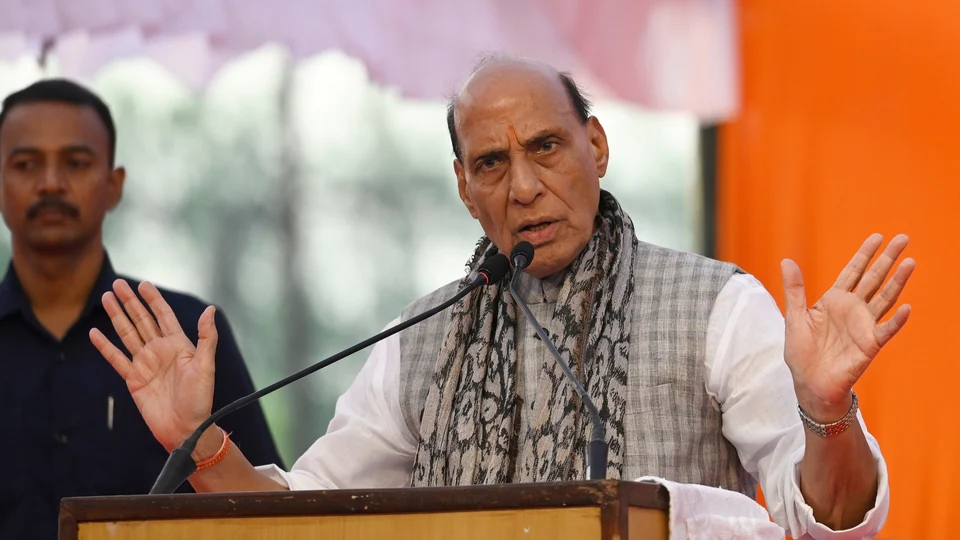
Defence Minister Rajnath Singh raised India’s concerns over US military assistance to Pakistan during talks with US Defence Secretary Pete Hegseth in Cebu, the Philippines, on Wednesday. The discussions took place on the sidelines of the ASEAN Defence Ministers’ Meeting-Plus (ADMM-Plus), where the two sides also reviewed progress under their 10-year Major Defence Partnership Framework.
According to officials familiar with the discussions, India expressed concern about Washington’s support for Pakistan’s F-16 fighter aircraft fleet following a recently announced $686 million upgrade package. Indian officials also highlighted the risk of Pakistan sharing advanced American military technology with a third country, in an apparent reference to China.
The discussions brought together two major defence partners at a time when India is seeking deeper military cooperation with the United States while continuing to raise questions about American security assistance to Pakistan. The meeting also covered military technology, information sharing, defence production, maritime security and counterterrorism.
Singh and Hegseth reaffirmed their commitment to strengthening bilateral defence cooperation. Their discussions reflected the breadth of the partnership, alongside the differences that remain over US military engagement with Pakistan and India’s concerns about regional security.
Why India is concerned about US military assistance to Pakistan
India’s concerns over American military assistance to Pakistan centre on the potential implications for regional security and the possibility that advanced US-origin technology could reach other countries. During the Cebu meeting, Singh reportedly raised the issue of Pakistan sharing American technology with a third country, an indirect reference to China, according to officials familiar with the discussions.
The concern extends beyond the supply of military equipment itself. Advanced fighter aircraft can incorporate sensitive avionics, communications systems, software and other technologies designed to support military operations. The security of these systems can become an important consideration when equipment is supplied to countries whose strategic relationships overlap with those of other major powers.
India’s position reflects its broader concerns about the regional balance of military capabilities. New Delhi has consistently objected to American military assistance to Pakistan, arguing that support for Islamabad must be considered in the context of the security challenges facing India and the history of tensions between the two neighbouring countries.
However, the reported concern about technology transfers should be distinguished from confirmation that such a transfer has taken place. The officials cited in the account described the risk raised by India during the talks; the available information does not establish that Pakistan has transferred the specific American technology in question to China.
The issue presents a diplomatic challenge for Washington, which maintains defence relationships with both India and Pakistan. India is seeking access to advanced technology and deeper military cooperation with the United States, while American assistance to Pakistan remains a point of disagreement between New Delhi and Washington.
US support for Pakistan’s F-16 fighter fleet
Singh also raised concerns about US support for Pakistan’s F-16 fighter fleet following a reported $686 million upgrade package. The issue was discussed alongside the broader question of American military assistance and the potential security implications of supplying advanced defence technology to Pakistan.
The F-16 is a multirole combat aircraft used by several countries, including Pakistan. Maintaining and upgrading such aircraft can involve technical support, spare parts, avionics, software and other systems needed to keep the fleet operational.
For India, the continued support of Pakistan’s F-16 fleet is part of a wider debate over the military relationship between Washington and Islamabad. Indian officials have raised objections to assistance that could affect the regional security balance, particularly when India and Pakistan continue to have unresolved security concerns and a history of military confrontation.
The reported upgrade package has therefore become an important issue in discussions between India and the United States. New Delhi’s concerns involve both the military capabilities that support could sustain and the handling of sensitive technology associated with American-origin aircraft.
At the same time, the precise scope and operational implications of an upgrade package must be assessed on the basis of its documented components and stated purpose. The reported $686 million figure alone does not establish the degree to which the package would change Pakistan’s overall military capabilities.
The issue illustrates how defence cooperation between two countries can affect their relationships with other regional powers. Washington and New Delhi are expanding their own defence partnership, but their differing approaches to US assistance for Pakistan remain a subject of discussion.
India and the United States review their 10-year defence framework
Despite the concerns over Pakistan, Singh and Hegseth reviewed progress under the 10-year India-US Major Defence Partnership Framework, which was signed in October 2025. The agreement provides a broad policy direction for strengthening defence cooperation over the following decade.
In a post on X after the meeting, Singh said the two sides had reviewed progress under the framework, focusing on strategic convergence in military technology, information sharing and co-production. He also described the partnership as a cornerstone for a free, open and secure Indo-Pacific.
Hegseth said the leaders had marked the framework’s first anniversary and explored ways to strengthen cooperation. The statements from both sides highlighted the importance they attach to continuing and expanding bilateral defence engagement.
The framework is intended to provide a shared vision for the relationship, helping guide cooperation across military and industrial areas. Its focus includes improving operational readiness, strengthening technology collaboration and expanding opportunities for defence production.
For India, deeper cooperation with the United States can support efforts to develop domestic defence manufacturing capabilities, improve access to advanced systems and strengthen military coordination with a major international partner. For Washington, closer defence ties with India provide a basis for working with a significant regional partner on security challenges in the Indo-Pacific.
The relationship has developed through a series of agreements and initiatives over several years. The latest framework provides an overarching direction for further cooperation, although the pace and scope of implementation will depend on specific projects, negotiations and the practical requirements of both countries.
Military technology, information sharing and defence production
The discussions between Singh and Hegseth covered several areas identified as priorities for the partnership, including military-to-military exchanges, maritime security and stronger defence supply chains. The Indian defence ministry said the two sides discussed ways to expand ongoing collaboration between their defence industries.
Military-to-military exchanges can help the armed forces of both countries improve familiarity with each other’s procedures, strengthen professional relationships and identify opportunities for coordination. Such engagement can also support joint training and improve understanding of regional security concerns.
Information sharing is another important part of defence cooperation. Timely access to relevant information can help military organisations develop a clearer picture of security developments and coordinate their responses. The precise information exchanged depends on the agreements, systems and safeguards established between the participating countries.
Defence technology cooperation can include discussions about equipment, research, manufacturing and technical expertise. Co-production can provide opportunities for industrial collaboration, while stronger supply chains may help support the availability and maintenance of defence equipment.
For India, these areas are relevant to its efforts to strengthen domestic defence production and reduce dependence on imported equipment in selected sectors. Cooperation with the United States could provide additional opportunities for industrial partnerships and technology development, subject to the terms agreed by both governments.
The challenge is to translate the broad goals of the 10-year framework into concrete outcomes. That requires progress on individual projects, the resolution of technical and commercial questions, and arrangements that address each side’s security and industrial requirements.
Counterterrorism remains a central issue in the talks
Counterterrorism was another key subject discussed by Singh and Hegseth. According to the Indian defence ministry, both leaders reaffirmed their commitment to combating global terrorism, while Singh called for a zero-tolerance approach towards countries that support, train or fund terrorist organisations.
India has repeatedly raised concerns about terrorism originating across its borders and has argued that countries providing financial, logistical or other support to terrorist organisations should be held accountable. The issue remains an important part of New Delhi’s security diplomacy and its engagement with international partners.
During the meeting, Hegseth reaffirmed Washington’s support for India’s fight against cross-border terrorism, the defence ministry said. Singh thanked the United States for what India described as consistent and strong support.
The statements highlighted an area in which both governments publicly expressed a shared objective. However, cooperation against terrorism involves more than political declarations. It can also depend on intelligence sharing, coordination between security agencies, efforts to disrupt terrorist financing and cooperation in addressing threats that cross national borders.
The discussion of terrorism also took place against the background of India’s concerns about US military assistance to Pakistan. For New Delhi, the relationship between regional security and counterterrorism remains relevant when assessing the implications of defence support provided to neighbouring countries.
The reported exchange did not establish that the two governments had resolved their differences over Pakistan’s F-16 fleet or the potential transfer of American technology. Instead, the meeting brought these concerns into discussions that also covered areas of cooperation and shared security priorities.
ASEAN defence ministers’ meeting brings regional security partners together
The Singh-Hegseth meeting took place on the sidelines of the 13th ASEAN Defence Ministers’ Meeting-Plus in Cebu, the Philippines, scheduled for October 28 and 29. The gathering brings together defence ministers from the Association of Southeast Asian Nations (ASEAN) and eight dialogue partners: India, the United States, China, Russia, Japan, South Korea, Australia and New Zealand.
ASEAN has 11 member states: Brunei, Cambodia, Indonesia, Laos, Malaysia, Myanmar, the Philippines, Singapore, Thailand, Timor-Leste and Vietnam. The ADMM-Plus provides a forum for these countries and their dialogue partners to strengthen defence cooperation and discuss shared regional and international security challenges.
The ASEAN Defence Ministers’ Meeting is the organisation’s principal defence consultative and cooperative mechanism. Its expanded format allows participating countries to engage on security issues that cross national boundaries and affect the wider Indo-Pacific region.
For India, participation in the forum supports its broader engagement with Southeast Asian countries under its regional diplomatic and security policies. Discussions can cover maritime security, counterterrorism, military cooperation and other issues relevant to regional stability.
Singh was scheduled to address the gathering on Thursday, focusing on regional and international security issues. His participation also provided an opportunity for bilateral meetings with defence counterparts from several participating countries.
Rajnath Singh also meets Japanese and other defence leaders
Alongside his discussions with Hegseth, Singh held bilateral talks with counterparts from Japan, Australia, South Korea and other participating countries. These meetings formed part of India’s broader effort to review existing defence relationships and explore additional areas of cooperation.
After meeting Japanese Defence Minister Shinjiro Koizumi, Singh said the two sides had held productive discussions on their ongoing bilateral defence cooperation and opportunities to strengthen the India-Japan Special Strategic and Global Partnership.
The meeting followed a memorandum of arrangement signed by India and Japan two months earlier to deepen maritime security cooperation. The arrangement focused on closer engagement between the Indian Navy and the Japan Maritime Self-Defense Force, adding to a series of initiatives intended to strengthen defence ties between the countries.
Maritime security is an important part of India’s engagement with Japan and other Indo-Pacific partners. Cooperation in this area can involve exchanges, coordination and efforts to improve understanding of security developments across regional waterways.
Singh’s meetings with other defence leaders similarly provided opportunities to review ongoing cooperation and discuss future priorities. Together, the engagements reflected India’s interest in maintaining multiple defence partnerships while participating in multilateral discussions on regional security.
What the meeting means for India-US defence relations
The talks in Cebu highlighted two parallel aspects of India-US relations: the continued expansion of defence cooperation and India’s willingness to raise concerns about American military assistance to Pakistan.
The 10-year defence framework gives both governments a basis for developing cooperation in military technology, information sharing, co-production and industrial integration. The meeting also reinforced their publicly stated commitment to counterterrorism and regional security.
At the same time, India’s concerns over Pakistan’s F-16 fleet and the potential sharing of advanced American technology with a third country illustrate that closer defence ties do not eliminate disagreements over regional policy.
The next phase of the partnership will depend on how effectively both governments implement their framework and manage areas where their security assessments differ. The reported discussion of Pakistan demonstrates that New Delhi intends to keep these concerns on the agenda while pursuing deeper cooperation with Washington.
For now, the meeting represents another step in the ongoing India-US defence dialogue. Both sides have expressed a desire to expand cooperation, while India has used the opportunity to raise questions about military assistance to Pakistan and the security implications of sensitive defence technology.
The discussions at the ASEAN summit also placed these bilateral issues within a wider regional context, where maritime security, counterterrorism and military cooperation remain important subjects for participating countries. Whether the talks lead to further practical measures will become clearer as the two governments advance the projects and commitments covered by their 10-year defence framework.
For breaking news and live news updates, like us on Facebook or follow us on Twitter and Instagram. Read more on Latest India on thefoxdaily.com.





COMMENTS 0