A crowded series of diplomatic and strategic developments across South Asia and beyond has put regional relationships under fresh scrutiny, with India–China border talks, Pakistan‘s engagement with Iran, Bangladesh‘s evolving foreign policy and India’s infrastructure partnership with the Maldives all unfolding at nearly the same time.
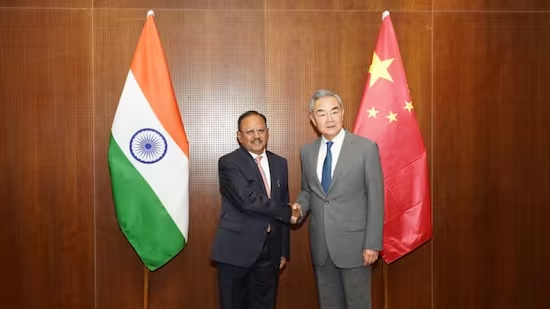
The most closely watched development is National Security Adviser Ajit Doval‘s visit to Beijing for the 25th round of India-China Special Representatives talks on the long-running boundary dispute. Doval is scheduled to meet Chinese Foreign Minister and his Chinese counterpart Wang Yi, with the discussions taking place against the backdrop of efforts to consolidate border stability and improve the wider bilateral relationship.
At the same time, Pakistan Army chief Field Marshal Asim Munir is due to travel to Tehran as Islamabad seeks to support regional peace efforts amid stalled US-Iran negotiations. Bangladesh, meanwhile, has signalled that Prime Minister Tarique Rahman’s possible visit to India will not be rushed and that national interests will remain central to Dhaka’s foreign policy decisions.
Elsewhere, Bangladesh has indicated that it could consider joining a Saudi Arabia-Pakistan-Turkiye defence framework if doing so serves its interests. In the Maldives, the installation of the final bridge segment linking Male and Villingili marked a significant step in an India-funded connectivity project.
The developments may appear unrelated, but together they reveal how quickly South Asia’s strategic environment is evolving. Border management, regional security, infrastructure, economic interests and diplomatic balancing are increasingly interconnected.
Ajit Doval heads to Beijing for India-China boundary talks
The most consequential development for India is Doval’s scheduled visit to Beijing for the latest round of Special Representatives negotiations with Wang Yi.
The talks focus on the India-China boundary dispute, a longstanding issue that has remained one of the biggest sources of tension between the two Asian powers.
The Special Representatives mechanism was established in 2003 to allow senior officials to address the boundary question at a political and strategic level. Although the mechanism has not resolved the dispute, it has provided an important channel for communication when relations have come under pressure.
The latest meeting is therefore significant not because it is expected to produce an immediate settlement of the boundary issue, but because sustained dialogue can help both sides manage differences and prevent disagreements along the border from damaging the broader relationship.
The talks also come as India and China seek to build on a period of improved communication following years of serious tension along the Line of Actual Control.
Why the Doval-Wang meeting matters
The boundary dispute is not simply a question of cartography. It affects military deployments, infrastructure construction, border management and political trust between India and China.
For New Delhi, maintaining stability along the frontier is essential to preventing a renewed military crisis and allowing attention to remain on wider economic and strategic priorities. For Beijing, stable relations with India can reduce the risk of another prolonged confrontation with a major Asian power.
That makes the Special Representatives dialogue useful even when the two countries remain far apart on the final settlement of their boundary.
The immediate objective is more practical: preserve communication, address outstanding concerns and ensure that border stability continues to support broader diplomatic engagement.
India-China relations are bigger than the border dispute
Although the boundary issue remains central, the relationship between India and China extends into trade, investment, technology, multilateral institutions and regional security.
This makes the management of the border particularly important. A serious deterioration in frontier relations can spill over into other areas, while greater stability can create space for dialogue on economic and international issues.
The Doval-Wang talks therefore have significance beyond the meeting room in Beijing. Their outcome, even if limited, will be watched for signs of whether the two sides can maintain the current diplomatic momentum.
The key measure of progress will not necessarily be a dramatic breakthrough. Regular communication, implementation of existing understandings and continued restraint can themselves be important indicators of stability.
Pakistan Army chief Asim Munir to visit Tehran
While India focuses on China, Pakistan is turning attention toward Iran.
Pakistan Army chief Field Marshal Asim Munir is scheduled to visit Tehran for discussions with senior Iranian officials. Iran’s Foreign Ministry said the visit is aimed at strengthening bilateral cooperation and building on Pakistan’s efforts to promote peace and security in the region.
The timing is particularly important because the United States and Iran remain locked in a difficult diplomatic confrontation. Negotiations have stalled over major questions including security guarantees, sanctions and the status of the Strait of Hormuz.
Pakistan has maintained communication with both sides and has sought to play a role in reducing tensions. Munir’s visit therefore has both a bilateral and regional dimension.
What Pakistan is trying to achieve
Pakistan has strong geographic and security interests in maintaining stability along its western border. Prolonged instability in Iran could have consequences for cross-Border Security, trade and regional connectivity.
Islamabad also has an interest in preventing the wider US-Iran confrontation from escalating further. Any major disruption in the Gulf or Strait of Hormuz could affect energy markets and shipping routes, with consequences for countries across South Asia.
The visit does not guarantee a diplomatic breakthrough. But direct communication between senior Pakistani and Iranian officials provides another channel through which concerns can be discussed at a time when the wider regional diplomatic system remains under pressure.
Bangladesh says there is no rush for Tarique Rahman’s India visit
Bangladesh is taking a cautious approach to Prime Minister Tarique Rahman’s possible visit to India.
Dhaka has indicated that there is “no rush” to arrange the trip and that the visit should take place at an appropriate time after sufficient progress in bilateral discussions.
The position reflects the broader “Bangladesh First” approach being articulated by the new government, under which national interests are being placed at the centre of foreign-policy decisions.
Bangladesh has simultaneously stressed that it wants a positive and effective relationship with India. The message from Dhaka is therefore not that engagement with New Delhi is being rejected, but that the timing and substance of the relationship will be determined according to Bangladesh’s priorities.
Why the proposed visit is diplomatically important
A visit by the Bangladeshi prime minister to New Delhi would carry significance beyond ceremonial diplomacy. India and Bangladesh share a long border and extensive economic, security and connectivity interests.
The two countries also have a wide range of issues requiring continued engagement, including trade, water resources, border management, energy cooperation and regional connectivity.
For that reason, a bilateral visit can provide political momentum to discussions that are difficult to resolve through routine diplomatic channels.
But Dhaka’s decision not to rush the visit indicates that the government wants sufficient groundwork before the prime minister travels to India. That approach could make the eventual meeting more substantive if both sides use the intervening period to narrow disagreements.
Bangladesh keeps defence alliance option open
Dhaka is also assessing its position toward a newly established defence framework involving Saudi Arabia, Pakistan and Turkiye.
Bangladeshi officials have said the country is open to considering participation if it serves the interests of Bangladesh and its people.
The position is consistent with the government’s broader emphasis on strategic flexibility. Rather than committing itself automatically to a new alliance structure, Dhaka is signalling that any decision will be evaluated according to national interests.
This approach reflects the increasingly complex diplomatic environment surrounding Bangladesh. The country has relationships with India, China, Pakistan, Gulf states, Western countries and other major partners, and each relationship carries different economic and security considerations.
Why the alliance question matters
Bangladesh’s possible participation would have implications beyond the three existing partners because it could broaden the strategic reach of the framework.
However, joining a defence arrangement also involves political and strategic calculations. Dhaka would have to consider how participation could affect relations with India, China, the United States and other partners.
That explains why Bangladeshi officials have emphasised national interest rather than presenting membership as an automatic policy choice.
India-funded Maldives bridge reaches a major milestone
While security diplomacy dominated much of the regional agenda, infrastructure provided a different but equally important example of India’s engagement with its neighbours.
In the Maldives, the final bridge segment connecting Male with Villingili was set in place as part of the Greater Male Connectivity Project.
The project is designed to create a 6.74-kilometre bridge and causeway network linking Male with Villingili, Gulhifalhu and Thilafushi. It is being implemented with Indian support and has been described as the Maldives’ largest infrastructure project.
The installation of the final Male-Villingili segment represents a visible step toward completion of a project intended to improve connectivity between the capital and nearby islands.
Infrastructure as diplomacy
The Maldives project illustrates a broader feature of India’s neighbourhood policy: strategic partnerships are not built only through military or political agreements.
Large infrastructure projects can have direct effects on transport, economic activity and urban development while also strengthening long-term bilateral relationships.
For the Maldives, improved connectivity between islands can help reduce logistical barriers and create greater integration between population and economic centres.
For India, participation in such projects demonstrates its capacity to provide development financing and infrastructure support in the Indian Ocean region.
The project therefore has both practical and diplomatic significance.
Indian diaspora concerns emerge in the United States
The busy regional agenda also included a political dispute involving India’s diaspora in the United States.
The Telangana chapter of the Indian Overseas congress expressed disappointment over the reported denial of political clearance for Telangana Chief Minister A Revanth Reddy’s proposed US visit.
The reaction highlights how political and diplomatic decisions involving Indian state leaders can attract attention among overseas Indian communities.
For Indian political organisations abroad, visits by prominent leaders can provide opportunities to engage with diaspora groups, businesses and community organisations. When such visits are delayed or denied, they can become political issues in their own right.
The episode is separate from the India-China and South Asian security developments, but it forms part of the wider picture of India’s increasingly international political engagement.
Indian national killed in New York shooting
In New York City, a 27-year-old Indian national was reportedly shot dead following an altercation with an unidentified man.
Details surrounding the incident remained limited in the initial reporting.
The case has nevertheless drawn attention because incidents involving Indian nationals overseas often become matters of concern for families, community organisations and Indian diplomatic authorities.
Until investigators establish the circumstances and identify those responsible, the motive and broader context of the shooting should not be assumed.
Iran’s long-term war planning draws attention
Another development from Washington focused on Iran’s ability to withstand prolonged conflict.
An Indian military expert argued that Iran had spent decades preparing for the possibility of war with the United States and had developed plans designed to maintain state resilience even under extreme circumstances, including the loss of senior leadership.
The assessment points to an important feature of the Iran conflict: military campaigns against large states are rarely determined only by the destruction of individual weapons systems or command centres.
Countries can build redundancy into military structures, disperse assets and establish alternative command arrangements. Geography can also make sustained military pressure more difficult.
That does not mean Iran is immune from military damage. Rather, it explains why achieving a decisive political outcome through military force can be substantially harder than destroying individual targets.
A region balancing multiple strategic relationships
Taken together, these developments show a South Asian region dealing with several overlapping strategic questions at once.
India is managing its relationship with China while strengthening connectivity partnerships with countries such as the Maldives. Pakistan is attempting to maintain its relationship with Iran while positioning itself as a possible facilitator in the wider US-Iran crisis. Bangladesh is seeking closer regional engagement while emphasising that its foreign policy will be guided by national interests.
These choices are not necessarily mutually exclusive.
Modern regional diplomacy increasingly involves countries maintaining relationships with several competing powers simultaneously. Governments seek economic opportunities from one partner, security cooperation from another and political support from a third.
That makes strategic flexibility increasingly valuable, but it also creates difficult balancing acts.
What the diplomatic developments mean for India
For New Delhi, the most immediate strategic priority is maintaining stability along its borders while protecting its wider regional interests.
The Doval-Wang talks provide a direct channel for managing the India-China relationship. At the same time, developments in Bangladesh matter because of the two countries’ geographic proximity and extensive economic and security connections.
The Maldives remains important because of its location in the Indian Ocean, making infrastructure cooperation there relevant to both economic development and India’s broader regional presence.
Pakistan’s engagement with Iran also matters indirectly. Instability involving Iran can affect energy markets, shipping and security conditions across South Asia.
India therefore has an interest in regional stability even when it is not directly involved in a particular diplomatic initiative.
What could come next
The next phase of regional diplomacy will depend on whether these separate initiatives produce concrete progress.
For India and China, the key question is whether continued Special Representatives talks can preserve border stability and create space for wider bilateral engagement.
For Pakistan and Iran, attention will centre on whether Islamabad can contribute meaningfully to efforts to reduce tensions between Tehran and Washington.
For Bangladesh and India, the timing and agenda of Tarique Rahman’s possible visit will provide an important signal about the direction of bilateral ties.
In the Maldives, the focus will shift from the bridge’s construction milestones toward its eventual completion and practical use.
None of these developments guarantees a major diplomatic breakthrough. But together they demonstrate that South Asia’s strategic environment is being shaped by many simultaneous negotiations, partnerships and competing interests.
A busy diplomatic day reflects a changing regional balance
The significance of the latest developments lies less in any single announcement than in their cumulative effect.
Doval’s Beijing talks show the continuing importance of managing the India-China relationship. Munir’s Tehran visit reflects Pakistan’s effort to maintain a role in regional diplomacy. Bangladesh’s cautious approach to India and its openness to a new defence framework demonstrate Dhaka’s determination to preserve strategic room for manoeuvre.
The Maldives connectivity project shows how infrastructure has become an important instrument of regional partnership, while developments involving Indian citizens and diaspora organisations in the United States demonstrate that India’s international engagement also extends into community and political affairs.
The broader lesson is that South Asian diplomacy is no longer defined by one bilateral relationship at a time. Security, trade, infrastructure, energy, borders and diaspora interests increasingly overlap.
For India and its neighbours, that means foreign policy will require careful balancing between national priorities and the competing interests of major powers. The coming weeks will show whether the region’s many diplomatic channels can produce greater stability or whether unresolved disputes continue to pull governments in different directions.
For breaking news and live news updates, like us on Facebook or follow us on Twitter and Instagram. Read more on Latest World on thefoxdaily.com.






COMMENTS 0