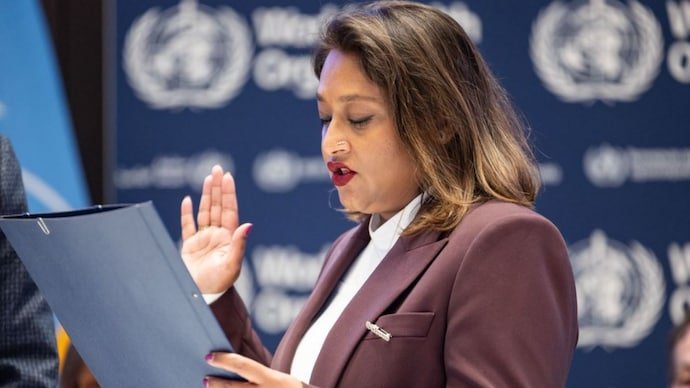
Saima Wazed, daughter of ousted Bangladesh Prime Minister Sheikh Hasina, has resigned as the World Health Organization’s regional director for South-East Asia amid ongoing investigations into allegations involving financial fraud, academic credentials and the acquisition of land in Bangladesh.
Wazed submitted her resignation to WHO Director-General Dr Tedros Adhanom Ghebreyesus on Wednesday, September 9, bringing an early end to a five-year term that began in February 2024. She had already been on unpaid administrative leave since July 2025 as scrutiny of her conduct intensified.
In her resignation letter, Wazed said she had lost trust and confidence in the WHO leadership and argued that she had been prevented from effectively carrying out her responsibilities. She also cited the financial strain of remaining without a salary for nearly a year.
Wazed has denied the allegations against her. She has described one disputed travel expense as an administrative error involving $901, defended the honorary doctorate that became part of the credentials dispute and said the property in Bangladesh was acquired before she joined the WHO.
Her resignation is now likely to accelerate the WHO’s process for choosing a new regional director, while the investigations and questions surrounding her tenure remain unresolved.
Why did Saima Wazed resign from the WHO?
Wazed’s resignation came after months of uncertainty over her future at the UN health agency.
She wrote that she had been elected to serve the countries of the WHO South-East Asia region but believed she had been prevented from effectively performing those responsibilities.
She also said she had lost “all trust and confidence” in Tedros’ leadership.
A second factor was financial. Wazed had been on unpaid administrative leave for an extended period, and she said the lack of remuneration had made her financial situation untenable.
The decision to resign therefore appears to have been driven by both professional and personal considerations: an increasingly difficult relationship with WHO leadership and the practical consequences of remaining suspended from active duties without pay.
Her departure, however, does not resolve the allegations. The issues that led to the investigation remain matters of dispute, and Wazed continues to deny wrongdoing.
Wazed had been on unpaid leave since July 2025
Saima Wazed took office as WHO South-East Asia regional director on February 1, 2024, for a five-year term.
The position is one of the WHO’s senior regional leadership roles. The South-East Asia region covers 11 countries and more than two billion people, making it one of the organisation’s largest and most strategically important regions.
Her tenure was interrupted in July 2025 when she was placed on unpaid administrative leave after Bangladesh’s Anti-Corruption Commission filed charges against her earlier that year.
Since then, Wazed has not been performing her normal duties as regional director. The WHO South-East Asia office has continued operating under interim arrangements, with another senior official serving as officer-in-charge.
The prolonged leave effectively left Wazed holding the title while unable to exercise the full authority of the position. Her resignation now ends that unusual arrangement.
What are the allegations against Saima Wazed?
The scrutiny surrounding Wazed covers several distinct issues rather than one single allegation.
Bangladeshi authorities have pursued allegations involving fraud and forgery, while the WHO has separately examined concerns relating to travel expenses and academic credentials.
The WHO has also raised questions about the acquisition of a plot of land in Bangladesh, according to Wazed’s resignation letter.
The allegations should not be treated as established facts. Wazed has denied wrongdoing, and the investigations and legal proceedings have not produced a final finding that she committed the alleged offences.
The distinction is particularly important because her resignation from the WHO is an administrative and professional decision, not a judicial determination of guilt.
The $901 China travel dispute
One of the allegations concerns a relatively small amount of money compared with the scale of the controversy: approximately $901 related to travel to china.
According to a letter from Wazed’s lawyers to the WHO dated July 3, 2026, the organisation had accused her of financial fraud connected to the trip.
Wazed rejected the allegation and said the disputed reimbursement resulted from an administrative oversight by an assistant who was handling routine travel-related claims.
Her argument is that the discrepancy was a procedural mistake rather than deliberate fraud.
That distinction would be central in any investigation because financial misconduct generally depends not only on whether an incorrect reimbursement occurred but also on intent, knowledge, authorization and the circumstances surrounding the transaction.
Wazed has said she has no further comment on the matter while the investigations continue.
The academic credentials controversy
A separate issue concerns Wazed’s academic credentials.
According to correspondence reviewed in connection with the case, the WHO questioned whether she had accurately represented aspects of her educational qualifications.
Wazed has denied misrepresentation. She has said that she holds an honorary doctorate linked to her work on autism in Bangladesh and that she had been transparent with Tedros about the nature of the qualification.
An honorary doctorate differs from an earned academic doctorate. Universities confer honorary degrees to recognize contributions, achievements or public service, and such awards do not ordinarily signify that the recipient completed a doctoral research programme.
That distinction appears to be relevant to the credentials dispute involving Wazed.
Her defence is that there was no attempt to conceal the nature of the qualification. The WHO’s concerns, however, became part of the broader review of her conduct.
Land acquisition in Bangladesh is also under scrutiny
The third major issue concerns a plot of land in Bangladesh.
According to Wazed’s resignation letter, the WHO accused her of illegally acquiring the property.
Wazed denied the allegation and said the property had been acquired before she joined the WHO. She also argued that she was entitled to receive the land under a Bangladeshi law relating to the families of Sheikh Mujibur Rahman, Bangladesh’s founding leader and her maternal grandfather.
The timing is important. If the acquisition occurred before her appointment to the WHO, the dispute is less about a transaction made while serving as a UN official and more about the legality and circumstances of the property itself.
That does not automatically settle the issue, however. The relevant Bangladeshi law, eligibility criteria and documentation remain matters for the authorities to examine.
Bangladesh’s political upheaval forms the wider backdrop
Wazed’s case cannot be separated entirely from the political transformation that followed the fall of her mother’s government.
Sheikh Hasina was ousted in 2024 after a deadly uprising and subsequently left Bangladesh for India, where she has remained in self-imposed exile.
Since then, Bangladesh’s interim authorities have pursued a range of legal and corruption cases involving figures associated with Hasina’s Awami League government.
Several former officials and political allies have faced investigations or criminal proceedings. The new authorities have also been examining allegations surrounding the former government, including corruption and abuse of power.
Wazed has not been a politician or government minister, but her family connection to Hasina has inevitably made her position more politically sensitive.
That does not establish that the allegations against her are politically motivated. It does, however, explain why her case has attracted attention well beyond the WHO’s internal procedures.
Why Wazed’s WHO position was especially significant
The WHO regional director for South-East Asia oversees one of the agency’s largest regional operations.
The region includes countries with enormous and diverse health challenges, ranging from Infectious Diseases and maternal health to non-communicable diseases, Mental health, disaster preparedness and health-system capacity.
Regional directors also have an important role during health emergencies, coordinating WHO responses to outbreaks and helping translate global health priorities into regional programmes.
Wazed’s resignation therefore creates a leadership vacancy at a significant institution rather than merely ending a personal employment dispute.
The incoming regional director will inherit a region with more than two billion people and a wide range of public-health pressures.
How is the WHO South-East Asia region currently being managed?
With Wazed on leave, the WHO had already put temporary leadership arrangements in place.
Dr Nilesh Buddha has been serving as officer-in-charge of the South-East Asia regional office since August 17, 2026.
The arrangement allowed the office to continue its regular functions despite the prolonged absence of the regional director.
Wazed’s resignation now makes a permanent replacement necessary.
That could simplify the organisation’s leadership structure, but it also begins another politically important election process involving the member states of the South-East Asia region.
WHO regional directors are elected, not simply appointed
The regional director position is different from an ordinary senior WHO staff appointment.
Regional directors are elected every five years by member states in their respective regions. In the South-East Asia region, that includes Bangladesh and India among the countries taking part in the process.
According to people familiar with the matter, the WHO was preparing for a new election even before Wazed resigned.
Nominations are expected to open in October, applications will undergo scrutiny later in the year, and an election is planned for January 2027.
The process means Wazed’s resignation does not leave the WHO without a clear institutional mechanism for replacing her. Member states will ultimately determine who takes over the position for the remainder of the leadership cycle.
Why the timing of the replacement matters
A leadership transition at a regional WHO office can affect priorities, diplomatic relationships and the pace of large public-health initiatives.
The South-East Asia region faces persistent health challenges that require long-term programmes rather than short political cycles.
These include infectious disease surveillance, vaccination, antimicrobial resistance, mental health, climate-related health threats and the growing burden of chronic illnesses such as Diabetes and cardiovascular disease.
The next regional director will therefore have to balance continuity with the need to restore confidence after a highly public leadership controversy.
The WHO will also want the selection process to be credible enough that the new office can focus on health policy rather than the circumstances surrounding its predecessor.
Wazed says she lost confidence in WHO leadership
Wazed’s resignation letter contains unusually strong criticism of the WHO’s top leadership.
She argued that she had tried to serve the member states of the region sincerely but was prevented from carrying out her duties.
Her declaration that she had lost trust and confidence in Tedros makes clear that the resignation was not presented as a routine retirement or voluntary career move.
The financial consequences of being on unpaid leave also appear to have played a major role.
For nearly a year, Wazed said she had received no remuneration from the WHO, leaving her finances under unsustainable pressure.
The letter therefore presents her departure as a decision reached after a prolonged breakdown in her working relationship with the organisation.
WHO has been cautious about the allegations
The WHO has not publicly released a detailed account of its internal investigation into Wazed.
When asked about the case, the organisation has referred to confidentiality and declined to discuss individual personnel matters in detail.
That approach is common in employment and disciplinary proceedings, particularly at international organisations where staff privacy rules can restrict the publication of investigative material.
It also means that much of the public understanding of the allegations has come through Wazed’s legal correspondence, resignation letter and reporting based on those documents.
As a result, some details remain contested or unavailable publicly.
Resignation does not end the underlying investigations
Wazed’s departure from the WHO does not necessarily terminate every investigation related to her conduct.
The organisation may still need to close or document its internal proceedings, while Bangladeshi authorities can continue their own legal processes independently.
Her resignation also does not determine whether any alleged wrongdoing occurred.
That will depend on evidence and, where applicable, the decisions of courts or competent authorities.
This is especially important because the allegations span two different jurisdictions and involve both an international organisation and Bangladeshi institutions.
Why the WHO case is attracting international attention
The controversy has gained attention because Wazed occupied one of the WHO’s most senior regional positions while being the daughter of a recently removed head of government.
The combination of political family ties and allegations involving public institutions creates a natural focus on questions of accountability and conflicts of interest.
International organizations such as the WHO rely heavily on perceptions of neutrality and institutional integrity. Senior officials are therefore expected to meet high standards for financial conduct, transparency and disclosure.
At the same time, allegations against senior figures must be handled according to evidence rather than assumptions about their political background.
Wazed’s case sits directly at that intersection.
Her role in autism advocacy remains part of her public profile
Before joining the WHO, Wazed became particularly known for her work on autism and mental health in Bangladesh.
She served as an adviser to the WHO director-general on mental health and autism before becoming regional director. She also chaired Bangladesh’s National Advisory Committee on Autism and Neurodevelopmental Disorders.
Her work in this area helped establish an international profile separate from her family’s political influence.
That background is also relevant to the credentials dispute because Wazed’s explanation of her honorary doctorate is linked to her contributions in autism advocacy.
Her supporters have emphasized her public-health work, while critics have focused more heavily on the allegations surrounding her appointment and conduct.
Wazed’s election itself drew scrutiny
Wazed was elected WHO regional director for South-East Asia in November 2023, taking office in February 2024.
Her election attracted criticism in Bangladesh because of her relationship with Sheikh Hasina, with opponents questioning whether the government at the time had used its influence to support her candidacy.
The WHO has previously maintained that regional directors are elected by member states through a formal voting process.
The controversy surrounding her selection became more significant after the fall of Hasina’s government, when questions about individuals associated with the former administration were subjected to renewed scrutiny.
That political background is part of the context of the current case, but it does not itself establish the allegations that led to her leave or resignation.
What happens to the WHO South-East Asia leadership now?
Wazed’s resignation leaves the regional office preparing for a new election rather than simply restoring her authority.
The selection process is expected to involve nominations in October, screening of candidates later in the year and a vote in January 2027.
The eventual winner will take over a region where the WHO is responsible for supporting 11 member states and coordinating policies across a population exceeding two billion.
The new director will also inherit the institutional consequences of the controversy and may face pressure to demonstrate stronger transparency and accountability at the regional office.
Why this is bigger than a resignation
Saima Wazed’s departure matters on several levels.
For the WHO, it closes a prolonged leadership crisis in one of its biggest regions. For Bangladesh, it adds another prominent figure connected to the former Hasina administration to the list of people facing scrutiny. For international organizations, it raises familiar questions about how senior officials should be investigated and how allegations should be handled without compromising either accountability or due process.
And for Wazed herself, the resignation marks the premature end of a five-year mandate that was supposed to run until 2029.
The unusual circumstances surrounding her departure make it unlikely that the controversy will disappear simply because she has left office.
A leadership controversy involving both WHO and Bangladesh
Wazed’s case brings together several separate strands: alleged financial misconduct, disputed academic credentials, a property controversy, the political fallout from Sheikh Hasina’s removal and internal disagreement with WHO leadership.
None of these issues should be automatically treated as proven simply because they appear in an investigation. Wazed has denied the allegations and has offered specific explanations for the disputed travel expense, academic qualification and land acquisition.
At the same time, her resignation means the allegations can no longer be viewed simply as an unresolved personnel dispute inside the WHO. The organisation must now transition to a new regional director while Bangladesh’s legal authorities continue their own processes.
The case also demonstrates how quickly questions surrounding a senior international official can become entangled with domestic political change.
What the resignation means for Sheikh Hasina’s family and allies
Wazed’s departure comes amid a broader reckoning following the end of Hasina’s long period in power.
Many former officials and political allies have faced investigations and criminal cases since the 2024 upheaval. Hasina herself remains outside Bangladesh and faces multiple legal proceedings announced by authorities in the country.
Wazed was not a member of her mother’s government, but her prominent position at the WHO meant that she remained a visible international figure with a direct family connection to the former prime minister.
Her case therefore carries both institutional and political symbolism.
It also reinforces the challenge faced by international organisations when senior officials have prominent political family backgrounds. The distinction between personal achievement and political association can become difficult to maintain when allegations arise.
The road ahead for Saima Wazed
Wazed’s next steps remain uncertain.
Her resignation removes her from the WHO regional director position but does not settle the allegations against her. She could continue to contest the claims through legal or administrative channels, particularly in Bangladesh.
Her public work in mental health and autism may also remain part of her professional identity, regardless of the outcome of the current investigations.
For now, however, her political and institutional circumstances have fundamentally changed.
WHO now faces the task of restoring stability
The immediate priority for the WHO is to ensure continuity in the South-East Asia region while the organisation prepares for a new election.
The regional office cannot afford a prolonged leadership vacuum because its responsibilities include public-health emergencies, disease surveillance and coordination across a region containing some of the world’s most populous countries.
The interim leadership arrangement provides continuity in the short term, but a permanent director will eventually need to be chosen by the member states.
The election will be closely watched because the next regional director will not only inherit a major public-health portfolio but also take charge after a leadership controversy that has placed questions of Governance and credibility under a global spotlight.
Saima Wazed’s WHO tenure ends under a cloud of allegations
Saima Wazed’s resignation brings an early end to her tenure as WHO South-East Asia regional director, a position she began in February 2024 with a five-year mandate.
Her resignation follows more than a year on unpaid administrative leave and comes amid investigations by both the WHO and Bangladeshi authorities. The allegations concern financial fraud related to a China trip, questions over her academic credentials and the acquisition of property in Bangladesh.
Wazed has denied the allegations and has provided explanations for each of the issues raised. She says the $901 travel matter was an administrative oversight, that she disclosed the honorary nature of her doctorate and that the land was acquired before she joined the WHO under a law she says covered the families of Sheikh Mujibur Rahman.
Her resignation letter also makes clear that relations with the WHO leadership had deteriorated. She said she had lost confidence in Tedros and could no longer sustain the financial consequences of remaining on unpaid leave.
The next chapter will now shift toward the investigation process and the election of a successor. The WHO is expected to begin nominations for the regional director’s post in October, with a new election planned for January 2027.
The episode is ultimately a test of more than one official’s career. It is a test of how a major international health organisation handles allegations against senior leadership, how member states choose regional officials and how accountability is maintained when global institutions become entangled with the political upheavals of individual countries.
For Wazed, the resignation closes a turbulent chapter. For the WHO, it begins the process of rebuilding stable leadership in a region responsible for the health of more than two billion people.
For breaking news and live news updates, like us on Facebook or follow us on Twitter and Instagram. Read more on Latest World on thefoxdaily.com.




COMMENTS 0