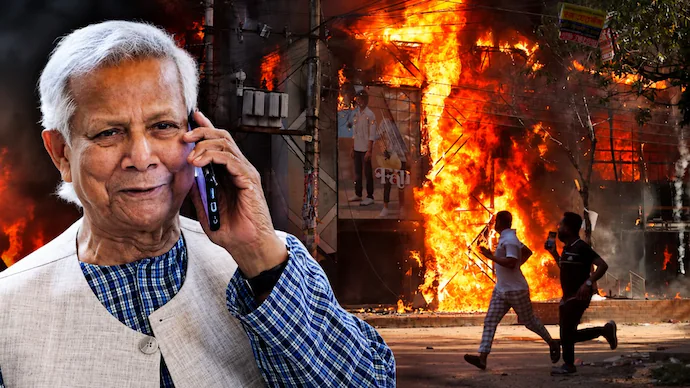
A journalist working for French news agency Agence France-Presse (AFP) reportedly helped student protest leaders establish contact with Nobel laureate Muhammad Yunus before Bangladesh Prime Minister Sheikh Hasina left the country on August 5, 2024. The account has emerged from Shafiqul Alam, a former AFP Dhaka bureau chief who later served as Yunus’s press secretary.
In a Facebook post dated October 28, Alam identified Qadaruddin Shishir, who worked in AFP’s Dhaka fact-checking department, as the intermediary who facilitated the initial communication between the student leaders and Yunus. According to Alam, Shishir approached Yunus on behalf of the protesters when they wanted him to lead a possible interim government after Hasina’s departure.
The account has renewed discussion about the sequence of events leading to the formation of Bangladesh’s interim administration. However, Alam’s statements describe the role he attributes to Shishir and do not, by themselves, establish that the wider protest movement was part of a coordinated regime-change operation.
What Shafiqul Alam Revealed About Qadaruddin Shishir
Alam said the student leaders needed a trusted intermediary to reach Yunus as the protests against Hasina’s government intensified in July and August 2024. He credited his AFP colleague with taking on that responsibility.
In his Facebook post, Alam described Shishir as a bridge-builder who helped connect the student leaders with the Nobel Peace Prize winner. He said Shishir worked quietly on the communication while continuing his responsibilities at AFP’s Dhaka office.
Alam also said Shishir sat approximately a yard away from him in the newsroom and managed the sensitive effort discreetly. According to Alam, Shishir made the initial approach to Yunus and facilitated the first discussions between the two sides.
The former press secretary characterised the operation as high-stakes, arguing that the political circumstances made secrecy important. He suggested that discovery by the Hasina government could have put Shishir and the wider AFP team at risk.
Alam further stated that Shishir began collecting video evidence of killings during the government’s crackdown on the protests. These details form part of Alam’s account; the Facebook post alone does not independently verify every allegation or establish the full extent of Shishir’s involvement in the political transition.
How the July-August 2024 Protests Led to Hasina’s Departure
The demonstrations began as a student-led movement against government job quotas before expanding into a wider challenge to Hasina’s administration. As unrest escalated, security forces and protesters were involved in deadly confrontations, and calls for the government’s resignation grew.
Hasina left Bangladesh on August 5, 2024, as the protests reached a decisive point. She travelled to India, where she has remained in exile in Delhi, according to the supplied report.
The student movement’s emergence as a major political force and the speed of the subsequent transition prompted debate about the planning, organisation and competing interests behind the protests. Alam’s account adds a specific detail to that discussion by describing an effort to contact Yunus before Hasina’s departure.
Nevertheless, establishing contact with a potential head of an interim government before a political transition does not, on its own, prove that the entire protest movement was orchestrated in advance. The extent of any advance planning would require corroborating evidence beyond the account of a single participant or observer.
Student Leaders Proposed Yunus After Hasina Left
On August 6, 2024, a day after Hasina’s departure, student protest leaders publicly proposed Muhammad Yunus as the head of an interim administration. The announcement involved student leaders including Nahid Islam and Asif Mahmud, both of whom later served as advisers in the interim government.
Yunus returned to Bangladesh from Paris on August 8, 2024, arriving at Hazrat Shahjalal International Airport in Dhaka. He subsequently took charge as chief adviser to the interim government.
The sequence of events is central to the questions raised by Alam’s disclosure. According to his account, the initial contact between Yunus and the student leaders began before Hasina left the country. The public proposal followed on August 6, and Yunus arrived in Dhaka two days later.
While these events establish the broad timeline described in the report, the precise nature of the discussions before August 5 and the decisions made during them would need further documentation to establish how the transition was organised.
Yunus Previously Described the Protests as Carefully Designed
In September 2024, during an event in New York, Yunus introduced his special assistant Mahfuz Alam as the “brain behind the whole revolution,” according to the supplied report.
Yunus also described the movement as carefully organised rather than an entirely spontaneous development. Speaking about the July-August protests, he said:
“It’s amazing. Meticulously designed thing. It’s not just suddenly came. It’s not like that. Very well-designed. Even the leadership pattern. People don’t know who the leader is. So you can’t catch one and say, okay, it’s over. It’s not over.”
His remarks have featured in discussions about the organisation and leadership of the protests. However, describing a movement as carefully designed does not independently establish who planned it, what specific arrangements were made or whether the protests were directed by a single group.
The account of Shishir’s role provides another element of the timeline, but further evidence would be needed to determine the full scope of contacts between student leaders, Yunus and other political actors before Hasina’s departure.
What Is Aynaghar, Mentioned in Alam’s Account?
Alam referred to Aynaghar while describing the risks he believed Shishir faced during the final days of Hasina’s government. The term, commonly translated as “House of Mirrors,” has been associated with allegations of secret detention and abuse in Bangladesh.
Former detainees and critics of the Hasina administration have linked the name to allegations of enforced disappearances and secret confinement. Alam said he feared that Shishir and the AFP team could have faced serious consequences if the government had discovered their communications with the student leaders.
His reference illustrates the security concerns he associated with the political environment at the time. It remains his account of the risks surrounding the reported contact rather than independent proof of what would have happened if the discussions had been discovered.
Sheikh Hasina Says She Plans to Return to Bangladesh
The disclosure comes amid continuing political developments involving Hasina’s future. According to the supplied report, she said during an online event on October 19 that she intended to return to Bangladesh in December.
“I will go back to Bangladesh in December,” Hasina said. She also stated that she was not afraid despite the possibility of arrest, torture or being killed.
Her comments came after she left Bangladesh on August 5, 2024, during the mass protests that brought an end to her tenure as prime minister. Her prospective return remains a politically sensitive issue amid the country’s changing leadership and ongoing disputes over the events surrounding her departure.
Former Air Force Officer’s Death Raises Separate Questions
The supplied report also describes the death of former Bangladesh Air Force officer Flight Lieutenant KM Tahsif Souri, whose family has alleged murder. His body was reportedly found in a river in Dhaka on October 28.
Souri, who was 28, was reportedly linked to footage showing Hasina leaving the country on August 5, 2024. The clip allegedly showed her switching from cars to a helicopter during her departure. According to the report, Souri had been dismissed from service in August 2024.
His family’s allegation raises questions about the circumstances of his death, but the information provided does not establish the cause of death or demonstrate that it was connected to the footage or the political transition. Any such connection would require independent evidence and findings from an investigation.
What Happened to the Leaders of the Protest Movement?
Several student leaders who played prominent roles in the anti-Hasina movement later joined Yunus’s interim administration. Some subsequently formed the National Citizen Party (NCP), which, according to the supplied report, contested elections as part of an alliance involving Jamaat.
The movement’s transition from street protests to participation in government and electoral politics marked a significant development in Bangladesh’s post-Hasina political landscape. The roles of former protest leaders in the interim administration also placed them at the centre of debates about the country’s political future.
The timeline surrounding Yunus’s appointment, the participation of student leaders in the interim government and the emergence of the NCP helps explain why the reported pre-departure communication has attracted attention. However, the political consequences of these developments should be distinguished from claims about the intentions or coordination of individual actors.
What the AFP Journalist Revelation Does and Does Not Establish
Alam’s account provides a specific claim about how Yunus was approached by student protest leaders before Hasina left Bangladesh. It identifies Shishir as the intermediary and describes the communication as a confidential effort undertaken during a period of political uncertainty.
The disclosure also adds context to the events that followed: student leaders publicly proposed Yunus on August 6, 2024, and he arrived in Dhaka on August 8 before assuming leadership of the interim administration.
However, several questions remain unanswered by the account alone. The supplied material does not provide independent records of the initial communications, details of the discussions between Yunus and the student leaders, or evidence establishing the involvement of every group alleged to have influenced the protests.
For that reason, the reported role of an AFP journalist is a relevant detail in reconstructing the political transition, but it should not be treated as conclusive proof that the entire movement was a pre-planned regime-change operation. Establishing that broader claim would require independently corroborated evidence about the planning, participants and objectives of the events leading to Hasina’s departure.
About the Author
Sushim Mukul
Sushim Mukul is a keen observer with interests in politics, geopolitics, culture and heritage.
Separate the unrelated developments Tighten repeated qualifications Reduce speculative political framing
For breaking news and live news updates, like us on Facebook or follow us on Twitter and Instagram. Read more on Latest World on thefoxdaily.com.



COMMENTS 0