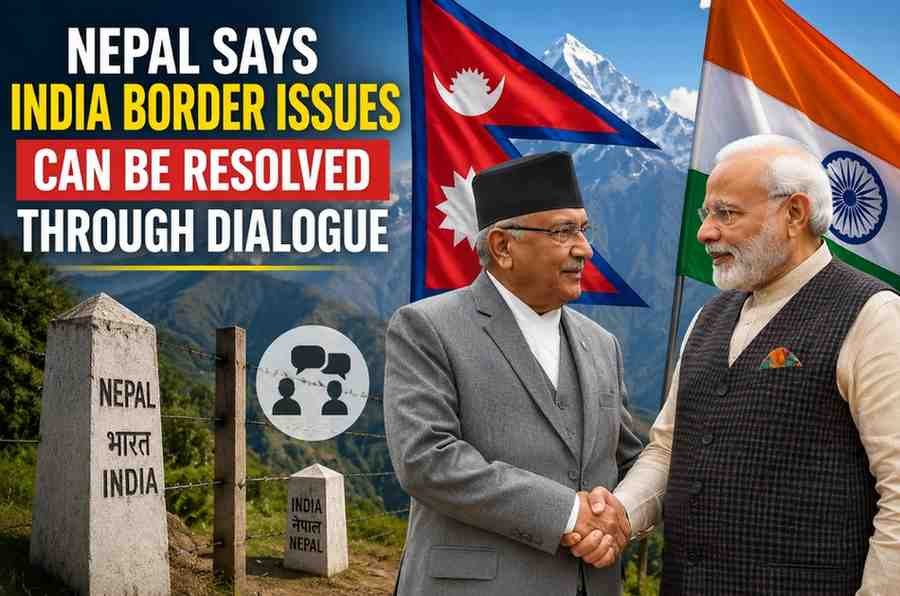
Nepal has once again emphasized that its border disputes with India should be resolved through peaceful diplomatic engagement, historical evidence, and existing bilateral mechanisms. Speaking before Nepal’s Upper House of Parliament, Foreign Minister Shishir Khanal reiterated that while disagreements over territories such as Kalapani, Lipulekh, Limpiyadhura, and Susta remain unresolved, both countries possess the institutional framework necessary to reach mutually acceptable solutions.
The remarks come at an important time in South Asian Geopolitics. India and Nepal share one of the world’s most unique international borders an open frontier stretching over 1,850 kilometers that facilitates unrestricted movement of citizens, deep cultural exchanges, religious tourism, and extensive economic cooperation. Despite these close ties, unresolved territorial claims continue to test bilateral relations periodically.
With the next meeting of the India-Nepal border working mechanism expected soon, Kathmandu’s latest statement signals an attempt to keep diplomatic channels active while avoiding escalation. For both countries, maintaining stability along their shared frontier is becoming increasingly important amid shifting regional geopolitical dynamics.
Why the India-Nepal Border Issue Continues to Matter
The border dispute between India and Nepal is not a recent development. It is rooted in differing interpretations of historical treaties, colonial-era maps, river boundaries, and changing geographical features.
The most prominent disputed areas include:
- Kalapani – A strategically important Himalayan region administered by India but claimed by Nepal.
- Lipulekh Pass – A vital mountain pass connecting India with Tibet that also serves as an important route for the Kailash Mansarovar pilgrimage.
- Limpiyadhura – Claimed by Nepal as the true origin of the Mahakali River, making it central to Nepal’s territorial claim.
- Susta – A lowland border area where changes in the course of the Gandak River have complicated boundary demarcation.
Unlike many international border disputes driven by military confrontation, the India-Nepal disagreement largely revolves around historical cartography, legal interpretation, and differing readings of treaties signed during the British colonial period.
Understanding the Historical Background
The foundation of today’s dispute can be traced to the Treaty of Sugauli signed in 1816 following the Anglo-Nepalese War. The treaty established the Mahakali River as the western boundary between Nepal and British India.
The principal disagreement concerns identifying the true source of the Mahakali River. Nepal argues that the river originates from Limpiyadhura, placing Kalapani and Lipulekh within Nepalese territory. India maintains that the river begins further east, resulting in different boundary interpretations.
Because historical maps produced during different periods vary considerably, both governments rely on separate documentary evidence to support their claims.
Timeline of the India-Nepal Border Dispute
| Year | Major Development |
|---|---|
| 1816 | Treaty of Sugauli defines Nepal’s western boundary. |
| 1962 | India strengthens security presence in Kalapani following the India-China war. |
| 1990s | Bilateral technical committees begin examining border demarcation. |
| 2020 | India inaugurates Lipulekh road; Nepal issues a revised political map including Kalapani, Lipulekh and Limpiyadhura. |
| 2024-2025 | Diplomatic engagement resumes through bilateral mechanisms. |
| 2026 | Nepal reiterates commitment to resolving disputes through dialogue. |
What Nepal’s Foreign Minister Said
Foreign Minister Shishir Khanal acknowledged that border disagreements exist but stressed that both governments possess functioning diplomatic mechanisms capable of resolving them peacefully.
According to Nepal, historical documents, official maps, and bilateral negotiations should form the basis for any settlement. The minister also confirmed that the next meeting of the bilateral border working committee is expected to take place soon, keeping negotiations active.
The statement reflects Kathmandu’s continued preference for diplomacy despite political sensitivities surrounding territorial claims.
India’s Position on the Border Dispute
India has consistently maintained that disputes involving Kalapani, Lipulekh, and Limpiyadhura should be addressed exclusively through bilateral dialogue.
New Delhi considers these territories part of Uttarakhand and has repeatedly rejected proposals involving third-party mediation. India’s long-standing diplomatic position is that all outstanding issues with Nepal can be settled through established bilateral mechanisms.
India has also emphasized the importance of preserving the broader strategic partnership with Nepal despite periodic disagreements over specific border segments.
Why the Open Border Makes the Relationship Unique
The India-Nepal relationship differs significantly from most international borders.
Citizens of both countries can travel across the border without passports or visas under long-standing bilateral arrangements. Millions of Nepalese live and work in India, while Indian businesses maintain significant investments in Nepal.
The two nations also cooperate extensively in:
- Trade and commerce
- Hydropower development
- Cross-border infrastructure
- Energy transmission
- Education and healthcare
- Religious tourism
- Disaster management
- Security cooperation
This deep integration explains why both governments generally avoid allowing border disputes to derail broader diplomatic relations.
The Strategic Importance of Kalapani and Lipulekh
The disputed Himalayan regions possess strategic value beyond historical claims.
Lipulekh Pass serves as one of the important mountain crossings between India and the Tibet Autonomous Region of china. It also provides one of the main routes for pilgrims travelling to Mount Kailash and Lake Manasarovar.
Kalapani occupies a high-altitude location overlooking sensitive Himalayan terrain, making it strategically significant from a security perspective.
Given the broader regional security environment, control over these areas carries implications that extend beyond bilateral boundary management.
The Susta Dispute: A Different Kind of Border Challenge
Unlike the Himalayan disputes, Susta illustrates a different border problem.
Located in Nepal’s southern plains, Susta has been affected by changes in the course of the Gandak River over several decades.
River boundaries often shift naturally because of flooding, erosion, and sediment deposition. Such geographical changes create complications in determining where the international boundary should lie, making Susta primarily a river-boundary management issue rather than a strategic territorial dispute.
How Bilateral Mechanisms Work
India and Nepal have established several institutional mechanisms to address border matters.
These include:
- Joint Boundary Working Groups
- Survey teams
- Joint Technical Committees
- Foreign Secretary-level discussions
- Joint Commission meetings
- Regular diplomatic consultations
These platforms allow experts, surveyors, diplomats, and policymakers to examine historical records, verify maps, conduct field surveys, and recommend practical solutions.
Although progress is often gradual, these mechanisms have successfully resolved most sections of the India-Nepal boundary over the past several decades.
Economic Stakes Are Too High for Prolonged Tensions
India remains Nepal’s largest trading partner, one of its biggest investors, and a major source of development assistance.
Cross-border trade supports thousands of businesses, while energy cooperation has expanded significantly through electricity exports and power transmission projects.
Modern connectivity initiatives including highways, rail links, integrated check posts, and petroleum pipelines have further strengthened economic integration.
Any prolonged diplomatic tension could affect investor confidence, logistics, tourism, and regional development projects, making dialogue the preferred option for both governments.
China’s Growing Presence Adds Regional Complexity
Although Nepal’s latest statement focuses exclusively on India, regional geopolitical competition increasingly shapes South Asian diplomacy.
China has expanded infrastructure investment, connectivity projects, and economic engagement with Nepal over the past decade. This broader regional context makes India-Nepal relations strategically important beyond bilateral border management.
For Kathmandu, maintaining balanced relations with both neighboring powers remains an important foreign Policy objective.
For New Delhi, preserving stable relations with Nepal is equally important for regional security, connectivity, and Himalayan cooperation.
Public Sentiment and Domestic Politics
Border issues often carry strong emotional significance in both countries.
In Nepal, territorial sovereignty remains a politically sensitive issue across party lines. Similarly, Indian policymakers view the disputed regions through both historical and National Security perspectives.
As a result, governments on both sides must carefully balance domestic political expectations with diplomatic pragmatism.
This explains why negotiations tend to move slowly even when diplomatic engagement remains constructive.
Why Dialogue Remains the Most Practical Solution
International experience demonstrates that boundary disputes involving friendly neighbors are usually resolved through sustained negotiations rather than unilateral actions.
Given the extensive people-to-people connections, economic interdependence, and security cooperation between India and Nepal, diplomacy remains the least disruptive and most sustainable path.
The fact that both governments continue participating in institutional dialogue indicates that neither side views military escalation or confrontation as a viable option.
Future Outlook: Can India and Nepal Reach a Lasting Settlement?
While a comprehensive settlement is unlikely in the immediate future, recent diplomatic messaging suggests both governments remain committed to keeping communication channels open.
The upcoming meetings between bilateral border committees may not produce dramatic breakthroughs, but incremental progress such as additional surveys, confidence-building measures, and technical consultations could gradually narrow differences.
As regional geopolitics continue evolving, maintaining a stable India-Nepal relationship will become even more important. Border disputes are likely to remain part of bilateral discussions, but they need not define the overall relationship.
Ultimately, Nepal’s renewed emphasis on dialogue reflects a broader recognition that peaceful negotiations, historical evidence, and institutional cooperation offer the strongest foundation for resolving one of South Asia‘s longest-running boundary disagreements while preserving an otherwise close and mutually beneficial partnership.
For breaking news and live news updates, like us on Facebook or follow us on Twitter and Instagram. Read more on Latest World on thefoxdaily.com.






COMMENTS 0