- Why the India-US Economic Relationship Matters More Than Ever
- India as a “Trusted Partner” in a Fragmented Global Economy
- The $60 Billion Signal: Why American Companies Are Investing Heavily in India
- India and the US as “Natural Partners”
- India’s Shift From Assembly to Innovation
- Why Global Capability Centres Are Becoming Important
- The Manufacturing Push and the Bhavya Scheme
- Why MSMEs Are Central to India’s Global Ambitions
- The Seven-Day Payment Suggestion: Why It Matters
- India’s Long-Term Growth Story and the 2047 Vision
- The Geopolitical Angle Behind the Partnership
- Conclusion
The India-US relationship is no longer defined only by Diplomacy or defence cooperation. It is increasingly becoming an economic partnership built on technology, manufacturing, Innovation, digital infrastructure, and long-term strategic trust.
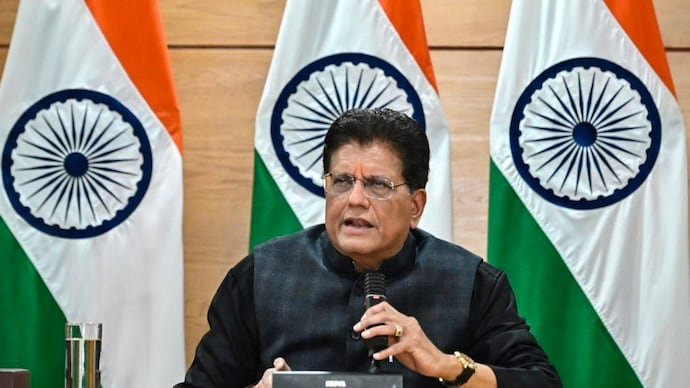
That was the central message delivered by Union Commerce and Industry Minister Piyush Goyal during the Annual Leadership Summit of the American Chamber of Commerce in India held in New Delhi.
According to Goyal, India and the United States are now working “more closely than ever,” supported by mutual confidence, shared economic interests, and complementary strengths rather than direct competition.
His remarks come at a crucial moment in the Global Economy when multinational corporations are actively reassessing supply chains, reducing dependence on single-country manufacturing hubs, and searching for stable long-term investment destinations.
India is positioning itself as one of the biggest beneficiaries of that global shift.
And Washington’s growing strategic alignment with New Delhi is accelerating the process.
Why the India-US Economic Relationship Matters More Than Ever
The partnership between India and the United States has evolved dramatically over the past two decades.
What was once a relationship focused largely on geopolitical balancing has transformed into one of the world’s most important strategic-economic partnerships.
Today, cooperation spans multiple high-growth sectors:
- Technology
- Artificial intelligence
- Defence manufacturing
- Semiconductors
- Digital infrastructure
- Renewable energy
- Healthcare
- Supply chains
- Quantum computing
Goyal’s speech reflects a broader reality: the global economy is entering a phase where trusted partnerships matter as much as low-cost manufacturing.
Countries are increasingly prioritizing reliability, political stability, talent availability, and strategic alignment.
India is attempting to position itself at the center of that transition.
India as a “Trusted Partner” in a Fragmented Global Economy
One of the most important themes in Goyal’s speech was trust.
That word carries enormous significance in today’s geopolitical climate.
Global businesses are dealing with:
- Supply Chain disruptions
- Trade tensions
- Geopolitical conflicts
- Technology restrictions
- Rising protectionism
- Economic uncertainty
As a result, multinational corporations are increasingly searching for dependable long-term partners.
India’s pitch to global investors is becoming clear:
It offers political continuity, a large domestic market, skilled labor, democratic institutions, digital infrastructure, and growing manufacturing ambitions.
Goyal emphasized that India consistently delivered during global crises, reinforcing perceptions of reliability among international businesses.
This narrative is especially important as companies pursue “china Plus One” strategies to diversify production and reduce overdependence on a single manufacturing geography.
The $60 Billion Signal: Why American Companies Are Investing Heavily in India
According to Goyal, commitments from American companies over the last six months alone are estimated to exceed $60 billion.
That figure reflects growing confidence in India’s long-term economic trajectory.
Major technology giants including Amazon and Google are significantly expanding their presence in India, especially in areas like:
- Data centres
- Cloud infrastructure
- Artificial intelligence
- Digital services
- Consumer technology ecosystems
These investments matter because they are not merely financial transactions.
They represent strategic bets on India’s future as both a massive consumer market and a global technology hub.
| Key Areas of India-US Economic Collaboration | Why They Matter |
|---|---|
| Technology & AI | Innovation, digital transformation, future industries |
| Defence Manufacturing | Strategic security cooperation and local production |
| Data Centres | Digital economy expansion and cloud infrastructure |
| Semiconductors | Supply chain diversification and chip resilience |
| Healthcare & Medical Devices | Growing demand and research collaboration |
| Renewable Energy | Clean energy transition and climate goals |
India and the US as “Natural Partners”
Goyal described India and the United States as “natural partners,” arguing that the two countries complement each other rather than compete directly in many strategic sectors.
This is a key distinction.
India offers:
- A massive skilled workforce
- Large-scale manufacturing potential
- Rapidly expanding domestic demand
- Digital infrastructure at scale
- Cost-efficient innovation ecosystems
The United States brings:
- Advanced research capabilities
- Global capital
- Cutting-edge technology
- High-end innovation ecosystems
- Strategic defence expertise
Together, these strengths create powerful opportunities for collaboration.
This is especially visible in emerging sectors like quantum computing, aerospace, semiconductor manufacturing, and advanced defence systems.
India’s Shift From Assembly to Innovation
One of the most strategically important points in Goyal’s speech was India’s effort to move beyond low-cost assembly work.
For years, India was often viewed primarily as a services economy or back-office destination.
That perception is now changing.
According to Goyal, global firms are increasingly choosing India not only for manufacturing, but also for:
- Research and development
- Product design
- Intellectual property creation
- Global capability centres (GCCs)
- Engineering innovation
This shift is critical for India’s long-term economic ambitions.
Countries achieve higher-value economic growth when they move up the value chain from simple assembly into design, innovation, and proprietary technology development.
The rise of Global Capability Centres in India reflects this transformation.
Instead of merely outsourcing support functions, multinational companies are increasingly locating strategic operations, engineering teams, and innovation hubs inside India.
Why Global Capability Centres Are Becoming Important
India has become one of the world’s largest hubs for GCCs.
These centers are no longer limited to customer support or IT maintenance.
Today, many GCCs handle:
- AI development
- Cybersecurity
- Product engineering
- Financial analytics
- Semiconductor design
- Enterprise innovation
This matters because GCCs create higher-paying jobs and deepen integration with global value chains.
For multinational firms, India is increasingly becoming a strategic operations base rather than simply a low-cost labor destination.
The Manufacturing Push and the Bhavya Scheme
Goyal also outlined India’s manufacturing ambitions through the proposed Bhavya scheme.
The initiative aims to create 100 industrial parks across the country through area-based industrial development.
Unlike traditional industrial zones focused only on factories, the proposed model seeks to build integrated industrial ecosystems including:
- Worker housing
- Recreational facilities
- Social infrastructure
- Transportation connectivity
- Industrial support systems
This reflects a broader global lesson: manufacturing competitiveness increasingly depends on complete ecosystem development rather than isolated production units.
Countries that succeed in advanced manufacturing typically combine Logistics, housing, talent, infrastructure, and supply chain networks efficiently.
Why MSMEs Are Central to India’s Global Ambitions
Another major focus of Goyal’s speech was India’s micro, small and medium enterprises (MSMEs).
MSMEs form the backbone of India’s employment ecosystem, but many struggle to integrate into global supply chains.
Goyal said the proposed Export Promotion Mission would help smaller businesses secure international certifications necessary for participation in global manufacturing networks.
This is an important challenge.
Global supply chains increasingly demand:
- Quality certification
- Compliance standards
- Traceability systems
- Environmental standards
- Technology integration
Without these, smaller firms often remain excluded from international markets.
Helping MSMEs upgrade operational standards could significantly expand India’s export capacity.
The Seven-Day Payment Suggestion: Why It Matters
Goyal also urged larger corporations to clear MSME dues within seven days after goods approval.
Though seemingly technical, this issue is extremely important.
Delayed payments are one of the biggest financial challenges facing small businesses in India.
When large companies delay payments:
- Cash flow weakens
- Production slows
- Employment suffers
- Borrowing increases
- Growth becomes difficult
Faster payments could significantly improve MSME stability and productivity.
In many advanced economies, prompt-payment frameworks are increasingly viewed as essential for healthy industrial ecosystems.
India’s Long-Term Growth Story and the 2047 Vision
Goyal expressed confidence that India could remain the world’s fastest-growing major economy for the next 25 years.
That optimism is tied to India’s broader “Viksit Bharat 2047” vision the goal of becoming a developed nation by the centenary of independence.
India’s growth strategy currently revolves around several pillars:
- Digital infrastructure
- Manufacturing expansion
- Renewable energy
- Infrastructure development
- Skilled workforce creation
- Technology adoption
The rapid rollout of 5G infrastructure, expansion of renewable energy capacity, and large-scale public infrastructure projects are central to this vision.
The Geopolitical Angle Behind the Partnership
The India-US partnership is not only economic it is also deeply geopolitical.
As global power balances shift, both countries increasingly see strategic value in closer cooperation.
For the United States:
- India is a major democratic counterweight in Asia.
- It offers an alternative manufacturing ecosystem.
- It is critical to Indo-Pacific strategy.
For India:
- US technology and investment are vital for modernization.
- Strategic cooperation strengthens defence capabilities.
- Partnerships help accelerate economic transformation.
This convergence of economic and geopolitical interests is why the relationship is deepening so rapidly.
Conclusion
Piyush Goyal’s remarks reflect a broader transformation underway in the India-US relationship from traditional diplomacy toward a comprehensive strategic-economic partnership built on trust, technology, manufacturing, and shared long-term interests.
As global supply chains evolve and geopolitical uncertainty reshapes international trade, India is positioning itself as a reliable economic partner capable of delivering scale, talent, innovation, and stability.
American investments worth billions of dollars, growing collaboration in advanced sectors, and India’s manufacturing ambitions all point toward a partnership entering a new phase.
The real significance of this moment lies not only in trade figures or investment announcements, but in the larger strategic shift taking place globally.
In an increasingly fragmented world economy, countries are no longer choosing partners based only on cost they are choosing them based on trust, resilience, and long-term alignment.
India and the United States appear determined to build exactly that kind of partnership for the decades ahead.
For breaking news and live news updates, like us on Facebook or follow us on Twitter and Instagram. Read more on Latest Business on thefoxdaily.com.






COMMENTS 0