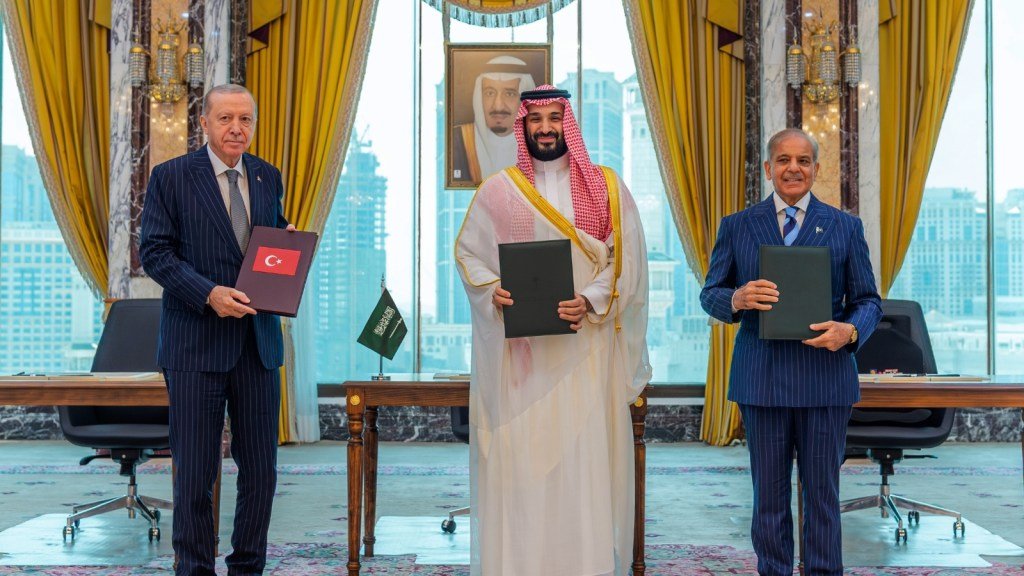
Pakistan, Saudi Arabia and Turkey have signed a landmark joint defence agreement that could reshape security cooperation across the Middle East and South Asia. The pact, signed in Mecca on August 7, 2026, comes as the wider region faces heightened military tensions, missile threats and growing uncertainty over the security of Gulf states.
The agreement is significant because it brings together three countries with very different strategic strengths. Saudi Arabia has enormous financial resources, energy importance and a central position in the Gulf. Turkey brings one of the region’s largest and most capable militaries while remaining a NATO member. Pakistan contributes a large military, extensive experience in regional security and the status of a nuclear-armed state.
The three countries have now moved beyond separate bilateral defence relationships and established a framework for collective security. The agreement states that an armed attack against any one of the three signatories will be treated as an attack against all three, giving the pact a much more consequential character than a routine military-cooperation agreement.
For India, the development will be closely watched because of Turkey’s increasingly close defence relationship with Pakistan. For the Gulf, meanwhile, the agreement reflects a growing effort to strengthen regional security arrangements as governments reassess their dependence on traditional external security partners.
What is the new Pakistan-Saudi Arabia-Turkey defence pact?
The agreement, known as the Mecca Joint Defence Agreement, establishes a collective defence framework involving Pakistan, Saudi Arabia and Turkey.
Its central principle is straightforward: an armed attack against one of the three countries will be considered an attack against all three. That language gives the pact a collective-security dimension and makes it more significant than an agreement limited to training, arms sales or military exchanges.
Turkish President Recep Tayyip Erdogan, Saudi Crown Prince Mohammed bin Salman and Pakistani Prime Minister Shehbaz Sharif were present for the signing. Pakistan’s army chief, Asim Munir, also accompanied the Pakistani prime minister.
The agreement had been under discussion for months. Turkish and Pakistani officials had previously discussed broader regional security cooperation, while Saudi Arabia and Pakistan already maintained a longstanding defence relationship.
The new arrangement effectively connects those relationships into a three-country security framework.
Why was the defence pact signed now?
The timing is one of the most important aspects of the agreement.
The Middle East has entered a period of heightened security uncertainty following the escalation of conflict involving Iran, Israel and the United States. Missile attacks and threats against regional infrastructure have increased concerns among Gulf governments about their ability to protect critical facilities, cities, ports and energy infrastructure during a wider conflict.
Saudi Arabia is particularly exposed to regional instability because of its geography and its importance to global energy markets. Its territory sits between several areas where conflicts and armed groups have become active, while its Red Sea and Gulf interests are connected to major international shipping routes.
The disruption surrounding the Strait of Hormuz has added another layer of concern. The waterway is one of the world’s most important energy chokepoints, and prolonged instability there can affect oil shipments, insurance costs, shipping routes and the broader global economy.
For Riyadh, the lesson from recent regional crises is that military threats do not necessarily remain confined to battlefields. Drones, missiles and attacks on infrastructure can create security and economic consequences far beyond the immediate target.
What does Saudi Arabia gain from Turkey and Pakistan?
Saudi Arabia has invested heavily in developing its own military capabilities, but a collective defence arrangement gives Riyadh access to additional strategic depth.
Turkey offers an important military-industrial and operational dimension. Ankara has developed substantial capabilities in drones, naval systems, armoured vehicles and other defence technologies. Turkish defence companies have also expanded their international presence in recent years.
Pakistan offers something different. It has one of the largest standing militaries in the Muslim world and has maintained a longstanding military relationship with Saudi Arabia. Pakistani military personnel have previously been deployed in Saudi Arabia under bilateral arrangements, although the nature and scale of any future role under the new agreement will depend on subsequent implementation.
The combination gives Saudi Arabia a partnership that brings together military manpower, defence technology, strategic geography and financial resources.
Why Turkey is a crucial part of the agreement
Turkey’s participation makes the agreement particularly significant.
Unlike Saudi Arabia and Pakistan, Turkey is a member of NATO. That does not make the three-country pact a NATO arrangement, and NATO’s collective-defence obligations do not automatically extend to countries outside the alliance. Nevertheless, Turkey’s NATO membership gives Ankara extensive experience with multinational military planning, interoperability and alliance operations.
Turkey also has a large and increasingly sophisticated domestic defence industry. Its growing ability to produce and export military equipment has made Ankara an important defence partner for countries seeking to diversify their sources of military technology.
For Pakistan, deeper defence cooperation with Turkey can support its long-term effort to expand military-industrial cooperation and reduce dependence on a limited number of external suppliers.
For Saudi Arabia, Turkey offers another major military partner at a time when Riyadh is seeking to strengthen its ability to respond to regional threats.
Pakistan’s strategic interest in the new pact
For Pakistan, the agreement provides an opportunity to strengthen its role beyond South Asia.
Pakistan has maintained particularly close ties with Saudi Arabia for decades. The two countries have extensive political, economic and military links, and Saudi Arabia has historically been an important partner for Islamabad.
The addition of Turkey changes the strategic scale of that relationship.
Pakistan can now work within a three-country framework that links South Asian military capabilities with two influential Middle Eastern powers. That potentially gives Islamabad greater relevance in discussions about Gulf security and regional defence cooperation.
It also reinforces Pakistan’s longstanding defence relationship with Turkey. Ankara and Islamabad have expanded military cooperation across several areas, including defence equipment, naval cooperation and training.
For Pakistan’s military establishment, a broader regional security role could also provide opportunities for greater interoperability, joint exercises and defence-industrial cooperation.
How is this different from the existing Saudi-Pakistan defence relationship?
The new agreement does not start from zero.
Saudi Arabia and Pakistan already have a bilateral defence arrangement under which an attack on one country is treated as an attack on the other. Saudi officials have previously described the agreement as covering all military means.
The new pact expands that security architecture by adding Turkey.
That matters because the three countries bring different capabilities and geographical positions. Instead of Saudi Arabia relying only on a bilateral defence relationship with Pakistan, the new arrangement creates a broader framework involving a NATO member with a substantial defence industry.
It also creates the possibility of closer coordination among the three militaries, although the practical meaning of that coordination will depend on how the agreement is implemented.
Does the pact mean the three countries will fight together?
The collective-defence language is significant, but its practical implications should not be exaggerated.
The agreement establishes the principle that an armed attack against one signatory will be treated as an attack against all three. However, the precise mechanisms for responding to such an attack will matter enormously.
Questions remain about how the three governments would coordinate a military response, what circumstances would trigger consultations, how decisions would be made and what forces each country would commit.
A Defence Pact does not automatically mean that every military incident involving one country will result in an immediate deployment by the other two. The details of implementation, political decisions and the circumstances of any attack would determine what happens in practice.
That distinction is particularly important in a region where countries often seek to deter threats without becoming directly involved in every conflict.
What does the pact mean for Iran?
Iran is an obvious strategic factor in the background of the agreement, although the pact should not automatically be described as a formal anti-Iran alliance.
Saudi Arabia and Iran have competing strategic interests and have experienced periods of severe tension, although they have also pursued diplomatic engagement. Turkey has its own complicated relationship with Tehran, combining competition, economic interests and cooperation on some regional issues. Pakistan, meanwhile, shares a long border with Iran and has generally had to balance its relationship with Tehran against its ties with Gulf countries.
That makes the three-country arrangement more complicated than a simple bloc confrontation.
The agreement can strengthen deterrence without necessarily committing the signatories to a particular policy toward Iran. Its stated collective-defence principle provides a mechanism for responding to attacks while leaving individual governments room to manage their broader diplomatic relationships.
Why India will be watching closely
The agreement is also important from India’s perspective.
New Delhi has watched Turkey’s close defence and political relationship with Pakistan with concern. Ankara has become one of Islamabad’s important defence partners, and the two countries have repeatedly emphasized their strategic relationship.
Adding Saudi Arabia to the same defence framework creates a more complicated regional picture for India.
India has substantial and growing relations with Saudi Arabia, particularly in energy, trade, investment and strategic cooperation. Riyadh is an important partner for New Delhi, and India has worked to deepen ties with Gulf countries despite their relationships with Pakistan.
This means the new defence pact does not automatically translate into a three-country bloc directed against India. Saudi Arabia has strong reasons to maintain its own relationship with New Delhi.
Nevertheless, Indian policymakers are likely to examine whether the agreement eventually produces deeper military cooperation between Turkey and Pakistan with Saudi participation, and whether that changes the strategic balance across the wider region.
What Turkey gets from the agreement
Turkey also has clear strategic reasons to participate.
President Erdogan has sought to expand Turkey’s influence across the Middle East while maintaining Ankara’s position as a major regional military power. A formal security relationship with Saudi Arabia and Pakistan gives Turkey another platform for projecting that influence.
The agreement can also strengthen Turkey’s defence-industrial relationships. Turkish defence companies have increasingly looked to international markets, while Saudi Arabia has ambitious plans to expand domestic defence production and reduce its reliance on foreign suppliers.
That creates potential space for future cooperation involving technology, training, maintenance, joint production and military exercises.
However, those possibilities should not be confused with commitments already contained in the pact. The defence agreement establishes the political and security framework; specific military-industrial projects would require separate decisions and agreements.
The Gulf security question
Perhaps the biggest issue behind the new pact is the changing nature of Gulf security.
For decades, Gulf monarchies have relied heavily on partnerships with the United States and other Western powers for defence and deterrence. Saudi Arabia remains a major US partner, and the new agreement does not replace that relationship.
Instead, the pact suggests that regional governments increasingly want additional layers of security.
That approach is understandable after years of drone attacks, missile threats, conflicts involving armed groups and disruptions to energy infrastructure and shipping.
Building relationships with other regional powers can give governments more options when facing a crisis. It can also make security arrangements less dependent on a single outside power.
But multiple overlapping defence partnerships can create their own complications. Different countries may have different interests, threat perceptions and foreign-policy priorities. The success of the new pact will therefore depend not simply on its symbolism but on whether the three governments can coordinate effectively when their interests do not completely align.
What could happen next?
The most important developments will come after the signing.
The first question will be how the three countries translate the agreement’s collective-defence principle into practical military cooperation. Joint exercises, intelligence coordination, defence planning and military-to-military communication would provide clues about how deeply the partnership is developing.
Defence-industrial cooperation could become another important area. Turkey’s defence industry, Pakistan’s military expertise and Saudi Arabia’s financial resources and industrial ambitions create obvious opportunities for cooperation, although individual projects would need separate agreements.
The three governments could also seek to expand the framework by bringing other regional countries into future security discussions. Whether that happens will depend on the political direction of the partnership and how neighbouring states respond.
A new regional security equation
The Pakistan-Saudi Arabia-Turkey defence pact is important because it connects three influential Muslim-majority countries with complementary strategic capabilities.
Saudi Arabia brings economic power, energy importance and a pivotal Gulf position. Turkey brings NATO experience, military capabilities and an expanding defence industry. Pakistan brings a large military, nuclear deterrence and decades of defence cooperation with Saudi Arabia.
The agreement does not erase the countries’ differences, nor does it automatically create a NATO-style military alliance. But the decision to treat an armed attack against one signatory as an attack against all three gives the partnership a serious collective-security dimension.
Its timing is equally significant. The agreement comes as the Middle East is experiencing heightened military tensions and Gulf states are reassessing how they protect their territory, infrastructure and economic interests.
For Saudi Arabia, the pact adds another layer to its security architecture. For Turkey, it strengthens its role as a regional military power. For Pakistan, it expands its strategic footprint beyond South Asia.
And for India, the development will be watched carefully because it brings Pakistan and Turkey even closer to a major Gulf partner with which New Delhi also has important strategic and economic ties.
The real significance of the agreement will ultimately depend on what comes next. If the three countries build integrated military planning, regular exercises and meaningful defence cooperation around the new framework, the pact could become an important pillar of regional security. If it remains primarily political, its immediate military impact may be more limited.
Either way, the signing marks a notable shift in how three major regional powers are approaching security at a time when the old assumptions about Middle Eastern stability are being tested.
For breaking news and live news updates, like us on Facebook or follow us on Twitter and Instagram. Read more on Latest World on thefoxdaily.com.


COMMENTS 0