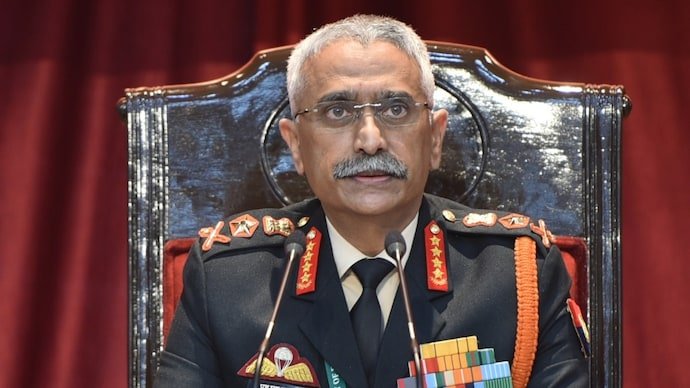
Former Indian Army chief General Manoj Naravane has drawn a sharp distinction between the security challenges posed by Pakistan and China, describing Pakistan as an immediate concern because of continued terrorism while identifying China as India’s principal long-term competitor.
Speaking at the launch of his new book, The Curious and the Classified: Unearthing Military Myths and Mysteries, published by Rupa Publications, Naravane said both neighbouring countries would remain on India’s security radar because of unresolved borders and their history of conflict with India.
But he argued that the nature of the two challenges is different. Pakistan’s continuing association with terrorism keeps India’s western border under immediate pressure, he said, while China’s growing influence means competition with Beijing is likely to extend far beyond the military domain.
Naravane, who served as Chief of the Army Staff from December 31, 2019, to April 30, 2022, said India should therefore avoid treating China simply as an enemy. Instead, he described Beijing as a competitor, while arguing that differences should be managed through diplomacy, dialogue and a credible military deterrent.
His assessment offers a framework for understanding why India’s security planning has to operate on two different timelines: responding to immediate threats along the western frontier while preparing for a much broader strategic competition with China over the years ahead.
Why Pakistan remains India’s immediate security concern
According to Naravane, terrorism is the key factor keeping Pakistan at the forefront of India’s immediate security calculations.
India and Pakistan have fought multiple wars and continue to have an unsettled relationship shaped by the disputed border and longstanding security tensions. The former Army chief said both Pakistan and China would remain threats and challenges because India has fought wars with both countries and has unresolved borders with them.
However, he said Pakistan receives particular attention because of what he described as its continued support to terrorism.
That distinction is important. A country’s military strength is only one element of a National Security assessment. Terrorist attacks, infiltration, cross-border militancy and instability along a contested frontier can create immediate security demands even when a conventional war is not taking place.
For India, the western border therefore requires sustained attention even as the country simultaneously prepares for a very different challenge on its northern frontier.
Why Naravane calls China a competitor, not an enemy
Naravane’s choice of the word “competitor” is central to his assessment of India’s relationship with China.
He said China is likely to become India’s main competitor in the long term, deliberately avoiding the term “enemy”. That distinction suggests a relationship in which confrontation and cooperation can coexist, with the two countries competing in several areas while still having an interest in managing their disputes.
China’s challenge, in Naravane’s assessment, is therefore much broader than the possibility of a military confrontation along the India-China border.
He identified four major areas of competition: politics, economics, trade and the military.
This wider definition matters because India-China competition can influence India’s strategic choices even when there is no armed conflict. Economic relationships, supply chains, infrastructure, trade routes, diplomatic influence and military capabilities can all shape the balance between the two countries.
Military preparedness remains essential, but Naravane’s comments indicate that military power should be viewed as one component of a much larger national competition.
The border dispute makes military preparedness unavoidable
India’s relationship with China has been complicated by unresolved border issues and periods of military tension.
That history explains why Naravane argues that diplomacy cannot operate independently of military preparedness.
His approach is not to suggest that military force should be the first response to every disagreement. Instead, he said force should be the last priority, with negotiations and dialogue used to resolve differences wherever possible.
At the same time, he argued that diplomacy becomes more credible when it is backed by the ability to deter an adversary from taking military action.
This is the logic behind his emphasis on credible military deterrence. A country seeking peaceful solutions must nevertheless be capable of protecting its interests if negotiations fail.
Why deterrence matters in India’s China strategy
Deterrence is based on a relatively simple principle: an adversary is less likely to take an aggressive action if the expected cost is sufficiently high.
For India, maintaining deterrence along the China border requires military preparedness even when the preferred policy is dialogue.
Naravane said there can be a point when it becomes clear that a particular dispute cannot be resolved through negotiation alone. At that stage, he argued, India needs sufficient military strength to prevent what he called a potential “misadventure.”
This does not necessarily mean that India should seek confrontation. In fact, Naravane explicitly placed the use of force at the bottom of the hierarchy of responses.
The broader message is that peace and preparedness are not necessarily contradictory. From this perspective, military capability is intended to prevent conflict rather than automatically lead to it.
India’s China challenge goes beyond the battlefield
Naravane’s description of China as a long-term competitor also highlights an aspect of strategic competition that can sometimes be overlooked in discussions focused on Border Security.
India and China are competing not only over territory and military influence but also across economic and political spheres.
Trade is one obvious area. The ability of countries to build strong domestic industries, secure supply chains and maintain access to international markets can influence their strategic independence.
Political competition also extends beyond bilateral relations. India’s and China’s approaches to neighbouring countries, international institutions and broader regional partnerships can affect their respective influence across Asia.
The military dimension remains significant, but Naravane’s comments suggest that the long-term balance between India and China will depend on much more than the number of soldiers, aircraft or weapons deployed along the border.
Economic resilience, technological capability, diplomatic influence and national capacity can all become components of strategic power.
Pakistan and China require different approaches
Naravane’s remarks effectively divide India’s security challenge into two broad categories.
| Challenge | Pakistan | China |
|---|---|---|
| Immediate concern | Continued terrorism and western-border security | Long-term strategic competition and border tensions |
| Primary character described by Naravane | Security and terrorism-related threat | Broad national competition |
| Areas of concern | Security and terrorism | Political, economic, trade and military spheres |
| Preferred approach | Security preparedness | Dialogue backed by credible deterrence |
The comparison does not mean that Pakistan is only a short-term problem or that China poses no immediate security challenge. Rather, Naravane’s point is that the two relationships require different strategic priorities.
Pakistan’s terrorism-related threat demands immediate security attention. China, meanwhile, requires India to think about competition over a much longer period and across a wider range of national interests.
Why India’s neighbourhood matters to national security
Naravane also broadened his assessment beyond India’s two largest security concerns to the wider neighbourhood.
He argued that India should work toward stability in Nepal, Bhutan, Bangladesh and Myanmar, emphasising that a country’s security is closely connected to the condition of its neighbours.
His argument was blunt: countries cannot choose their neighbours, either in everyday life or Geopolitics, so they have to make the best of the relationships and circumstances they inherit.
This is particularly relevant for India because instability across neighbouring countries can create consequences inside India’s own borders.
How instability in neighbouring countries can affect India
Naravane specifically pointed to several potential consequences of instability, including refugee movements, smuggling, drug trafficking and the movement of illegal weapons.
These problems do not necessarily remain confined to the country experiencing the instability.
A conflict or prolonged political crisis can force civilians to cross borders in search of safety. Border regions can also become vulnerable to criminal networks operating across jurisdictions. Smuggling routes and illegal arms movements can become harder to control when neighbouring states are dealing with internal disorder.
For India, the concern is particularly relevant because of its long land borders with several countries and its geographical position at the centre of South Asia.
Naravane used the situation in Myanmar to make the broader point. He argued that instability in a neighbouring country should concern India rather than be viewed with satisfaction simply because it is happening outside India’s borders.
His reasoning is straightforward: instability next door can eventually create security and humanitarian problems at home.
Myanmar illustrates the cross-border challenge
Naravane’s reference to refugees from Myanmar reflects the way instability can spill across international boundaries.
India has a long and difficult-to-police border with Myanmar, particularly across remote and mountainous areas in the northeast. When conflict or instability intensifies on the other side, India can face additional pressure involving people seeking safety, border management and security concerns.
That makes stability in neighbouring countries a strategic interest rather than simply a diplomatic preference.
The same principle can apply differently across India’s other neighbouring states. Political instability, economic disruption or deteriorating security conditions can affect trade, migration, border security and regional connectivity.
Peace remains the ultimate objective, Naravane says
Despite his emphasis on military preparedness, Naravane framed peace as India’s ultimate objective.
His argument is not that military power should replace diplomacy. Instead, he presented the two as complementary.
India should pursue talks and dialogue to resolve differences, particularly with China, but must maintain enough military strength to ensure that diplomacy is supported by credible deterrence.
This approach reflects a familiar strategic principle: the ability to defend national interests can strengthen a country’s negotiating position, while diplomacy provides a mechanism for avoiding unnecessary escalation.
The challenge is finding the balance between the two.
What Naravane’s assessment means for India’s security strategy
Viewed together, Naravane’s comments suggest that India’s security planning cannot focus on a single adversary or a single type of conflict.
The country faces an immediate requirement to monitor and respond to terrorism and security threats along its western border. At the same time, it needs to prepare for a long-term strategic competition with China that extends into economic, political, technological, trade and military areas.
Beyond those two major relationships, India must also consider how instability in its neighbourhood could affect its own internal security.
That creates a demanding strategic environment. India has to maintain conventional military preparedness while investing in broader national capabilities and maintaining diplomatic relationships across South Asia.
The significance of the “competitor” distinction
Perhaps the most important part of Naravane’s assessment is his deliberate refusal to describe China simply as an enemy.
Calling China a competitor leaves room for cooperation, negotiation and management of disagreements while recognising that the two countries’ interests may increasingly collide.
That distinction can matter in foreign policy because an enemy relationship implies a fundamentally adversarial framework, while competition allows for the possibility of simultaneous rivalry and engagement.
Naravane’s position therefore combines caution with an emphasis on avoiding unnecessary escalation.
His message is that India should be prepared for competition without making conflict inevitable.
What happens next for India’s security policy?
The challenges identified by Naravane are unlikely to disappear quickly.
The immediate focus on Pakistan will continue to depend heavily on the terrorism and security environment along India’s western frontier. The longer-term relationship with China will depend on how the two countries manage their border differences and broader strategic competition.
At the same time, developments in Nepal, Bhutan, Bangladesh and Myanmar will remain relevant to India’s regional security calculations.
The former Army chief’s central argument can therefore be reduced to a balance of two ideas: India should seek peace, but it should not assume that peace can be preserved without preparedness.
His statement, “If you want peace, prepare for war,” captures that philosophy. It does not amount to a call for conflict. In the context of his wider remarks, it is an argument for maintaining sufficient military capability to deter aggression while using dialogue and diplomacy whenever possible.
For India, that means treating Pakistan and China as different strategic problems rather than viewing them through a single lens. Pakistan remains an immediate security concern because of terrorism, while China represents a much broader contest over India’s long-term strategic, economic and political space.
How successfully New Delhi manages both challenges, while maintaining stability in its neighbourhood, will remain a central test of India’s national security strategy in the years ahead.
For breaking news and live news updates, like us on Facebook or follow us on Twitter and Instagram. Read more on Latest India on thefoxdaily.com.






COMMENTS 0