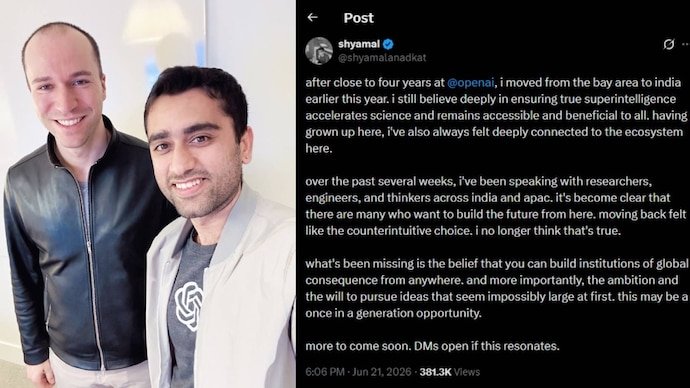
At a time when the world’s biggest Artificial Intelligence companies are locked in an expensive battle for talent, one former OpenAI researcher has chosen a very different path.
Instead of chasing the next opportunity in Silicon Valley‘s booming AI industry, Shyamal WHO spent close to four years at OpenAI has moved back to India. The decision stands out at a moment when companies such as OpenAI, Anthropic, Google DeepMind, and Meta are spending heavily to recruit top researchers. Yet according to him, returning home no longer feels like the unconventional choice it once did.
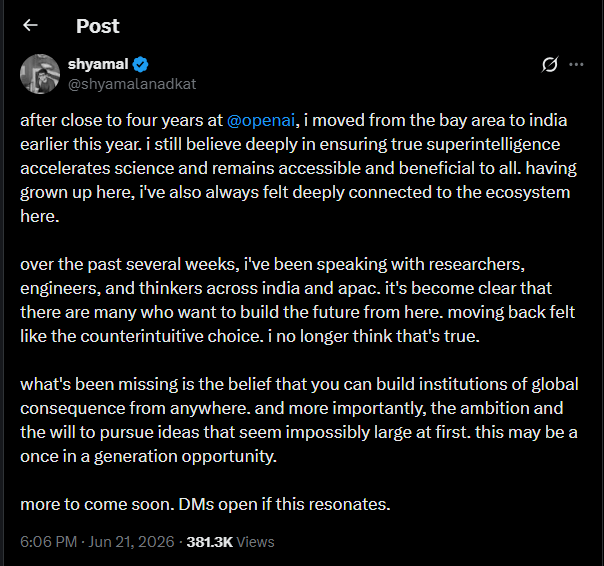
In a post shared on X, Shyamal revealed that he relocated from the Bay Area earlier this year after spending years at the center of the global AI boom. While reaffirming his belief that future superintelligent systems should accelerate scientific progress and benefit humanity, he also suggested that India may be entering a rare and important moment in its technological evolution.
“Moving back felt like the counterintuitive choice. I no longer think that’s true,” he wrote.
The comment quickly resonated across India’s technology community because it touched on a question that has lingered for years: Can world-changing AI companies be built from India, or will the country’s brightest minds continue to create breakthroughs elsewhere?
Why His Decision Matters
For decades, the standard path for many of India’s most ambitious engineers was straightforward. Study in India, move abroad, join a leading technology company, and build a career in global innovation hubs such as Silicon Valley.
That journey helped produce generations of successful Indian-origin executives, founders, and researchers. But it also reinforced the perception that cutting-edge technological breakthroughs had to be built somewhere else.
Shyamal believes that assumption is beginning to change.
After speaking with researchers, founders, engineers, and academics across India and the wider Asia-Pacific region, he said he found growing evidence that many talented people now want to build the future from within the region rather than simply contribute to companies headquartered overseas.
According to him, the real challenge is no longer talent. It is belief.
“What’s been missing is the belief that you can build institutions of global consequence from anywhere,” he wrote.
That observation reflects a broader shift taking place across India’s startup ecosystem. Over the past decade, the country has produced globally recognized technology companies, attracted billions of dollars in venture capital, and built one of the world’s largest pools of software talent. Artificial intelligence could become the next major test of those capabilities.
The Global AI Talent War
The timing of Shyamal’s move is particularly striking because the AI industry is currently experiencing one of the most aggressive talent races in technology History.
Leading companies are offering extraordinary compensation packages to attract researchers capable of building the next generation of AI systems. Every breakthrough in reasoning models, autonomous agents, and advanced language models has increased the value of elite AI talent.
Against that backdrop, leaving Silicon Valley is not the obvious career move.
Yet Shyamal’s decision suggests that some researchers increasingly see opportunity beyond California. As AI development becomes more global, countries with deep engineering talent and expanding computing Infrastructure may have a greater role to play than ever before.
The move also comes at a time when conversations around “reverse brain drain” are gaining momentum. More Indian founders, investors, and researchers are beginning to argue that the next generation of globally significant technology companies does not necessarily need to emerge from the United States.
India’s AI Ambitions Are Growing
India has made no secret of its desire to become a major player in artificial intelligence. The government’s India AI Mission, backed by significant public investment, aims to provide startups and researchers with access to computing resources that were previously available only to a handful of large technology companies.
The goal is simple: reduce the barriers that prevent Indian founders and researchers from building advanced AI systems at scale.
While India still trails the United States and china in the development of frontier AI models, the ecosystem is evolving rapidly. New startups are emerging across sectors ranging from large language models and voice AI to Healthcare, education, financial services, and enterprise Automation.
Several founders are also exploring AI products designed specifically for India’s linguistic and cultural diversity, an area where global models often struggle to deliver consistent performance.
What remains uncertain is whether India can produce institutions capable of competing at the very highest level of AI research. That is precisely the challenge Shyamal appears interested in tackling.
A Once-in-a-Generation Opportunity
The phrase that attracted the most attention from his post was simple but ambitious.
“This may be a once in a generation opportunity.”
Artificial intelligence is increasingly being compared to transformative technologies such as electricity, the internet, and smartphones. The countries and companies that establish leadership during this phase could shape innovation, economic growth, and technological influence for decades.
For India, the opportunity extends beyond building successful startups. It is about creating globally influential research institutions, attracting world-class talent, and developing technologies capable of solving problems at unprecedented scale.
Whether that vision becomes reality remains to be seen. But the return of researchers with experience at some of the world’s most advanced AI laboratories is an encouraging signal for India’s ambitions.
For years, ambitious technologists often believed they had to leave India to help build the future. Shyamal’s move suggests a different possibility: that some of the future’s most important breakthroughs could be built from India itself.
For breaking news and live news updates, like us on Facebook or follow us on Twitter and Instagram. Read more on Latest Technology on thefoxdaily.com.






COMMENTS 0