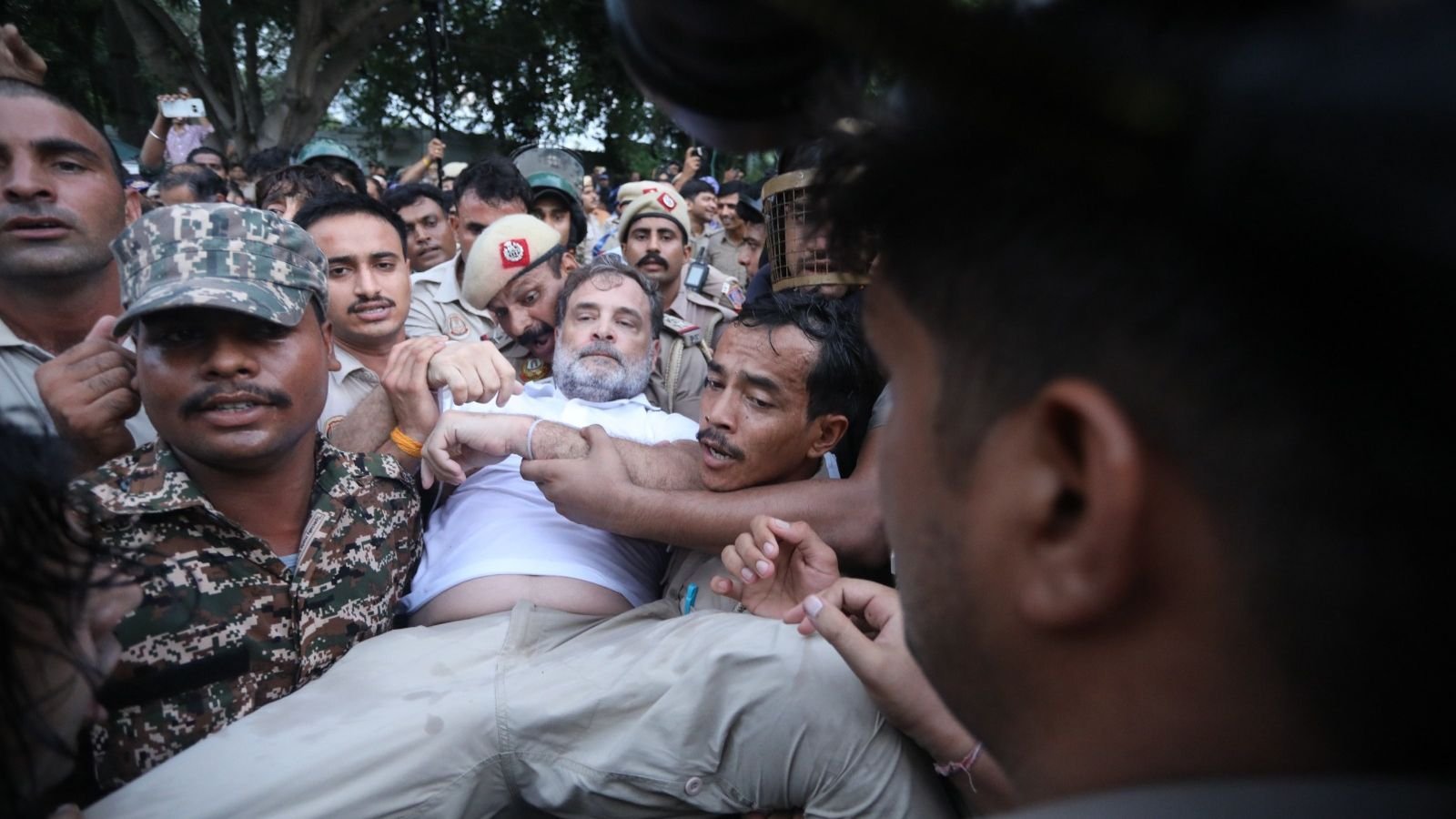
India’s competitive examination system has once again found itself at the center of a nationwide political and public debate after fresh protests over alleged examination paper leaks and recruitment irregularities. What began as demonstrations by students demanding transparency and accountability has rapidly evolved into a larger national issue, drawing support from several opposition parties, student organizations, and civil society groups.
The controversy intensified after student protesters attempting to march toward Parliament were stopped by police in New Delhi. The following day, several senior opposition leaders joined demonstrations, accusing the government of failing to protect the integrity of India’s examination system while criticizing the handling of the protests. The government, meanwhile, defended its actions, stating that it remains committed to discussing examination reforms in Parliament and ensuring accountability through existing legal and administrative mechanisms.
Beyond the immediate political confrontation, the controversy highlights a much deeper concern affecting millions of Indian students. Every year, crores of candidates compete for limited seats in universities, engineering institutes, medical colleges, and government jobs. When allegations of paper leaks emerge, they undermine confidence not only in a single examination but in the credibility of the entire recruitment ecosystem.
Why Examination Integrity Matters More Than Ever
India conducts some of the largest competitive examinations in the world. National-level entrance tests determine admission to prestigious institutions, while recruitment examinations decide careers in central and state government departments. For many families, years of preparation, financial Investment, and emotional commitment depend on the fairness of these examinations.
A single confirmed paper leak can have consequences extending far beyond one examination cycle. Students often spend years preparing, relocate to coaching hubs, and invest significant household income in educational resources. When examinations are cancelled or questioned, candidates face additional financial costs, emotional stress, and uncertainty about their academic or professional future.
This explains why allegations involving examination security often generate widespread public reaction. Even isolated incidents can weaken confidence if authorities fail to respond quickly and transparently.
India’s Expanding Competitive Examination Ecosystem
The scale of India’s examination infrastructure has expanded dramatically over the past decade. Every year, millions of students appear for examinations conducted by central agencies, state governments, universities, and public sector organizations.
| Category | Examples | Purpose |
|---|---|---|
| Medical Entrance | NEET | Admission to medical and dental colleges |
| Engineering Entrance | JEE Main, JEE Advanced | Engineering admissions |
| Government Recruitment | SSC, UPSC, Railway Recruitment | Central government employment |
| Teacher Recruitment | CTET and State TETs | Teaching eligibility |
| University Admissions | CUET | Undergraduate admissions |
The enormous scale of these examinations makes maintaining security a complex logistical challenge involving encrypted question papers, digital infrastructure, transportation, surveillance systems, and coordination among multiple agencies.
How Paper Leaks Affect Students
For students, examination controversies are about far more than politics. They directly affect academic plans, career opportunities, and Mental health.
- Preparation schedules are disrupted when examinations are postponed or cancelled.
- Families incur additional coaching, travel, and accommodation expenses.
- Students experience increased anxiety due to prolonged uncertainty.
- Meritorious candidates fear losing opportunities because of unfair practices.
- Trust in public recruitment systems declines.
Mental health experts have repeatedly highlighted that prolonged uncertainty surrounding competitive examinations can significantly increase stress levels among aspirants. Since many candidates prepare for several years, repeated delays can also affect employment timelines and Financial Planning.
What Triggered the Latest Political Confrontation?
The latest controversy escalated after large groups of students gathered in the national capital to demand stronger action against alleged examination irregularities. Their primary demands included greater transparency, accountability for officials responsible for lapses, faster investigations, and reforms aimed at preventing future paper leaks.
As demonstrations gained momentum, opposition parties expressed support for the protesters, arguing that the concerns reflected widespread frustration among India’s youth regarding competitive examinations and recruitment processes.
The political confrontation intensified when senior opposition leaders staged protests in New Delhi, criticizing both the handling of student demonstrations and the broader examination system. Government representatives responded by maintaining that Parliament remained the appropriate forum for discussing examination reforms while accusing opposition parties of politicizing student concerns.
The differing narratives have transformed what began as an education-related controversy into a broader political issue likely to remain prominent during the ongoing parliamentary session.
Background: Why Paper Leaks Have Become a Recurring Concern
India has witnessed multiple examination-related controversies over the past decade involving recruitment tests, professional entrance examinations, and state-level Competitive Exams. While each case differs in scale and legal outcome, recurring allegations have highlighted vulnerabilities in question paper handling, digital security, transportation, and examination center management.
Several states have introduced stricter anti-cheating laws, increased surveillance, biometric verification, and Technology-driven monitoring systems in response. At the national level, authorities have also strengthened coordination among investigating agencies whenever allegations of organized examination fraud emerge.
Despite these measures, recurring incidents continue to fuel public debate about whether existing safeguards are sufficient for examinations involving millions of candidates.
Government Measures to Strengthen Examination Security
Recognizing the importance of maintaining public confidence, the central government has introduced legislative and administrative measures aimed at protecting public examinations.
One of the most significant recent initiatives is the Public Examinations (Prevention of Unfair Means) Act, which seeks to deter organized cheating, question paper leaks, impersonation, and other examination-related fraud. The law provides stricter penalties for individuals and organized groups involved in compromising examination integrity.
Authorities have also emphasized greater use of technology, encrypted question paper distribution, biometric verification, artificial intelligence-assisted surveillance, and stronger coordination between examination agencies and law enforcement organizations.
Supporters argue these measures represent an important step toward improving examination security. Critics, however, contend that stronger implementation, quicker investigations, and institutional accountability remain equally important for restoring public confidence.
Why This Issue Resonates Beyond Politics
Unlike many political controversies, examination integrity affects nearly every section of Indian society. Parents, students, educational institutions, coaching centers, employers, and policymakers all have a stake in ensuring fair examinations.
For millions of young Indians, competitive examinations represent one of the few pathways toward higher education, stable employment, and upward social mobility. Consequently, allegations involving paper leaks often generate intense public attention because they strike at the heart of merit-based opportunity.
As India’s youth population continues to grow and competition for educational and employment opportunities becomes even more intense, maintaining public trust in examination systems will remain one of the country’s most significant governance challenges.
Political Reactions Reflect a Wider Debate on Governance
The examination controversy has also become a defining political issue because it intersects with broader concerns about youth employment, public recruitment, and governance. Opposition parties have argued that recurring allegations of examination irregularities indicate the need for stronger institutional accountability and comprehensive reforms.
Government leaders, on the other hand, have maintained that protecting examination integrity remains a priority and have defended recent legislative measures aimed at preventing organized cheating and paper leaks. Officials have repeatedly stated that investigations should be allowed to proceed through legal channels while Parliament remains the appropriate platform for discussing policy reforms.
This divergence in political messaging has transformed the debate from an education issue into a larger discussion about transparency, institutional credibility, and public confidence.
Why Youth Issues Are Becoming Central to National Politics
India is home to one of the world’s youngest populations. Every year, millions of graduates and students enter an increasingly competitive environment where educational qualifications, recruitment examinations, and skill development play a decisive role in shaping future careers.
As a result, issues affecting students often resonate far beyond campuses. Concerns over examination fairness, delayed recruitment, cancelled tests, and hiring transparency influence not only aspiring candidates but also families that invest significant financial and emotional resources in education.
Political parties across the spectrum increasingly recognize that education and employment have become central electoral issues. Student movements, therefore, frequently evolve into larger conversations about governance, economic opportunity, and Public Policy.
How Other Countries Protect Examination Integrity
Several countries have adopted advanced technologies and standardized procedures to minimize examination fraud. While no system is completely immune, international best practices offer useful lessons for strengthening India’s examination ecosystem.
| Country | Key Security Measures | Primary Focus |
|---|---|---|
| United Kingdom | Encrypted paper distribution, strict examination center protocols | Question paper security |
| Singapore | Multiple verification layers and controlled logistics | Operational integrity |
| South Korea | National coordination, restricted transport routes, intensive monitoring | Exam-day security |
| India | Biometric verification, CCTV surveillance, digital monitoring, anti-cheating legislation | Technology-assisted security |
Experts note that technology alone cannot eliminate malpractice. Effective implementation, institutional accountability, rapid investigations, and transparent communication remain equally important in maintaining public trust.
The Economic Cost of Examination Irregularities
Paper leak allegations carry consequences beyond education. Every cancelled or delayed examination increases administrative expenditure, logistical costs, and legal expenses. Examination authorities may need to print new question papers, arrange fresh examination centers, deploy additional security personnel, and reorganize evaluation schedules.
Students also bear substantial indirect costs. Many travel long distances, pay coaching fees, rent accommodation in educational hubs, and postpone employment opportunities while preparing for competitive examinations. When schedules change unexpectedly, these financial burdens multiply.
For the broader economy, repeated disruptions can delay recruitment into public institutions, affecting workforce planning and service delivery in sectors that rely on timely hiring.
Technology Can Help—But It Is Not a Complete Solution
Rapid advances in digital technology have significantly improved examination security. Artificial intelligence can detect suspicious activity, biometric verification reduces impersonation, and encrypted digital systems make unauthorized access more difficult.
However, technology is only one part of a much larger governance framework. Successful examination management also depends on secure logistics, trained personnel, effective coordination between agencies, strict compliance with procedures, and swift legal action against offenders.
Education policy experts frequently emphasize that prevention should remain the primary objective. Once public confidence is damaged, rebuilding trust can take years.
What Students Are Ultimately Asking For
Although political narratives differ, the concerns expressed by many students remain broadly consistent. Aspirants across the country have repeatedly called for:
- Transparent investigations into alleged examination irregularities.
- Faster communication from examination authorities.
- Time-bound legal action against individuals involved in malpractice.
- Improved digital and physical security for future examinations.
- Greater institutional accountability when lapses occur.
- Predictable examination calendars and recruitment schedules.
These demands reflect a broader expectation that competitive examinations should reward merit while providing equal opportunities to every candidate.
A Turning Point for India’s Examination System?
The current controversy may ultimately prove to be more significant than earlier incidents because it has generated nationwide discussion on systemic reforms rather than focusing solely on one examination. Policymakers, educational institutions, student organizations, and legal authorities now face increasing pressure to strengthen every stage of the examination process.
If implemented effectively, reforms introduced today could influence millions of future candidates by improving transparency, reducing opportunities for malpractice, and restoring confidence in merit-based selection.
Conversely, if recurring controversies continue, public trust could erode further, making comprehensive reforms increasingly urgent.
Looking Ahead: What Comes Next?
Several developments are likely to shape the next phase of this issue.
- Parliamentary discussions on examination reforms and accountability.
- Continuation of investigations by relevant authorities.
- Potential administrative and procedural changes by examination agencies.
- Greater use of secure digital technologies in future examinations.
- Renewed public debate over education governance and youth employment.
Much will depend on how effectively institutions respond—not only by investigating individual allegations but also by demonstrating that long-term reforms are being implemented to prevent similar incidents in the future.
Why This Story Matters Beyond Today’s Headlines
While political protests often dominate media coverage, the underlying issue extends far beyond a single demonstration or parliamentary debate. At its core, this is a conversation about trust in public institutions.
Competitive examinations remain one of the most important gateways to education and employment in India. For millions of young people, they represent years of dedication, personal sacrifice, and hope for a better future. Protecting the credibility of these examinations is therefore not simply an administrative responsibility—it is fundamental to ensuring fairness, social mobility, and confidence in the country’s merit-based systems.
Whether viewed through the lens of education, governance, or politics, the current controversy has reinforced one clear message: examination integrity is no longer a niche policy issue. It has become a national priority that demands sustained attention, meaningful reforms, and transparent implementation.
Conclusion
The ongoing debate surrounding examination paper leaks has evolved into one of the most consequential public policy discussions affecting India’s youth. While political disagreements continue over accountability and the handling of protests, the broader objective remains the same across stakeholders—ensuring that every competitive examination is fair, secure, and credible.
India’s examination ecosystem serves millions of aspirants every year and plays a critical role in higher education admissions and public recruitment. Strengthening this system requires more than stricter laws; it demands continuous investment in technology, transparent governance, institutional accountability, and timely communication with students.
The events surrounding the latest protests may eventually be remembered not only for the political confrontation they triggered but also for accelerating long-overdue conversations about safeguarding merit, restoring public trust, and modernizing one of the world’s largest examination systems. The reforms that emerge from this moment could shape opportunities for an entire generation of students and reinforce confidence in India’s education and recruitment framework for years to come.
For breaking news and live news updates, like us on Facebook or follow us on Twitter and Instagram. Read more on Latest India on thefoxdaily.com.






COMMENTS 0