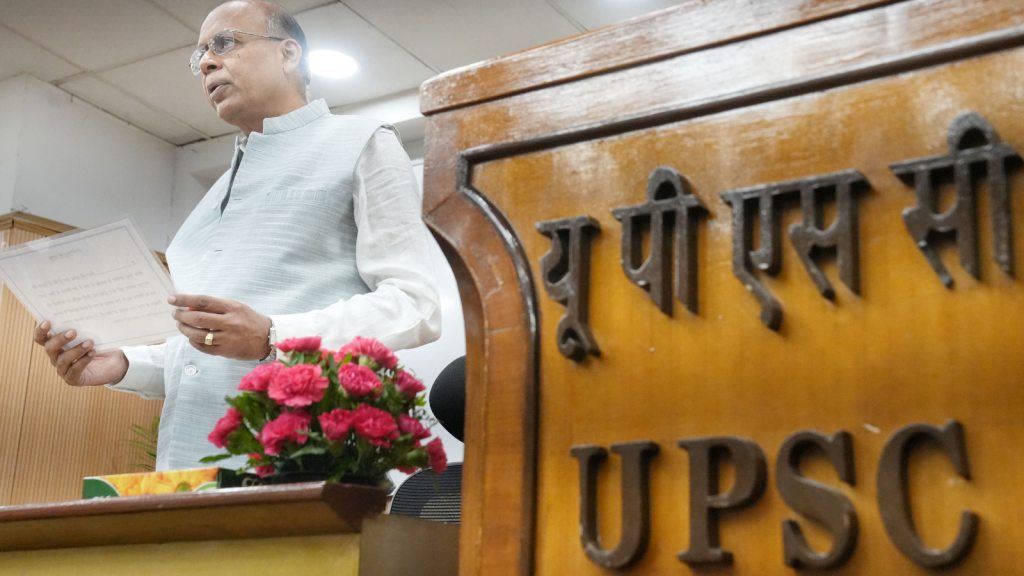
The Union Public Service Commission (UPSC) is stepping up efforts to strengthen examination security and improve recruitment administration through technology, while encouraging state public service commissions to follow more consistent operational standards.
At a one-day workshop held on Monday, the Commission brought together secretaries, joint secretaries and senior officers from state public service commissions to discuss recruitment challenges, exchange practical solutions and explore ways to harmonise administrative procedures across the country.
The initiative comes as public recruitment bodies face growing demands to conduct large-scale examinations securely, manage applications efficiently and protect selection processes against attempts to exploit technological or administrative weaknesses.
UPSC Highlights AI-Based Measures to Strengthen Exam Security
Addressing the workshop, UPSC chairman Ajay Kumar highlighted the role of technology in protecting the credibility of competitive examinations. He said recruitment bodies must continuously adapt as people attempting to misuse examination systems also find new ways to exploit technology.
Referring to the need for stronger safeguards, Kumar said technology should be used to detect and prevent malpractice while ensuring that the examination process remains fair, transparent and trustworthy.
He outlined several initiatives introduced by the UPSC, including AI-enabled face authentication of candidates at examination venues. The system is intended to strengthen identity verification and help ensure that the person appearing for an examination is the registered applicant.
Candidate authentication is an important part of examination security, particularly when recruitment tests involve large numbers of applicants across multiple examination centres. Technology-assisted verification can help examination authorities strengthen identity checks and reduce opportunities for impersonation.
However, the effectiveness of such systems also depends on reliable implementation, accurate verification and appropriate safeguards for candidates whose facial data may not be captured or matched correctly.
Universal Registration Number to Streamline Recruitment Applications
Another initiative highlighted by the UPSC chairman was the universal registration number for applicants. A common registration identity can help candidates maintain a consistent record across recruitment-related interactions with the Commission.
Such a system can also support more organised application management by reducing the need to repeatedly establish a candidate’s identity across different recruitment processes.
For applicants who appear in multiple examinations over time, a standardised registration mechanism can make it easier to manage application records. For recruitment authorities, it can support more systematic handling of candidate information.
The Commission also highlighted the digitisation of department promotion committee proposals. These committees play an important role in considering promotions within government services, making the handling and processing of related records an important part of administrative recruitment and personnel management.
Digitising these proposals can help move administrative procedures towards more organised electronic processing and reduce dependence on traditional paper-based workflows.
Computerised Randomisation of Interview Boards
The UPSC has also introduced computerised randomisation of interview boards, another measure highlighted during the workshop.
Interview boards form a crucial part of several recruitment processes, particularly where candidates are assessed through personality tests or interviews after qualifying in written examinations. Randomisation can help organise the allocation of interview boards through a computerised process rather than relying entirely on manual arrangements.
The measure is relevant to maintaining confidence in recruitment procedures because interview-stage administration must be conducted consistently and transparently. A computerised allocation process can make the assignment procedure more systematic.
Together, these initiatives reflect the Commission’s wider effort to use digital systems at different stages of recruitment, from candidate registration and examination-day verification to departmental promotion procedures and interviews.
UPSC Wants State Commissions to Share Best Practices
The workshop was not limited to presenting the UPSC’s own technology initiatives. A major objective was to identify effective practices already developed by state public service commissions and explore how they could be shared with other recruitment bodies.
UPSC secretary Shashi Ranjan Kumar welcomed the participating officers and emphasised that the gathering was intended to encourage collaboration rather than function as a one-way training exercise.
He said secretaries and senior administrative officers across the commissions perform similar responsibilities under the same constitutional obligations, even though they work in different administrative circumstances.
According to him, chairpersons and members establish the broader vision of public service commissions, while secretaries are responsible for ensuring that operational systems are robust, legally sound, fair and technologically modern.
He described their role as connecting policy objectives with administrative execution, highlighting the importance of strong procedures behind every recruitment decision.
Kumar also pointed out that several state commissions have developed effective solutions in areas such as digital application processing, conducting examinations in regional languages and grievance redressal.
He encouraged participants to pool these experiences into a shared repository of best practices so that successful administrative approaches could be understood and potentially adopted by other commissions.
Regional Language Examinations and Grievance Redressal Among Key Discussion Areas
The reference to regional-language examinations highlights an important operational challenge for state recruitment bodies. Public service commissions conduct examinations for candidates from different linguistic backgrounds, making accessible application and examination procedures an important consideration.
State commissions have developed their own approaches to handling applications and conducting examinations in regional languages. Sharing these practices could help other bodies understand how to manage language-related requirements while maintaining consistent examination administration.
Grievance redressal was another area identified as a source of useful experience. Candidates may need assistance with application submissions, examination arrangements and recruitment-related administrative decisions. Effective grievance systems can help authorities respond to concerns through clearer procedures.
Digital processing of applications was also highlighted as an area where state commissions have developed practical solutions. Sharing these methods could support improvements in application management and administrative efficiency across recruitment bodies.
Four Working Sessions Focused on Recruitment Procedures
Following the inaugural session, the workshop moved into four working sessions covering key operational areas of the UPSC.
The Commission’s branches dealing with examinations, recruitment, recruitment rules, and disciplinary and appeal cases presented their respective procedures and practices. Each presentation was followed by an open discussion involving officers from the participating state commissions.
The structure allowed officers to examine different aspects of recruitment administration rather than limiting discussions to broad policy objectives.
The sessions also provided an opportunity to discuss how procedures are implemented, where operational difficulties arise and which administrative practices could be useful across different state-level recruitment systems.
Why Uniform Recruitment Standards Matter Across States
Public service commissions play a central role in recruiting personnel for government services. Although the UPSC and state commissions operate at different levels, they share the responsibility of conducting recruitment processes that candidates can trust.
Differences in administrative capacity, examination infrastructure, digital systems and recruitment procedures can create challenges for commissions managing large applicant pools. Sharing established practices can help address some of these gaps without requiring every commission to develop solutions independently.
Greater consistency in administrative standards can also make recruitment processes easier to manage and understand. Areas such as application processing, candidate verification, examination arrangements and grievance handling benefit from clearly defined procedures.
However, harmonising administrative standards does not necessarily mean that every state commission must adopt identical examination systems. State-level recruitment bodies operate within their respective requirements and circumstances. The workshop’s emphasis on exchanging best practices provides a framework for cooperation while allowing commissions to consider which approaches are suitable for their own operations.
Technology Must Support Fairness and Transparency
The UPSC’s technology initiatives come amid wider efforts by recruitment authorities to protect examination systems from impersonation, irregularities and other forms of malpractice.
AI-enabled face authentication and computerised processes can strengthen specific administrative safeguards, but technology alone cannot guarantee the integrity of an examination. Reliable infrastructure, clear procedures, human oversight and effective grievance mechanisms remain important parts of a secure recruitment system.
Face authentication, for example, needs to account for genuine verification difficulties so that legitimate candidates are not unfairly prevented from appearing in examinations. Similarly, digital recruitment systems must be administered in a manner that protects candidate information and allows errors to be addressed through appropriate procedures.
The emphasis on sharing state-level experience is therefore significant. Technology adoption is only one part of modernising public recruitment; administrative capacity and consistent implementation are equally important.
UPSC Workshop Signals Wider Push for Recruitment Reform
The workshop reflects the UPSC’s effort to encourage closer coordination between the national and state-level public service commissions. By bringing officers responsible for recruitment administration into a common forum, the Commission aims to create opportunities for practical knowledge-sharing and institutional improvement.
Ajay Kumar linked the initiative to Prime Minister Narendra Modi’s emphasis on sharing best practices among public service commissions during the UPSC’s centenary celebrations. He described the workshop as an effort to put that vision into practice.
The discussions covered both technology-driven reforms and everyday administrative responsibilities, from examination security and recruitment rules to digital applications and grievance redressal.
The broader objective is to strengthen the systems through which public servants are selected across India. Whether these discussions lead to wider adoption of common practices will depend on how participating commissions apply the ideas within their own recruitment frameworks.
For candidates, the central expectation is that modernisation should translate into recruitment processes that are secure, accessible, transparent and fair. The UPSC’s latest initiative places cooperation and technology at the centre of that effort.
For breaking news and live news updates, like us on Facebook or follow us on Twitter and Instagram. Read more on Latest Education on thefoxdaily.com.






COMMENTS 0