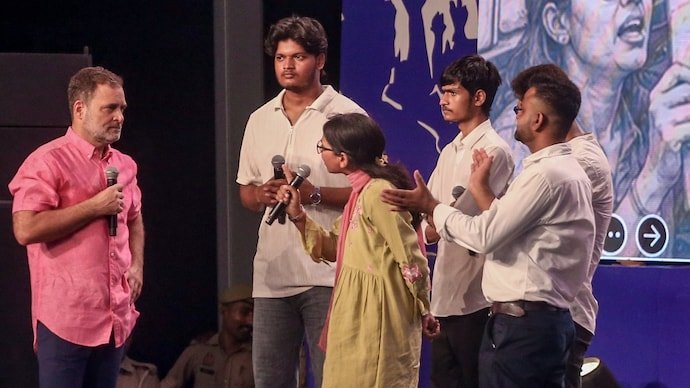
Rahul Gandhi used a student outreach event in Prayagraj to focus on youth, jobs, education, paper leaks and data, while the BJP attacked him over the ongoing JPSC–JSSC Protests in Jharkhand.
Congress leader Rahul Gandhi on Saturday turned his attention to India’s young population, telling students and competitive-exam aspirants that the country’s roughly 40 crore young people represent its greatest strength but are being held back by expensive education, limited employment opportunities and examination irregularities.
Speaking at the Chhatron Ki Goonj programme at KP Ground in Prayagraj, Gandhi organised his message around three themes “dard, data, daulat”, or pain, data and wealth. He argued that India’s demographic advantage could become a powerful economic asset if young people were given better opportunities and greater control over the value created by their work and data.
But the speech quickly became part of a wider political contest. The BJP questioned why Gandhi was campaigning for students in Prayagraj while aspirants in Jharkhand were continuing protests and a hunger strike over JPSC and JSSC recruitment issues in a state where the Congress is part of the ruling coalition.
Rahul Gandhi puts youth at centre of his message
Gandhi told the gathering that India’s young population was the country’s biggest strength and argued that the future of the economy depended on whether that potential could be converted into productive employment.
He described young Indians as being caught in a “chakravyuh” involving the cost of education, limited job opportunities and paper leaks.
The argument formed the central theme of the Prayagraj event, which was part of the Congress’s 40-day nationwide Chhatron Ki Goonj campaign. The campaign was launched to highlight concerns around paper leaks, recruitment irregularities, unemployment and the examination system.
Rather than treating these issues separately, Gandhi connected them to a larger question: whether India’s education and employment systems are capable of turning a large young population into an economic advantage.
‘Dard’: Gandhi highlights the pressure on students
The first part of Gandhi’s message focused on what he described as the “pain” experienced by students and young job seekers.
He argued that families can spend large amounts of money on higher education, including engineering, medicine and postgraduate courses, without receiving any guarantee of employment afterwards.
His criticism was aimed not only at the cost of education but also at the gap between obtaining a qualification and finding stable work.
Gandhi illustrated his argument with the experience of a competitive-exam aspirant who told him that he worked for nearly 10 hours a day for Blinkit before studying for government examinations. The student also said he had missed clearing an Indian Army examination by one mark.
Gandhi used the example to describe the pressure faced by aspirants who have to earn money while simultaneously preparing for highly competitive government recruitment examinations.
He then connected that pressure to allegations of paper leaks. His argument was that a candidate could spend years preparing for an examination only to see that effort undermined if examination material is leaked and made available to people willing or able to pay for it.
Paper leaks become a political issue
Examination integrity has increasingly become a politically sensitive subject because government recruitment and entrance examinations can attract enormous numbers of candidates.
For students, the consequences of a disputed examination can extend beyond a single test date. Preparation may involve years of study, coaching expenses and repeated attempts. A cancelled examination or allegation of malpractice can therefore create uncertainty for candidates who have already invested significant time and money.
Gandhi used this concern to argue that the examination system must protect the efforts of genuine candidates.
The Congress campaign is built around precisely these concerns, with the party seeking to make paper leaks, recruitment irregularities and unemployment prominent issues in its outreach to young voters.
‘Data’: Rahul Gandhi’s second argument
Gandhi then shifted from employment to technology and data, describing data as another major advantage India possesses.
He summarised his argument with the phrase “youth plus data is equal to the 21st-century economy”.
To explain the idea, Gandhi compared data with petroleum. His argument was that just as engines in the previous century required fuel to operate, Artificial Intelligence systems depend on data.
He told students that the enormous amount of information generated by Indians should be viewed as a national asset because people themselves create much of that data through their everyday digital activity.
Gandhi argued that this value should not simply flow toward large corporations. During his speech, he named Jio, Adani, Facebook and Google while making his argument about who benefits from India’s data economy.
The broader political question raised by his argument is about ownership and economic value. As artificial intelligence and digital services become increasingly important, the collection and use of personal and behavioural data are becoming central to debates about technology, business and economic power.
‘Daulat’: Who benefits from India’s young population?
The third part of Gandhi’s message focused on wealth.
His argument was that India’s large young population and enormous volumes of data could provide a significant economic advantage, but only if that value translates into opportunities for young people.
That connects the three themes of his speech. The “dard” is the frustration experienced by students and job seekers. “Data” represents a resource created by India’s digital population. “Daulat” is the economic value Gandhi believes can emerge if those resources are used in a way that benefits the wider population.
Rather than presenting youth simply as a demographic statistic, Gandhi framed them as a productive economic resource whose potential depends on access to education, employment and technology.
Gandhi attacks the social media economy
Gandhi also criticised the amount of time young people spend consuming short-form social media content.
He described endless consumption of reels as the “addiction of the 21st century” and contrasted the ease of creating and consuming digital content with the difficulty many young people face in finding secure employment.
His criticism targeted the broader digital economy rather than young people themselves. Gandhi argued that platforms encourage users to spend more time watching, sharing and creating content while the underlying employment problem remains unresolved.
The point also tied back to his argument about data. The more time people spend on digital platforms, the more information those platforms can collect about their behaviour and preferences. Gandhi’s speech linked that activity to his broader argument that data has economic value.
Gandhi says the target is the system, not individuals
Towards the end of his address, Gandhi sought to frame his political argument as a challenge to the system rather than a personal attack on individual leaders.
He referred to images of Prime Minister Narendra Modi, Home Minister Amit Shah, industrialist Gautam Adani and RSS chief Mohan Bhagwat that had been displayed during the programme.
Gandhi said there was no need to hate individuals and instead argued that the system should be changed. He ended the event with his familiar “Tata, bye-bye” sign-off.
This framing allowed Gandhi to combine criticism of political and economic power with a message aimed at young people, while presenting his broader objective as systemic change.
BJP turns Gandhi’s student outreach into a Jharkhand attack
The BJP quickly challenged the Congress leader’s focus on students.
BJP leader Amit Malviya said Gandhi should have travelled to Ranchi instead of Prayagraj, pointing to the ongoing protests by JPSC and JSSC aspirants in Jharkhand.
The BJP’s argument was straightforward: if Gandhi wanted to demonstrate solidarity with students facing recruitment problems, he should meet the protesters in a state where the Congress is part of the government.
BJP national spokesperson CR Kesavan went further, accusing Gandhi of “two-faced political hypocrisy”. He referred to the hunger strike by students in Jharkhand and said some protesters had reportedly fainted.
The criticism creates a political contrast between Gandhi’s national student campaign and the Congress’s position as a junior partner in the Jharkhand government.
Why Jharkhand became part of the political debate
The BJP’s response was linked to ongoing protests by aspirants over alleged irregularities in JPSC and JSSC recruitment examinations.
The students have continued their agitation in Ranchi, including a hunger strike, while demanding action from the state government. The issue has already attracted political attention, with JLKM MLA Jairam Mahato announcing a one-day waterless fast in support of the protesters.
That development makes the BJP’s attack on Gandhi more politically pointed. The Congress is participating in a state government that is facing direct pressure from protesting recruitment aspirants, while its national leader is simultaneously making youth employment and examination reform a central theme of his political outreach elsewhere.
Whether that contrast has a significant political impact will depend on how the Jharkhand government responds to the students’ demands and how effectively the Congress can reconcile its national messaging with its role in state governments.
Gen Z becomes a bigger political battleground
The Prayagraj event comes as political parties increasingly seek to engage younger voters around education, employment, technology and economic opportunity.
Recent student-led protests over examination irregularities and paper leaks have pushed these issues into the political spotlight. For parties, the challenge is not simply to attract young voters but to offer credible responses to problems that directly affect their education and career prospects.
Gandhi’s speech attempted to connect several of those concerns: the cost of education, recruitment examinations, employment, social media and the economic value of data.
The BJP, meanwhile, responded by highlighting a real-world student protest in Jharkhand and questioning whether Gandhi’s national message matched the actions of Congress-led or Congress-supported governments.
That exchange illustrates why youth issues are becoming increasingly useful political territory. Education and employment affect large numbers of young people directly, while controversies around examinations can rapidly mobilise students across regions.
PM Modi also addresses young people
The political focus on young voters was not limited to the Congress event.
Hours before Gandhi’s programme in Prayagraj, Prime Minister Narendra Modi addressed young people at the 57th convocation of IIT Delhi.
Modi urged graduating students to maintain curiosity, continue learning and approach large challenges by breaking them into smaller and more manageable problems.
More than 3,000 students and 587 PhD scholars were present at the IIT Delhi event, according to the material provided for the report.
The parallel appearances underscore the importance both major political camps are placing on young Indians. While Gandhi focused heavily on jobs, paper leaks and the economic value of data, Modi’s message centred more on curiosity, learning and problem-solving.
Two competing messages for young India
The contrast between the two outreach efforts is politically significant.
Gandhi’s argument begins with frustration: young people have education but struggle to secure jobs, compete in an examination system affected by alleged irregularities and generate valuable data that he says is benefiting powerful corporations.
Modi’s message, as presented at IIT Delhi, focused on individual capability and the importance of learning, curiosity and tackling difficult problems systematically.
The BJP’s attack added a third dimension by questioning Gandhi’s credibility on student issues through the example of Jharkhand.
Together, these competing narratives show that India’s young population is becoming more than an electoral demographic. Education, employment, examination integrity and technology are increasingly being presented as political questions that can shape how Gen Z views competing parties.
What matters for young voters now
The biggest test for political parties will be whether rhetoric about youth translates into concrete action.
For students and job seekers, promises about India’s demographic strength have limited value if recruitment examinations remain uncertain, employment opportunities remain difficult to secure or educational costs continue to rise.
Likewise, discussions about data and artificial intelligence matter most when they address how young people can participate in the resulting economy and benefit from the technology they help power.
That is where the political debate is likely to move next: from speeches and slogans to specific policies on examinations, recruitment, education, employment and digital rights.
Rahul Gandhi’s youth message faces a political test
Rahul Gandhi’s “dard, data, daulat” framework gives the Congress a broad narrative for reaching young Indians. It combines immediate concerns such as jobs and paper leaks with longer-term questions about artificial intelligence, data and economic power.
But the BJP’s response shows the vulnerability of such a national campaign. Political opponents can test broad promises against events taking place in states where the Congress is in government or part of a governing alliance.
For Gandhi, the challenge will be to turn the themes raised in Prayagraj into a credible programme on youth employment and examination reform while addressing questions about Congress’s record in states such as Jharkhand.
For the BJP, the challenge is equally direct: young voters may listen to criticism of the opposition, but their political choices are likely to be influenced most strongly by whether they see meaningful improvements in education, recruitment, employment and economic opportunity.
As Gen Z becomes a more important political constituency, the debate is therefore moving beyond who can speak most effectively to young Indians. The bigger question is who can convince them that their education, skills, data and aspirations will translate into real opportunities.
For breaking news and live news updates, like us on Facebook or follow us on Twitter and Instagram. Read more on Latest India on thefoxdaily.com.






COMMENTS 0