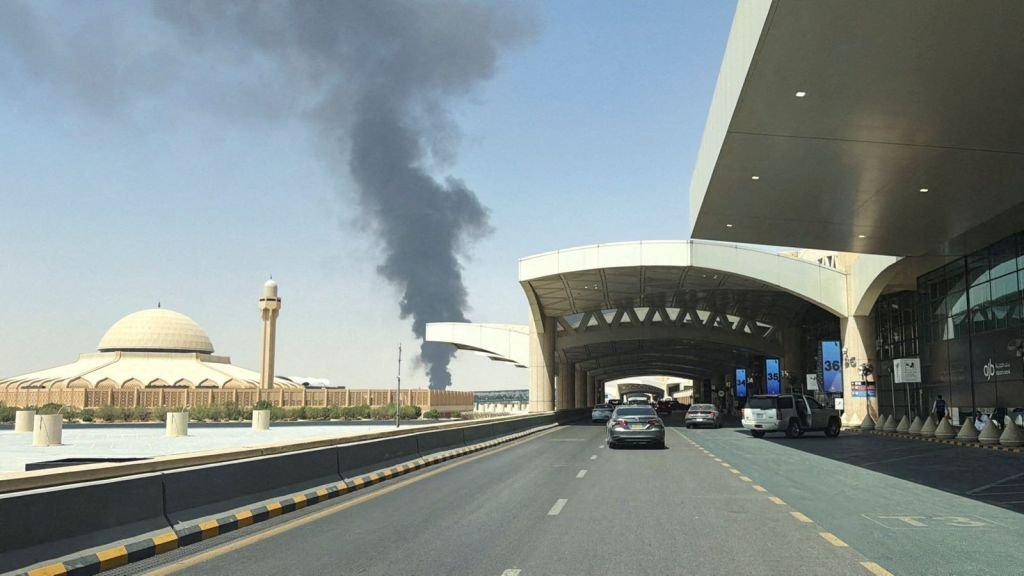
A large plume of black smoke was seen near Riyadh‘s main airport on Saturday after loud booms were heard in the Saudi capital, following overnight alerts warning residents about a possible aerial attack. The incident came amid an intensifying campaign by Yemen’s Houthi group against Saudi Arabia, raising fresh concerns over the security of civilian areas, energy infrastructure and critical shipping routes.
Video and photographs shared by Reuters showed a massive column of dark smoke rising near King Khalid International Airport. The airport highway, main terminal building and other facilities were visible in the foreground, while flames were seen rising behind what appeared to be fuel storage tanks at one point.
Reports also indicated that drones struck the airport area overnight, with the apparent impact involving the main jet-fuel storage facilities. The reported incident has not been fully detailed by Saudi authorities, however, and the precise extent of any damage remained unclear in the immediate aftermath.
The Saudi government’s media office did not immediately respond to questions about the smoke or the overnight alerts, according to Reuters.
Saudi Arabia issues aerial attack warnings in Riyadh and Al-Kharj
Saudi civil defence authorities sent emergency phone alerts overnight warning residents in Riyadh and Al-Kharj about a possible danger from aerial attacks. Al-Kharj is located east of the Saudi capital and forms part of the wider area surrounding Riyadh.
The warnings were followed by an all-clear on Saturday morning. A Reuters journalist in Riyadh’s Olaya district reported hearing loud booms before the all-clear was issued.
The sequence of events emergency alerts, reports of loud explosions and the subsequent appearance of a large smoke plume near the airport immediately drew attention to the security situation around the capital.
Riyadh has received aerial attack warnings at points this year following the start of the US-Iran war. However, according to the reported account, Saturday’s alerts were the first issued in the capital since the escalation involving the Houthis began in July.
The timing makes the incident particularly significant because it marks a new phase in the security environment around Saudi Arabia’s political and economic centre.
Smoke and flames reported near airport fuel facilities
King Khalid International Airport is a major aviation hub serving Riyadh. Images from the area showed a large plume of black smoke rising behind airport infrastructure, with flames visible near what appeared to be fuel tanks.
Fuel storage facilities are an important part of airport operations because aviation fuel is required for aircraft serving the airport. Any confirmed damage to such infrastructure could potentially affect airport operations, although the initial reports did not establish the extent of disruption.
The visual evidence showed the presence of fire and smoke, but several details remained subject to confirmation. In particular, the available information did not immediately establish the exact sequence of the reported drone strikes, the extent of damage to fuel facilities or whether airport operations had been significantly affected.
That distinction is important during a rapidly developing military incident. Images can establish that a fire or explosion occurred, but they do not by themselves determine the precise cause or the full operational consequences.
Houthi attacks expand pressure on Saudi Arabia
The incident took place against the backdrop of a widening confrontation between Saudi Arabia and Yemen’s Houthi movement. The Houthis control Yemen’s most populous areas as well as large parts of the country’s north.
The group declared a naval blockade against Saudi Arabia in July and has since launched attacks against Saudi interests, including vessels operating in the Red Sea. The escalation has increased security risks for Saudi cities while also putting pressure on maritime traffic in one of the world’s important shipping corridors.
The Houthis have also been accused of targeting Saudi energy infrastructure and other strategic sites. Such attacks carry consequences beyond their immediate military significance because Saudi Arabia is one of the world’s largest oil producers and plays a central role in global Energy Markets.
Any sustained threat to oil facilities, ports, pipelines or shipping routes can raise concerns about the reliability of energy supplies even when actual production losses remain limited.
Red Sea shipping faces another layer of risk
The Houthi campaign also threatens maritime traffic through the Red Sea, a major route connecting the Indian Ocean with the Mediterranean through the Suez Canal.
For Gulf exporters, the route provides an important alternative to routes passing through the Strait of Hormuz. With traffic through Hormuz described in the supplied report as remaining blockaded, disruption in the Red Sea could place additional pressure on Global energy transportation.
Shipping companies facing a higher risk of attack may have to reconsider routes, sailing schedules and security arrangements. Longer routes can increase fuel consumption, transit times and operating costs, while uncertainty can also affect insurance and freight rates.
The combination of threats around both major maritime corridors therefore creates a wider economic concern. Energy markets can react not only to actual supply losses but also to the possibility that critical infrastructure or transportation routes could remain vulnerable.
Houthi spokesperson warns of response
The latest incident followed comments from Houthi military spokesperson Yahya Saree on Friday. Saree said the group had thwarted unspecified “criminal attempts” in Yemen’s capital, Sanaa, and blamed Saudi Arabia for the alleged activity.
He also warned of a response, adding to concerns that the confrontation could intensify further.
The Houthis have claimed that the Saudi Air Force carried out hundreds of airstrikes against the group in recent days. Those claims form part of the Houthi account of the conflict and were made as the two sides exchanged accusations and threats.
Independent confirmation of individual military claims can be difficult during an active conflict. As a result, statements from the parties involved need to be distinguished from independently verified details about specific attacks and their consequences.
Why an incident near Riyadh airport matters
An aerial threat near Riyadh has significance beyond the immediate incident because of the city’s role as Saudi Arabia’s capital and a major centre of government, commerce and transportation.
King Khalid International Airport is also critical infrastructure. It connects the capital to domestic and international destinations and supports the movement of passengers, cargo and Business activity.
A confirmed attack affecting airport fuel facilities would therefore represent a direct challenge to critical civilian infrastructure. It could also raise questions about the security of other strategic sites around Riyadh.
At the same time, the initial reports should not be interpreted as confirmation that the airport suffered widespread operational disruption. The presence of smoke near an airport does not automatically mean that flights have been cancelled or that terminal operations have stopped.
Further official assessments would be needed to determine the extent of any damage and whether aviation services were affected.
Saudi cities and energy infrastructure under pressure
The reported incident highlights the broader challenge facing Saudi Arabia as the conflict expands beyond the immediate battlefield in Yemen.
Saudi authorities must protect densely populated cities while also securing infrastructure that is essential to the country’s economy. Airports, energy facilities, ports, industrial sites and transportation networks all have different security requirements and can be difficult to protect against a range of aerial and maritime threats.
Riyadh’s inclusion in the emergency alerts demonstrates that the threat environment is no longer limited to border areas or maritime locations.
Al-Kharj was also included in the warning, indicating that authorities were concerned about a potential threat affecting a broader area around the capital.
The combination of urban security concerns and risks to energy infrastructure makes the current escalation particularly sensitive for Saudi Arabia.
UN Security Council condemns Houthi attacks
The escalating attacks have drawn international condemnation. The UN Security Council on Friday condemned continued Houthi attacks against Saudi Arabia, including attacks affecting civilian and energy infrastructure.
The council said the attacks had resulted in civilian injuries, including injuries to women and children. It also condemned what it described as the Houthi military escalation in Yemen.
The statement underscores the international concern over attacks that affect civilian populations and critical infrastructure. It also places the latest developments within a wider regional security crisis involving military operations, energy infrastructure and international shipping.
For Saudi Arabia, international condemnation does not remove the immediate security challenge. The government still faces the task of protecting its population and infrastructure while responding to attacks attributed to the Houthis.
The significance of the fuel storage area
The reported location of the flames near apparent fuel tanks adds another dimension to the incident. Aviation fuel facilities require extensive safety measures because of the highly flammable nature of their contents.
A fire involving such infrastructure can produce a large and highly visible plume of smoke even when the precise level of physical damage is not immediately known.
If the reported drone strikes are confirmed to have hit the airport’s main jet-fuel storage facilities, the incident would demonstrate the vulnerability of critical aviation infrastructure to aerial attacks. It could also require authorities to inspect surrounding systems before determining the full impact on airport operations.
However, the initial reports did not provide sufficient information to establish the duration of the fire, the volume of fuel affected or the longer-term operational consequences.
What remains unclear after the all-clear
Although Saudi civil defence issued an all-clear on Saturday morning, several important questions remained unanswered.
Authorities had not immediately provided a detailed public account explaining the source of the smoke or confirming the precise nature of the aerial threat. The Saudi government’s media office also had not responded immediately to questions about the incident, according to Reuters.
The available reporting did not establish the number of drones involved, whether they were intercepted before reaching their intended targets or the exact extent of damage around the airport.
It also remained unclear whether the visible fire resulted directly from an impact on fuel storage infrastructure or another event associated with the reported aerial activity.
These details matter because the distinction between an attempted attack, an intercepted attack and a successful strike against critical infrastructure can significantly change the assessment of the incident.
A new security challenge for Riyadh
The overnight warnings and subsequent smoke near King Khalid International Airport illustrate how the Houthi escalation is creating a new security challenge for Saudi Arabia.
For years, Saudi Arabia has faced threats linked to the conflict in Yemen, including attacks involving missiles and drones. The latest escalation places additional attention on the capital, energy facilities and maritime infrastructure at a time when regional transportation routes are already under pressure.
The Red Sea is particularly important because disruption there can affect the movement of Gulf exports toward European and other international markets. Combined with the reported blockade of the Strait of Hormuz, continued attacks could increase uncertainty across global energy and shipping markets.
For residents of Riyadh and Al-Kharj, however, the most immediate issue remains physical safety. The emergency phone alerts show that authorities considered the possibility of an aerial threat serious enough to warrant direct warnings to civilians.
Regional escalation keeps pressure on Saudi Arabia
The reported incident near Riyadh airport comes at a time when the Houthi conflict is increasingly connected to wider regional security and energy concerns. The group’s attacks against Saudi interests, its activity around the Red Sea and Saudi military operations in Yemen are contributing to a rapidly changing security environment.
The United Nations Security Council’s condemnation of attacks affecting civilians and energy infrastructure reflects the wider international concern over the consequences of the escalation.
For Saudi Arabia, the priority will remain protecting population centres and critical infrastructure while maintaining the country’s transportation and energy networks.
The large plume of smoke seen near King Khalid International Airport made the latest incident highly visible, but the full circumstances remained subject to further clarification. The emergency alerts, reported booms, flames and smoke collectively point to a serious security incident, while additional official information will be necessary to establish the exact cause, damage and operational impact.
What is clear from the available reporting is that the latest warning represents another escalation in the security pressure surrounding Saudi Arabia. With the Houthis continuing to threaten Saudi interests and regional shipping routes already facing disruption, developments around Riyadh are likely to remain closely watched for their implications for civilian safety, aviation, energy infrastructure and global oil transportation.
For breaking news and live news updates, like us on Facebook or follow us on Twitter and Instagram. Read more on Latest World on thefoxdaily.com.





COMMENTS 0