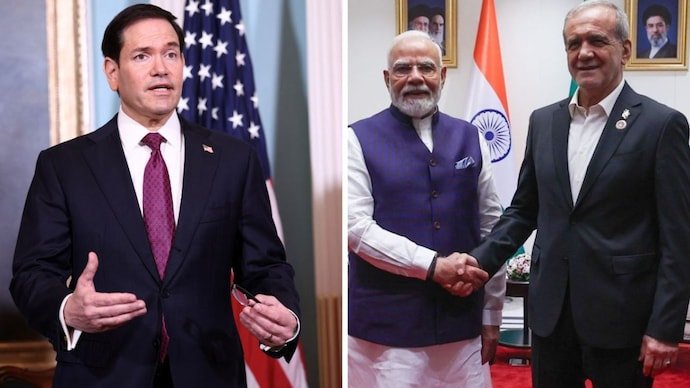
The United States has issued a pointed warning to India and other countries over economic engagement with Iran, saying nations that help Tehran evade American sanctions could themselves face US penalties.
US Secretary of State Marco Rubio delivered the message days after Prime Minister Narendra Modi met Iranian President Masoud Pezeshkian on the sidelines of the Shanghai Cooperation Organisation summit in Bishkek. The meeting focused on strengthening India-Iran relations, expanding and diversifying trade, the worsening situation in West Asia and the safety of commercial shipping and seafarers.
Asked whether India was working toward a new trade arrangement with Tehran, Rubio said he did not believe there was a trade deal between India and Iran. At the same time, he acknowledged that countries have the right to conduct their own foreign policy and maintain relationships with Iran.
But Washington’s position on sanctions was unequivocal. Rubio said countries should not help Iran create mechanisms that allow it to generate revenue in ways the United States considers sanctions evasion. He warned that governments choosing to facilitate such activity could themselves become targets of US sanctions.
The comments place New Delhi in a familiar but increasingly difficult diplomatic position. India has longstanding strategic and economic interests in Iran, while the United States has become one of India’s most important partners. As Washington intensifies its pressure campaign against Tehran, maintaining both relationships will require careful balancing.
What Rubio’s warning means for India-Iran trade
Rubio’s comments do not amount to a demand that every country sever diplomatic or economic relations with Iran. His remarks drew a distinction between maintaining contact with Tehran and helping the Iranian government circumvent US restrictions.
That distinction matters for India.
New Delhi has historically maintained relations with countries on opposing sides of major geopolitical disputes. Its relationship with Iran is rooted in trade, connectivity, regional security and longstanding diplomatic ties. At the same time, India’s relationship with Washington has expanded considerably across defence, technology, investment and strategic cooperation.
The challenge is therefore not simply whether India can continue talking to Iran. It is whether particular transactions, financial arrangements or trade mechanisms could be interpreted by Washington as sanctions evasion.
That creates a compliance issue for companies and financial institutions as well as a diplomatic issue for governments. Even when a country considers a transaction legitimate under its own laws, exposure to the US financial system can create additional risks if Washington determines that the activity violates its sanctions regime.
Rubio’s warning therefore adds another layer of uncertainty to any future expansion of India-Iran economic ties.
Why the Modi-Pezeshkian meeting matters
Modi’s meeting with Pezeshkian was significant because it came at a time when Iran is under intense economic and geopolitical pressure from Washington.
Modi said India remained committed to strengthening its longstanding friendship with Iran and expressed an interest in expanding and diversifying the bilateral trade basket. The two leaders also discussed the situation in West Asia and the need to support efforts aimed at achieving lasting peace.
The meeting was not presented as an announcement of a new trade agreement. Instead, India’s emphasis was on maintaining engagement and exploring ways to broaden economic relations.
That approach reflects New Delhi’s broader diplomatic position. India has repeatedly argued for dialogue and Diplomacy as the preferred way to resolve international disputes, particularly when conflict threatens regional stability and commercial activity.
For India, Iran is also important because developments in the Middle East can directly affect energy supplies, shipping routes, trade flows and the safety of Indian citizens working in the region.
Shipping safety was a major concern
The Modi-Pezeshkian discussions extended beyond trade and diplomacy to the safety of commercial vessels and seafarers.
India called for freedom of navigation and commerce to be protected and stressed that civilians, civilian infrastructure, commercial shipping and seafarers should not be targeted.
The issue has become particularly important as conflict and heightened tensions in West Asia increase risks for international maritime traffic. Commercial ships moving through strategically important waters can face disruption even when they are not directly involved in a conflict.
For India, the safety of seafarers has a practical dimension. Indian nationals work extensively in the global maritime sector, while Indian businesses depend on secure international shipping routes for imports and exports.
This means New Delhi’s engagement with Tehran is not limited to political symbolism. Regional stability has direct consequences for trade and maritime commerce.
Pezeshkian asks India to use its diplomatic influence
The Iranian side also used the meeting to seek India’s diplomatic engagement.
Pezeshkian thanked India for its support and cooperation and urged New Delhi to use its relationships with other countries to help reduce tensions in West Asia. He presented Iran’s position as one focused on peace, security and resolving disputes through dialogue.
He also criticized Washington’s approach toward Tehran, arguing that the United States had chosen confrontation rather than diplomacy.
Iran’s position is fundamentally different from Washington’s. While the Trump administration is seeking to intensify economic pressure on Tehran, Iranian officials have rejected the sanctions campaign and argued that Iran should not be forced to abandon relationships with its trading partners.
India’s diplomatic challenge is to maintain communication with both sides without becoming a participant in their confrontation.
Washington is escalating its economic pressure on Iran
Rubio’s warning is part of a broader US campaign to restrict Iran’s ability to generate and move money through international financial networks.
On August 24, US Treasury Secretary Scott Bessent announced what the administration called “Operation Economic Outcast,” describing it as a major campaign against Iran and entities helping sustain its economy.
The initiative is designed to target the financial connections and channels that Washington believes allow Tehran to maintain access to international commerce and generate revenue despite US restrictions.
The campaign has already moved beyond rhetoric. The US Treasury has subsequently targeted Iranian financial access through measures involving institutions and individuals connected to Iran’s banking and financial networks.
This matters because sanctions pressure increasingly reaches beyond Iranian companies themselves. Foreign banks, trading companies, shipping businesses and other intermediaries can face significant consequences if Washington determines that they are facilitating transactions that violate US restrictions.
That is the environment in which India-Iran economic discussions are now taking place.
Why secondary sanctions create a difficult choice
The most consequential part of Rubio’s message was his warning that countries helping Iran circumvent sanctions could themselves be sanctioned.
This is the logic behind secondary sanctions. Instead of restricting only US persons and entities from doing business with Iran, Washington can use the threat of penalties to influence foreign companies and institutions as well.
For businesses, the calculation can become complicated. A company may have legitimate commercial reasons for working with an Iranian partner, but the possibility of losing access to the US financial system or facing other American restrictions can change the economics of the transaction.
That can make sanctions compliance a central consideration in international trade even when the governments involved have not formally agreed to end their bilateral relations.
For India, the issue is particularly sensitive because the country has sought to preserve strategic autonomy in its foreign policy. New Delhi has continued to maintain relationships with countries that Washington itself has sanctioned or opposed, while simultaneously deepening cooperation with the United States.
India’s balancing act between Washington and Tehran
India’s relationship with Iran predates the current sanctions dispute by decades. The two countries have maintained political, economic and cultural links while cooperating on Regional Connectivity and trade.
At the same time, the India-US relationship has become increasingly broad. The two countries cooperate on defence, technology, investment, regional security and other strategic priorities.
That combination means India has an interest in avoiding a binary choice between Tehran and Washington.
New Delhi’s preferred approach has generally been to maintain independent relationships while explaining its positions directly to its partners. The Modi-Pezeshkian meeting fits that pattern: India expressed support for expanding trade with Iran while also stressing diplomacy, regional peace and protection of commercial shipping.
The question now is how much room remains for that balancing strategy as Washington expands its sanctions campaign.
The trade question is more complicated than a single deal
Rubio’s statement that he does not believe there is an India-Iran trade deal is significant because the two countries’ economic relationship does not depend on one single agreement.
Trade can expand through multiple channels, including individual commercial transactions, transport arrangements, financial mechanisms and sector-specific cooperation. Each can raise separate sanctions and compliance questions.
That means the immediate issue is less about whether India and Iran sign a headline-grabbing trade deal and more about whether individual forms of economic cooperation can operate without triggering US sanctions concerns.
India may therefore seek to preserve legitimate trade while avoiding mechanisms that Washington considers designed specifically to bypass sanctions.
For businesses, this distinction could become increasingly important. The legal and financial risks attached to an Iran-related transaction may depend on the parties involved, the nature of the transaction, the financial institutions used and the applicable sanctions rules.
Iran rejects the US sanctions approach
Tehran has strongly rejected Washington’s latest economic pressure campaign.
Iran’s Foreign Ministry has accused the United States of undermining international law and has argued that sovereign states should not be forced to accept Washington’s approach.
Iranian officials have also maintained that sanctions will not persuade Tehran’s trading partners to abandon their relationships with the country.
That creates a direct clash of positions. Washington wants to make Iran’s economic isolation more comprehensive by targeting the networks that provide Tehran with financial access. Tehran wants to preserve those relationships and demonstrate that it can continue operating despite American pressure.
Countries such as India sit between these competing objectives.
What the dispute means for India’s foreign policy
The broader significance of Rubio’s warning goes beyond one meeting or one potential trade arrangement.
India is trying to preserve strategic flexibility at a time when geopolitical relationships are becoming increasingly interconnected. Decisions involving Iran can have implications for India’s relationship with the United States, while decisions involving Washington can affect India’s ability to maintain established partnerships in West Asia.
India also has a practical interest in reducing instability in the region. Conflict can affect energy markets, shipping costs, supply chains and the movement of workers and goods.
That explains why Modi’s message emphasized both economic engagement and diplomacy. India can seek stronger ties with Iran while simultaneously calling for restraint and protection of commercial shipping.
The approach does not eliminate the tensions created by US sanctions, but it allows New Delhi to keep diplomatic channels open.
What happens next between India, Iran and the US?
The next phase will depend heavily on how Washington applies its sanctions campaign and how India and Iran structure future economic cooperation.
If India-Iran trade expands through transactions that the United States considers permissible, the relationship could continue developing despite the broader confrontation between Washington and Tehran. If new arrangements are viewed by US authorities as deliberate mechanisms for avoiding sanctions, pressure on Indian entities could increase.
Much will therefore depend on the details rather than political statements alone.
The situation could also be influenced by developments in West Asia. Any reduction in regional tensions could create greater room for trade and diplomacy, while further escalation could increase pressure on shipping, energy supplies and financial transactions.
For India, the immediate priority is likely to remain maintaining diplomatic engagement while protecting its commercial and strategic interests.
A warning that puts India’s Iran policy under closer scrutiny
Rubio’s remarks have made one thing clear: Washington is watching how other countries interact economically with Tehran and is prepared to use sanctions against entities it believes are helping Iran circumvent US restrictions.
India, however, has not indicated that it intends to abandon its relationship with Iran. Modi’s meeting with Pezeshkian reaffirmed New Delhi’s interest in strengthening bilateral ties, expanding trade and supporting diplomatic efforts to reduce regional tensions.
That leaves India navigating a narrow diplomatic path.
New Delhi’s challenge is not simply choosing between Iran and the United States. It is preserving room for an independent foreign policy while ensuring that economic engagement with Tehran does not create consequences under an increasingly aggressive US sanctions regime.
As Washington tightens its economic campaign and Tehran pushes back, India’s ability to maintain that balance will be tested through concrete decisions on trade, finance, shipping and regional diplomacy. The Modi-Pezeshkian meeting has kept the relationship moving, but Rubio’s warning shows that every future step will be watched closely in Washington.
For breaking news and live news updates, like us on Facebook or follow us on Twitter and Instagram. Read more on Latest World on thefoxdaily.com.






COMMENTS 0