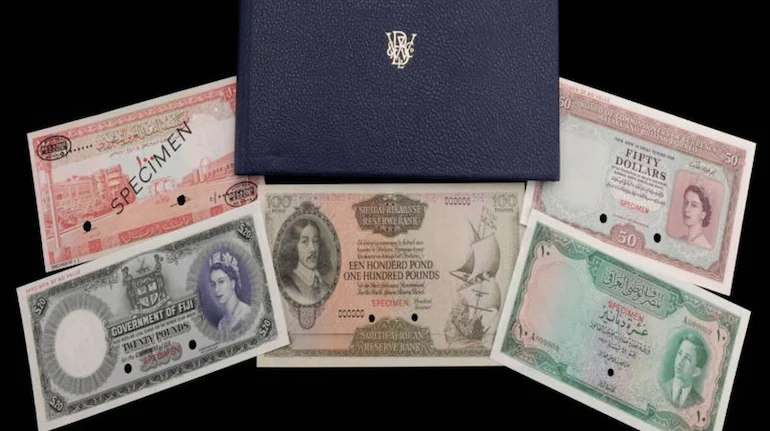
What appeared to be an ordinary donation to a charity shop in Edinburgh has turned into an extraordinary contribution to medical research. A collection of nearly 160 rare banknote lots, anonymously handed over to a British Heart Foundation (BHF) store, has fetched £85,860 at a specialist auction, transforming an overlooked collection of historical currency into funding for the fight against heart and circulatory diseases.
The donation was made at the British Heart Foundation’s Home and Fashion store at Straiton Retail Park in Edinburgh, Scotland. The albums initially attracted little attention from shop employees, who did not immediately recognise the potential historical and financial significance of the banknotes.
Closer examination, however, revealed that the collection contained unusual and valuable pieces from different countries and periods. Rather than placing the notes among ordinary donated goods, the charity arranged for the collection to be assessed by specialists and sent to the auction house Noonans.
The auction took place on October 14, 2026, generating a total of £85,860. The entire amount will support the British Heart Foundation’s research into cardiovascular conditions, including diseases affecting the heart and circulatory system.
The donor’s identity has not been revealed. Nevertheless, the contribution demonstrates how valuable historical objects sitting unnoticed in private collections can eventually support causes with a direct impact on public health.
How an Anonymous Charity Shop Donation Became an £85,860 Auction Success
The story began with an anonymous individual bringing albums of banknotes to the BHF Home and Fashion store at Straiton Retail Park.
Charity shops regularly receive donations ranging from clothing and furniture to books, household items and decorative objects. Most donated goods are assessed for resale through the store’s usual processes. Occasionally, however, an item or collection turns out to be significantly more valuable than its appearance initially suggests.
That was the case with the Edinburgh banknote donation.
The albums contained nearly 160 lots of currency, including rare issues, specimen notes, colour trial examples and designs that never entered official circulation. These characteristics made the collection particularly interesting from a numismatic perspective.
Numismatics is the study and collection of currency, including coins, banknotes, medals and related historical objects. Collectors often look beyond the face value of a banknote, considering its rarity, issuing authority, historical significance, printing characteristics and condition.
For example, an ordinary banknote issued in large quantities may have limited additional value to collectors. A specimen note, an unusual printing trial or an uncirculated historical issue can attract considerably more attention because fewer comparable examples may be available.
The Edinburgh collection contained several examples of precisely these characteristics.
Recognising that the albums could have substantial value, the charity arranged for the banknotes to be handled through specialist auction channels. This helped ensure that the collection could reach interested collectors rather than being sold as ordinary second-hand merchandise.
Why the Rare Banknote Collection Attracted Collectors
The value of historical banknotes is not determined by age alone. Two notes issued during the same decade can have very different market values depending on their rarity, condition, historical background and availability.
The Edinburgh collection was particularly distinctive because it brought together currency from several countries, including issues associated with the former Malaya and British Borneo currency system, Iraq and Saudi Arabia.
It also contained two hand-painted designs connected with Scottish banking history. These designs were never officially issued, giving them a different kind of significance compared with banknotes that entered everyday circulation.
Four categories of items stood out in the collection.
1. Rare Queen Elizabeth II Banknote From Malaya and British Borneo
One of the notable pieces was an uncirculated banknote featuring a portrait of a young Queen Elizabeth II.
The note was issued by the Board of Commissioners of Currency Malaya and British Borneo, a currency authority associated with the monetary arrangements of the region during the colonial period.
Its historical importance extends beyond its monetary denomination. The banknote represents a period when several territories in Southeast Asia operated under a shared currency arrangement before the emergence of their modern national monetary systems.
The portrait of the young monarch also gives the note a connection to the history of the British monarchy. For collectors, the combination of a historical issuing authority, an early royal portrait and an uncirculated condition can make such a banknote especially interesting.
Uncirculated banknotes are generally notes that have not entered normal public circulation. Their condition can be an important factor in determining collector demand because they may retain sharper details and fewer signs of handling.
2. Exceptionally Rare 1947 Iraqi 10-Dinar Colour Trial Note
Another significant item was a 1947 Iraqi 10-dinar colour trial banknote issued by the National Bank of Iraq.
A colour trial note is produced as part of the banknote design and printing process. Such examples can show how different colours and printing arrangements were tested before a final design was approved for production.
These notes are particularly interesting because they provide insight into how currency designs were developed. Unlike ordinary banknotes intended for public use, trial examples were connected with the technical and artistic preparation of a currency issue.
The 1947 Iraqi example was described as exceptionally rare, making it one of the distinctive pieces in the donated collection.
Its importance lies in the combination of its historical date, issuing institution and unusual production status. For collectors interested in Middle Eastern currency history, such an object can offer a perspective that standard circulated banknotes cannot provide.
3. Saudi Arabian 100-Riyal Specimen Banknote From 1961
The collection also included a 100-riyal specimen banknote from Saudi Arabia, dated 1961.
Specimen banknotes are generally produced to demonstrate or authenticate an approved currency design. They are often marked or otherwise distinguished from notes intended for ordinary circulation.
Such banknotes can be distributed to financial institutions, government authorities and other organisations involved in currency management so that they can identify genuine notes and become familiar with their features.
The Saudi Arabian specimen is therefore more than an old example of national currency. It represents an element of the country’s monetary history and the development of its banknote system.
Its presence alongside the Iraqi and Malaya and British Borneo issues also demonstrates the international character of the anonymous donation.
Two Never-Issued Scottish Banknote Designs Reveal a Different Side of Currency History
Among the most unusual pieces in the collection were two hand-painted designs for banknotes associated with the Royal Bank of Scotland.
Unlike the other historical notes, these designs were never officially put into production. They therefore represent proposed currency artwork rather than banknotes that circulated as legal tender.
The distinction is important. A banknote that enters circulation becomes part of everyday economic activity. An unused design, by contrast, offers a glimpse into the creative and institutional decisions involved in producing currency.
Both designs featured important figures and landmarks connected with Scotland’s history.
David Dale Design: Scottish Industry and Education
One of the hand-painted designs featured David Dale, the Scottish industrialist known for his association with the country’s industrial development.
The artwork also incorporated illustrations of the University of Glasgow and a statue of Lord Kelvin.
This combination brought together industrial history, academic achievement and scientific heritage. Rather than presenting currency merely as a financial instrument, the design reflected the idea that banknotes can also represent important elements of a country’s cultural and intellectual identity.
The inclusion of the University of Glasgow and Lord Kelvin gave the proposed design a strong connection to Scotland’s educational and scientific traditions.
Archibald Campbell Design: Edinburgh’s Architectural Heritage
The second design depicted Archibald Campbell, the third Duke of Argyll, alongside illustrations of Edinburgh Castle and the city’s historic Old Town.
The artwork connected an important historical figure with two of Edinburgh’s most recognisable architectural and cultural landmarks.
Edinburgh Castle and the Old Town represent a substantial part of the city’s historical identity. Their inclusion in a proposed banknote design suggests an attempt to incorporate Scotland’s heritage into the visual language of its currency.
Because the designs never entered official production, they also preserve an alternative possibility in Scottish banknote history: an example of what the Royal Bank of Scotland’s currency artwork could have looked like under a different design decision.
For collectors, unpublished or unused banknote artwork can be particularly compelling because it documents a stage of currency production that ordinary circulating notes cannot show.
Why Historical Banknotes Can Be Worth Far More Than Their Face Value
The Edinburgh auction provides a useful example of why collectors sometimes pay substantial amounts for banknotes that have little connection to their original purchasing power.
A banknote’s printed denomination represents its monetary value under the currency system for which it was issued. Its collector value, however, is determined by an entirely different set of considerations.
Several factors can influence the price of a rare banknote.
- Rarity: Notes produced in limited quantities or surviving in very small numbers can attract greater collector interest.
- Condition: Uncirculated notes and examples with minimal damage may be more desirable than heavily used banknotes.
- Historical significance: Currency connected with important political, economic or institutional changes can have additional appeal.
- Printing variations: Colour trials, printing errors and unusual production examples may be especially interesting to specialist collectors.
- Design and artwork: Unissued designs, hand-painted artwork and distinctive portraits can attract interest beyond ordinary currency collecting.
- Provenance: Information about a banknote’s ownership and history can help establish its authenticity and significance.
Not every old banknote is valuable, and age alone does not guarantee a high auction price. A common note that was printed in large numbers may remain relatively inexpensive even if it is several decades old.
By contrast, a rare specimen or a previously unused design can attract specialist attention because comparable examples may be difficult to find.
The Edinburgh collection brought together several different categories of collectible currency, helping explain why it was considered suitable for specialist auction rather than ordinary retail sale.
How the British Heart Foundation Will Use the Auction Proceeds
The most significant outcome of the auction is not simply the amount generated but the purpose for which the money will be used.
The entire £85,860 raised from the sale will support the British Heart Foundation’s research into heart and circulatory diseases.
The BHF is a charitable organisation that funds research aimed at understanding, preventing, diagnosing and treating cardiovascular conditions.
Heart and circulatory diseases cover a broad group of medical conditions involving the heart and blood vessels. These include coronary heart disease, heart failure, stroke-related circulatory conditions and other disorders affecting the cardiovascular system.
Research in this area is important because cardiovascular diseases can affect people across different age groups and may require long-term treatment, monitoring and rehabilitation.
Scientific research can contribute to better understanding of disease mechanisms, improvements in diagnostic methods and the development of new treatment approaches.
However, research funding does not automatically translate into an immediate medical breakthrough. Scientific work often involves several stages, from laboratory investigation and clinical studies to evaluation and eventual application in healthcare.
The £85,860 contribution will therefore support the broader research effort rather than guarantee a specific treatment or outcome.
The donation also illustrates an alternative way for charities to raise money. Instead of relying only on conventional cash donations or the sale of everyday second-hand goods, specialist collectibles can provide an additional source of funding.
Why Charity Shops Sometimes Receive Valuable Collectibles
Charity shops operate at the intersection of retail, reuse and fundraising. People donate goods they no longer need, and the organisations sell suitable items to generate money for their charitable activities.
Most donations are relatively ordinary household goods, clothing, books or furniture. Occasionally, however, people donate objects whose financial or historical value is not immediately obvious.
Rare coins, historical documents, jewellery, artwork, vintage watches and collectible banknotes can sometimes enter the charity retail system without the donor or shop staff initially recognising their significance.
The Edinburgh banknote collection demonstrates why specialist assessment can be important when an unusual donation arrives.
Had the albums been treated as ordinary paper collectibles, their potential value might not have been fully recognised. Sending them to a specialist auction house provided access to a market where collectors could assess their individual historical and numismatic importance.
This also highlights an important point for charity organisations: the resale value of donated goods is not always determined by their appearance or everyday usefulness.
A seemingly outdated banknote may be worth more to a specialist collector than a much newer item with a higher original face value.
What the Anonymous Donation Says About the Value of Private Collections
The identity of the individual who donated the banknotes has not been disclosed. There is also no confirmed explanation of why the collection was given to the charity shop.
Nevertheless, the result demonstrates how private collections can acquire a second purpose when they enter the charitable sector.
People collect banknotes for different reasons. Some are interested in monetary history, others focus on specific countries or historical periods, while some collect unusual printing examples and designs.
Over time, these collections can become valuable records of political, cultural and economic history.
The Edinburgh donation is particularly interesting because it brought together several different historical themes: British royal imagery, the monetary history of Southeast Asia, Iraqi currency production, Saudi Arabian banknotes and Scottish banking artwork.
Each item represented a different part of the international history of money. Together, they generated £85,860 for a charitable cause.
The transaction also shows why preserving historical currency matters. Banknotes are often discarded or exchanged without much thought once they lose their usefulness in everyday transactions. Yet certain examples can retain considerable historical and cultural importance long after their original monetary purpose has disappeared.
What Happens Next After the £85,860 Banknote Auction?
The auction held on October 14, 2026, has already converted the anonymous donation into a financial contribution for the British Heart Foundation.
The next stage is the use of those funds within the charity’s research activities. The supplied information does not identify a particular research project or medical study that will receive the entire amount, so the contribution should be understood as support for the organisation’s wider research work.
For the charity retail sector, the sale also provides an example of the fundraising opportunities that can emerge when unusual donations are identified and professionally assessed.
For banknote collectors, the collection stands out because of its combination of rare international issues and unpublished Scottish banknote artwork.
Ultimately, the Edinburgh donation tells a story that extends well beyond an auction result. A collection of historical currency, whose value was initially overlooked, has generated £85,860 for research into diseases that affect millions of people worldwide.
The donor remains anonymous, and the individual stories behind the banknotes may never be fully known. But their journey from private albums to a charity shop and then to a specialist auction has given these historical objects a new purpose: helping fund research that could improve the future of heart and circulatory health.
For breaking news and live news updates, like us on Facebook or follow us on Twitter and Instagram. Read more on Latest World on thefoxdaily.com.

COMMENTS 0