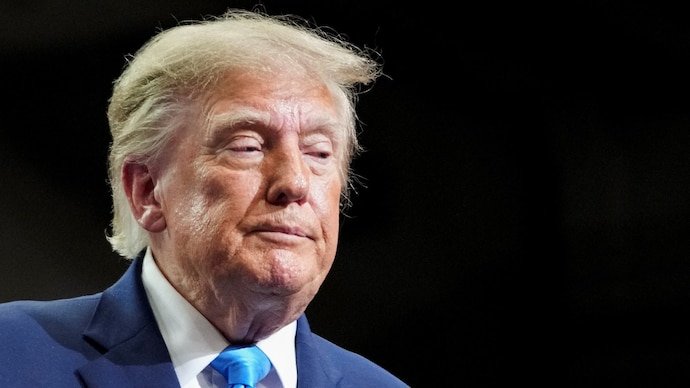
US President Donald Trump appeared to confuse India with Brazil in a Truth Social post about Brazil’s presidential election, claiming that 125 million people had voted in the first round of an Indian presidential election.
The reference was incorrect both in terms of the country involved and the way India’s presidential election works. Trump’s post came as Brazil held the first round of its presidential election, with Senator Flavio Bolsonaro advancing to a runoff against President Luiz Inacio Lula da Silva.
Trump made the claim while criticising the US election system and comparing the speed of election results in Brazil with voting and counting procedures in American cities and states.
Trump Says 125 Million Voted in India’s Presidential Election
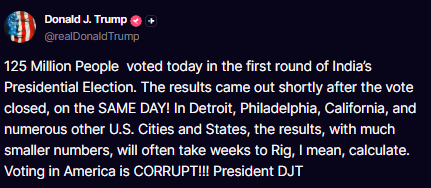
In a post on Truth Social, Trump wrote that “125 Million People voted today in the first round of India’s Presidential Election” and said the results were released shortly after voting closed.
He then contrasted what he described as the rapid announcement of results with election processes in locations including Detroit and Philadelphia, as well as California. Trump used the comparison while arguing that the US election system is “corrupt.”
However, the reference to India was inaccurate. India does not elect its president through a direct nationwide popular vote. The President of India is elected by an Electoral College consisting of elected members of both Houses of Parliament and elected members of the state legislative assemblies, along with the elected assemblies of Delhi and Puducherry.
The election uses proportional representation through the single transferable vote, with voting conducted by secret ballot. It is therefore fundamentally different from a nationwide presidential election in which citizens directly cast ballots for the presidential candidates.
Trump’s Post Came as Brazil Held Its Presidential Election
The timing of the post points to the apparent source of the confusion. Brazil was holding the first round of its presidential election when Trump made the statement.
Brazil’s election produced a runoff between Flavio Bolsonaro, a right-wing senator and son of former president Jair Bolsonaro, and incumbent President Luiz Inacio Lula da Silva.
According to the reported first-round results, Bolsonaro secured about 47 per cent of the vote, while Lula received about 45 per cent. Neither candidate secured the majority required to win the presidency in the first round, leading to a second-round contest scheduled for October 25.
The Brazilian election is a direct presidential election, making the country relevant to Trump’s comparison of presidential voting systems. India, by contrast, uses an electoral college for its presidential election.
Why the India Reference Was Incorrect
Trump’s statement contained more than a country-name mix-up. It also described an electoral process that does not exist in India.
India has a parliamentary system rather than a presidential system in which the head of government is chosen directly by voters through a nationwide presidential ballot. The President is the constitutional head of state and is elected indirectly by the members of the Electoral College.
The Election Commission of India states that the Electoral College includes elected members of both Houses of Parliament and elected members of the Legislative Assemblies of the states, as well as Delhi and Puducherry.
The voting system is also different from a standard first-past-the-post presidential contest. Electors rank candidates according to preference, and the election is conducted using proportional representation by means of the single transferable vote.
That means Trump’s reference to 125 million people voting directly in the first round of India’s presidential election does not correspond to India’s constitutional election process.
Social Media Users Mock Trump’s India-Brazil Mix-Up
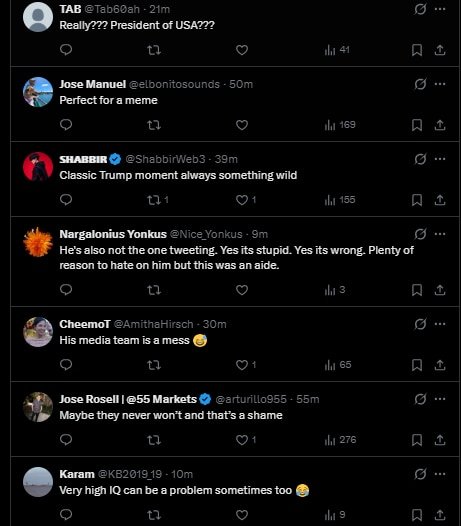
The post quickly became the subject of reactions and jokes on social media. Some users focused on Trump’s apparent confusion between India and Brazil, while others pointed out the error in describing India’s presidential election as a direct popular vote.
One user joked that the US president appeared to believe there were 125 million voters in India despite the country’s population being much larger.
Another joked that Brazil could effectively be renamed India the following day, playing on the apparent country mix-up.
Other reactions focused on the electoral system itself. One user pointed out that Indians do not directly vote for the President and that India operates under a parliamentary system rather than a presidential system.
Another social media post joked that “Brazil is just India with a different filter,” turning the geographical confusion into a meme.
Some reactions also questioned whether Trump was getting enough sleep. Such comments were social media speculation rather than evidence about his Health, and the available post itself does not establish any explanation for the error.
Trump Was Criticising the US Election System
The India-Brazil confusion appeared in the middle of a broader argument Trump was making about American elections.
He contrasted the speed of election results in Brazil with the way voting and counting can take place in the United States. His post referred specifically to Detroit, Philadelphia and California as examples while making a broader claim about the integrity of the American electoral system.
The geographical error consequently became the main focus of online discussion rather than the underlying argument about election administration.
Comparing election systems across countries requires attention to how voting is conducted, who is eligible to vote, how ballots are counted and what constitutional system each country uses. Brazil and India differ substantially on those points.
Brazil’s Election Produced a Bolsonaro-Lula Runoff
The actual election taking place when Trump posted his message was Brazil’s presidential vote.
Flavio Bolsonaro advanced to the runoff after performing strongly in the first round, while Lula also secured enough support to move into the second round. The contest between the two candidates is scheduled to continue on October 25.
Flavio Bolsonaro is the son of former Brazilian President Jair Bolsonaro. Lula is the incumbent president and is seeking another term in office.
The first-round result meant that neither candidate obtained enough votes to secure the presidency immediately. Brazil’s electoral system therefore moves the leading candidates into a second round when the required majority is not achieved.
This is the election that appears to have been the subject of Trump’s post, although he referred to India instead of Brazil.
Trump’s Earlier Country-Naming Errors
The latest India-Brazil mix-up is not the first occasion on which Trump has made a country-name error while discussing international affairs.
In July, during a discussion involving Ukrainian President Volodymyr Zelenskyy and US military operations, Trump referred to Iran as the “Islamic Republic of Japan.”
While discussing the Patriot missile system and recalling an attack involving the USS Abraham Lincoln, Trump said that missiles had been launched by what he called the Islamic Republic of Japan, despite the discussion concerning Iran.
The statement attracted attention because Iran and Japan are geographically and politically distinct countries, and the comment came during a discussion involving military operations and tensions surrounding Iran.
Greenland Was Also Referred to as Iceland
Another earlier example occurred in January, when Trump repeatedly referred to Greenland as Iceland during an address at the World Economic Forum in Davos.
The comments were notable because Trump was discussing Greenland in the context of his territorial ambitions, yet used the name of Iceland while speaking about the territory.
Like the latest India-Brazil error, that incident involved two geographically distinct places being incorrectly substituted during a public statement.
Why the Latest Gaffe Drew Attention
The latest error attracted particular attention because it involved both the identity of the country and the basic structure of its presidential election.
India and Brazil are both large democracies, but their systems for choosing national leaders are different. Brazil holds a direct presidential election in which voters choose among presidential candidates. India’s President is elected indirectly through an Electoral College.
The number cited by Trump also drew attention because it was presented as the number of people voting in an Indian presidential election. Since ordinary Indian voters do not directly cast ballots for the President, the figure does not describe India’s presidential election process.
The distinction matters when comparing election systems. A claim about the speed or transparency of election results can only be meaningfully compared when the underlying voting and counting mechanisms are understood.
India’s Presidential Election Is an Indirect Election
Under India’s constitutional system, the President is elected by elected representatives rather than through a direct popular vote.
The Electoral College includes elected members of Parliament and elected members of state legislative assemblies, including the legislative assemblies of Delhi and Puducherry. Nominated members are not part of the Electoral College.
The votes also do not simply count as one vote per elector in the same way as a conventional popular election. The value of votes assigned to members of state legislative assemblies varies according to the constitutional formula, while the value assigned to members of Parliament is calculated separately.
Electors mark preferences among candidates, and the result is determined under the single transferable vote system. The arrangement is designed to balance representation between the Union and the states rather than produce a direct nationwide popular tally.
A Viral Post Turns Into a Broader Election Debate
Trump’s post illustrates how a single error can shift attention away from the original subject of a political message. His stated purpose was to criticise the American election system and compare it with the speed of results elsewhere.
Instead, the India-Brazil mix-up became the central focus of the online response.
The incident also highlights the importance of distinguishing between presidential and parliamentary systems when discussing elections internationally. A country can hold national elections without allowing citizens to directly choose the head of state, as India’s presidential election demonstrates.
For Brazil, meanwhile, the election underway was an actual direct presidential contest, with Flavio Bolsonaro and Lula moving into the runoff after the first round.
Trump’s Latest Gaffe Adds to Recent Naming Slips
The India-Brazil error has drawn renewed attention because it follows other instances in which Trump has used the wrong country name while discussing international affairs. The previous examples involving Iran and Japan, as well as Greenland and Iceland, have similarly generated public discussion.
In the latest case, however, the error was especially significant because Trump’s claim combined the wrong country with an incorrect description of how that country’s presidential election works.
As Brazil moves toward its October 25 runoff, India’s presidential election system remains fundamentally different from the Brazilian model. Trump’s post brought the two countries into the same political discussion, but the constitutional and electoral processes of the two nations remain distinct.
For breaking news and live news updates, like us on Facebook or follow us on Twitter and Instagram. Read more on Latest World on thefoxdaily.com.





COMMENTS 0