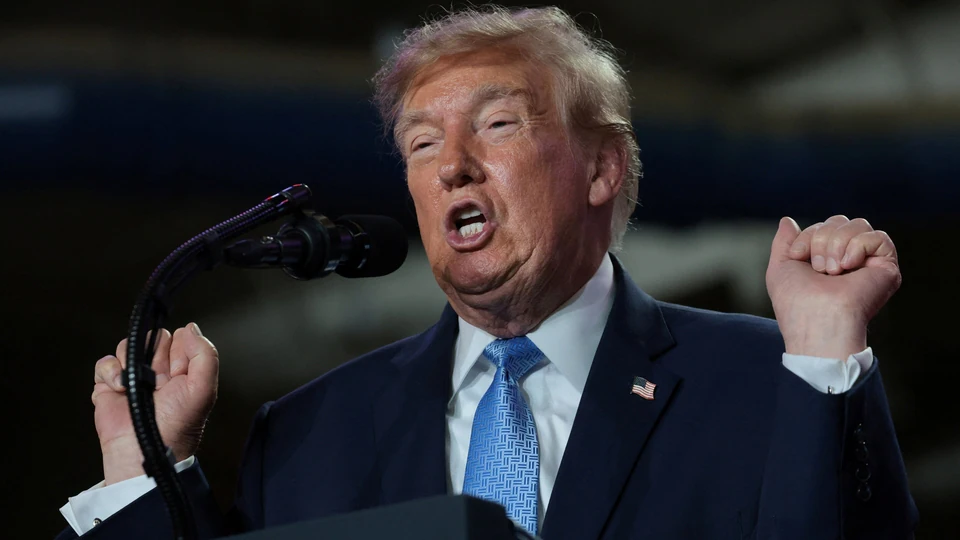
US President Donald Trump faced online fact-checks after claiming that his uncle, Dr John G. Trump, invented radar, prompting renewed discussion about the physicist’s contributions to wartime technology and the history of radar development.
Trump made the remark on October 24 while speaking during early voting for the 2026 midterm elections in Palm Beach, Florida. With First Lady Melania Trump beside him, the president linked his uncle’s scientific background to the US military campaign against Iran, saying his uncle would probably be angry that he had “knocked out their [Iran’s] radar”.
The video of the remarks circulated widely online. However, users quickly challenged the claim, pointing out that although John G. Trump contributed to radar research and development during World War II, he did not invent the technology.
The episode has drawn attention to the distinction between an individual’s contribution to a scientific breakthrough and the invention of the technology itself. It has also revived interest in John Trump’s career as an engineer and physicist at the Massachusetts Institute of Technology (MIT).
Trump Fact-Checked After Claiming His Uncle Invented Radar
During his remarks, Trump identified his uncle as John Trump and referred to his connection with MIT. He then claimed that his uncle had invented radar, linking the historical reference to his comments about US military operations against Iran.
The statement was challenged on X, where a community note explained that John G. Trump had contributed to the development and deployment of radar during World War II through work associated with MIT’s Radiation Laboratory, commonly known as the Rad Lab.
The note clarified that radar had emerged through the work of several scientists and researchers, including Heinrich Hertz, Christian Hülsmeyer and Robert Watson-Watt.
A podcast host cited in the online discussion also attributed a major role in radar’s development to Scottish physicist Sir Robert Watson-Watt, who helped advance practical radar systems during the 1930s.
The central correction is that John Trump was involved in important wartime scientific work, but there is no basis for describing him as the sole inventor of radar. The technology developed through decades of research into electromagnetic waves, radio detection and the practical systems used to identify objects at a distance.
Who Was Dr John G. Trump?
Dr John George Trump was an American electrical engineer, physicist and professor at MIT. He specialised in high-voltage phenomena, electron acceleration and radiation, making contributions to scientific research and the development of equipment used in medicine and nuclear research.
His work included the design of high-voltage equipment and X-ray generators used in cancer treatment. He also co-founded a company that manufactured generators for nuclear research, reflecting his involvement in the practical application of advanced electrical and radiation technologies.
Trump’s scientific career extended beyond radar. His research and engineering work contributed to areas involving high-energy physics, medical technology and industrial applications of radiation.
His association with MIT also made him a prominent figure in the institution’s scientific community. The university later recognised his career and his connection to the US president.
John Trump’s Role in World War II Radar Research
During World War II, John Trump contributed to Allied radar research. MIT’s Radiation Laboratory played an important role in developing and improving microwave radar systems that helped Allied forces detect aircraft, ships and other targets.
Radar works by transmitting radio waves and analysing the signals reflected by objects. By measuring the returned signals, a system can help determine an object’s presence, distance and, in some circumstances, its direction and movement.
Developing practical radar systems required advances in radio engineering, electronics, microwave technology and signal processing. Researchers and engineers across several countries contributed to those advances over time.
John Trump’s involvement in wartime research placed him within this broader scientific effort. His work contributed to the development and deployment of radar technology, but that is different from inventing radar itself.
The distinction matters because major technologies often emerge through the combined efforts of researchers working on different scientific and engineering problems. A scientist may make an important contribution to improving a system or making it usable in military operations without being its original inventor.
Who Invented Radar?
Radar does not have a single inventor in the same way that some individual inventions can be attributed to one person. Its development involved early discoveries about electromagnetic waves, experiments demonstrating radio-wave reflection and later engineering work that transformed those principles into practical detection systems.
German physicist Heinrich Hertz demonstrated the existence and behaviour of electromagnetic waves in the late 19th century, helping establish the scientific foundations on which later radio technologies developed.
German inventor Christian Hülsmeyer demonstrated a system for detecting distant objects using radio waves in the early 20th century. His 1904 telemobiloscope could detect ships and was an important precursor to later radar systems.
Scottish physicist Robert Watson-Watt became a key figure in the development of practical radar for Britain’s air-defence network during the 1930s. His work helped establish systems that could detect approaching aircraft and played a significant role in Britain’s wartime preparations.
Radar development subsequently involved researchers, engineers and military laboratories in several countries. During World War II, teams at institutions including MIT’s Radiation Laboratory helped advance microwave radar technology and its operational use.
For this reason, attributing the invention of radar exclusively to John Trump overlooks the technology’s earlier scientific foundations and the contributions of other researchers. His role is more accurately described as part of the wider wartime effort to develop and deploy radar systems.
Trump Has Mentioned His Uncle’s Scientific Expertise Before
The president has referred to his uncle’s scientific background on previous occasions. According to earlier reporting, Trump discussed John G. Trump during a 2024 rally in New Hampshire while campaigning for president.
A 2016 article in The New Yorker also reported that Trump had mentioned his uncle in interviews, speeches and debates.
During his first term as president, Trump referred to his uncle’s knowledge of nuclear physics while discussing nuclear-related issues, including the Iran nuclear deal and North Korea.
These references have presented John Trump as a family connection to advanced scientific knowledge. However, the fact that a relative was a physicist does not itself establish the accuracy of a claim about a particular technology or determine the merits of a political or military position.
MIT Recognised John Trump’s Scientific Legacy
MIT highlighted John Trump’s career in a post published in June, describing him as the president’s uncle while emphasising his wider achievements as a scientist, engineer, educator and entrepreneur.
The university noted his historical role in connection with D-Day and said there was more to his story than his relationship to the president. It also described him as a figure whose work continued to have an impact.
John Trump died in 1985. His professional legacy includes his work in electrical engineering, radiation research, medical equipment and wartime technology.
MIT’s recognition of his career provides a broader picture of the physicist beyond the political discussion surrounding his nephew’s remarks. His contributions to science and engineering can be acknowledged without overstating his role in the invention of radar.
Why the Radar Claim Matters
The online reaction illustrates how historical claims made by public figures can quickly attract scrutiny, particularly when they involve scientific inventions with well-documented histories.
Radar was not created in a single moment by one scientist. It developed through a series of discoveries and engineering advances, followed by major efforts to make the technology effective for military and civilian applications.
John Trump’s wartime research was part of that larger process. Describing him as a contributor to radar development is consistent with his scientific career, while claiming that he invented radar overstates his role.
The distinction also highlights the importance of separating a person’s documented achievements from claims made about them in political speeches. A scientist’s contribution can be significant without making that individual the sole inventor of a complex technology.
Conclusion
Donald Trump’s claim that his uncle invented radar was challenged online because the historical record points to a broader, collaborative development of the technology. John G. Trump was a respected MIT physicist and engineer who contributed to Allied radar research during World War II, but he was not the sole inventor of radar.
Radar’s development drew on earlier scientific discoveries and the work of researchers including Heinrich Hertz, Christian Hülsmeyer and Robert Watson-Watt, alongside the engineers and scientists who advanced practical systems during the war.
John Trump’s legacy extends well beyond radar, encompassing research into high-voltage phenomena, electron acceleration, radiation and medical equipment. His scientific achievements remain significant in their own right, even as the president’s latest remarks have renewed debate over the history of one of the 20th century’s most important technologies.
For breaking news and live news updates, like us on Facebook or follow us on Twitter and Instagram. Read more on Latest World on thefoxdaily.com.




COMMENTS 0