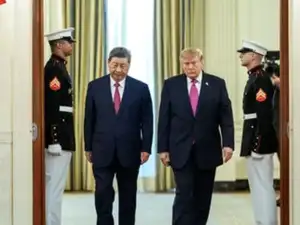
The trade relationship between the United States and China has undergone a dramatic shift since Donald Trump returned to the White House in January 2025. What began with new American tariffs over concerns involving fentanyl and immigration quickly developed into a wider economic confrontation, with both countries imposing duties on each other’s goods and restricting access to strategically important products.
At the height of the dispute, Washington and Beijing raised tariffs to extraordinary levels, threatening trade flows and increasing uncertainty for businesses. The confrontation also extended beyond traditional import duties, involving rare-earth minerals, technology restrictions, agricultural purchases and major investment commitments.
Repeated negotiations eventually helped both sides step back from the most severe measures. The October 2025 agreement reached during Trump’s meeting with Xi in South Korea established the foundation for a trade truce. Subsequent meetings and extensions have kept the arrangement alive, although a comprehensive settlement remains unresolved.
The two leaders are now expected to meet during the APEC leaders’ summit in Shenzhen, China, on November 18-19. Their discussions are taking place against the January 10, 2027, deadline for the extended trade truce. The immediate challenge is to prevent another escalation while finding a more durable framework for economic relations.
How the US-China Trade War Started in 2025
The latest phase of the trade conflict began in February 2025, when Trump imposed a 10% tariff on Chinese imports, citing concerns related to fentanyl and immigration. China responded with retaliatory duties on several American products, including coal, liquefied natural gas, crude oil and automobiles. Beijing also introduced export restrictions affecting metals important to defence and clean-energy industries.
In March 2025, Washington doubled its fentanyl-related tariffs on Chinese goods to 20%. China responded with additional duties of 10% to 15% on American agricultural products, affecting a significant market for US farmers.
The dispute intensified in April when Trump announced sweeping tariffs under his so-called Liberation Day trade policy. The measures included a 34% tariff on Chinese goods, prompting Beijing to announce retaliatory duties.
Neither government appeared willing to back down immediately. The United States repeatedly increased its tariffs, while China responded with further countermeasures. At one point, announced tariff rates reached 125% on both sides, illustrating how quickly the confrontation had escalated.
China also tightened controls on rare-earth exports, increasing pressure on American industries that depend on these materials. The dispute was no longer limited to the cost of imported goods. It had become a broader contest involving supply chains, industrial capacity and access to strategically important resources. :chatgpt-content-reference{index=”0″}
May 2025: Geneva Talks Bring the First Major Pause
The economic consequences of escalating tariffs created pressure for negotiations. In May 2025, American and Chinese officials met in Geneva, Switzerland, to find a way to prevent the dispute from becoming even more damaging.
The discussions produced a 90-day tariff pause. The United States reduced its tariffs on Chinese goods from 145% to 30%, while China lowered its duties on American imports from 125% to 10% under the temporary arrangement.
The agreement did not resolve the underlying disagreements, but it provided both governments with an opportunity to continue negotiations without immediately increasing trade barriers. The pause was subsequently extended in August, giving officials additional time to work towards a broader understanding.
For businesses, the reduction offered some relief from the uncertainty created by rapidly changing tariff rates. However, the temporary nature of the arrangement meant that companies still had to prepare for the possibility of renewed restrictions.
October 2025: Rare Earths Bring Fresh Tensions
The relative calm did not last. In October 2025, China expanded its rare-earth export controls, prompting another sharp response from Washington.
Trump threatened an additional 100% tariff on Chinese imports and announced export controls targeting critical software. His administration also raised the possibility of restrictions involving Boeing aircraft parts.
The dispute highlighted the importance of rare-earth minerals in the economic relationship between the two countries. These materials are used in several industries, including electronics, clean-energy technologies, defence equipment and advanced manufacturing.
China’s position in rare-earth supply chains gave its export restrictions significant implications for American manufacturers. For Washington, the issue was not simply about trade costs but also about the security and reliability of supplies needed by important industrial sectors.
The escalation increased the urgency of direct discussions between Trump and Xi. Later that month, the two leaders met in South Korea and reached an agreement that helped prevent the confrontation from developing into another round of major tariff increases.
The Busan Agreement: How Trump and Xi Reached a Trade Truce
The October 2025 meeting in Busan, South Korea, became a turning point in the trade dispute. Trump agreed to reduce certain tariffs in exchange for commitments from Beijing involving fentanyl precursor chemicals, renewed purchases of American soybeans and a pause in expanded rare-earth export controls.
The agreement, commonly associated with the Busan trade arrangement, established a temporary framework for managing disagreements between the two economies. Rather than resolving every dispute, both governments agreed to suspend or delay selected measures while continuing negotiations.
The arrangement was important because it reduced the immediate risk of another round of tariff retaliation. It also demonstrated that both sides could use negotiations to address specific trade concerns even when broader economic and strategic disagreements remained.
However, the agreement was not a comprehensive free-trade deal. Issues involving technology restrictions, market access, industrial policy and the balance of trade continued to complicate the relationship.
February 2026: US Supreme Court Ruling Changes the Tariff Landscape
Another major development came in February 2026, when the US Supreme Court ruled against Trump’s use of emergency powers to impose certain tariffs. The ruling struck down the emergency tariff measures, including the China-related fentanyl tariffs and the reciprocal tariff regime.
Trump responded by introducing a temporary 10% global duty under a different legal authority. The decision changed the legal framework surrounding the administration’s tariff policy but did not end the wider trade disagreement with China.
The episode demonstrated that the US administration’s trade measures were also subject to domestic legal constraints. It added another layer of uncertainty for businesses trying to understand which duties would remain in force and how Washington would pursue its trade objectives.
May 2026: Trump Visits Beijing for Trade Discussions
Trump travelled to Beijing in May 2026 for another meeting with Xi. The visit produced plans to establish new Boards of Trade and Investment to provide mechanisms for discussing economic issues and identifying opportunities for cooperation.
China also agreed to purchases involving Boeing aircraft and American agricultural products. These commitments were important because they offered a practical way to demonstrate progress in the trade relationship beyond simply suspending tariffs.
The proposed boards were intended to provide more structured channels for economic discussions. Regular engagement could help both governments address commercial disagreements before they developed into broader confrontations.
However, the announcements did not eliminate the central differences between Washington and Beijing. Both countries continued to pursue policies aimed at protecting important industries and managing their dependence on each other’s markets and supply chains.
September 2026: Another Trump-Xi Summit Extends the Truce
Trump hosted Xi at the White House in September 2026 for another round of discussions. The meeting produced an agreement to reduce tariffs on a $60 billion package of non-sensitive goods, with both sides considering reciprocal concessions.
The leaders also agreed to give negotiations more time by extending the broader trade truce. The arrangement, which had been due to expire in November, was extended by two months until January 10, 2027.
The extension was significant because it prevented the immediate return of several suspended trade measures. It also gave officials additional time to work towards a wider economic agreement.
However, the September meeting did not produce a final settlement. The two governments continued to disagree over several important issues, including market access, technology restrictions and the implementation of earlier commitments.
The November extension has since been reinforced by further decisions to maintain suspensions of selected trade measures. Officials from both countries have also held the first formal meeting of the Board of Trade, creating another channel for discussions ahead of the APEC summit. :chatgpt-content-reference{index=”1″}
Why the APEC Meeting Matters for Trump and Xi
The expected meeting between Trump and Xi in Shenzhen on November 18-19 comes at a sensitive point in the trade relationship. The two leaders have already met several times in 2025 and 2026, but the central economic disagreements remain unresolved.
The immediate priority is likely to be maintaining the existing truce and preventing fresh tariff increases before the January deadline. Both governments have an interest in keeping trade channels open while their officials continue working on outstanding issues.
Agricultural purchases, rare-earth exports and the implementation of previous commitments remain important parts of the negotiations. Washington has sought greater Chinese purchases of American goods and progress on commitments involving fentanyl-related chemicals. Beijing, meanwhile, has raised concerns about American restrictions affecting Chinese companies and access to technology.
The discussions also carry significance for global businesses. Companies operating across international supply chains need predictable trade rules to plan manufacturing, sourcing and investment. Renewed tariff escalation could increase costs and complicate decisions for manufacturers, exporters and importers in both countries.
The APEC meeting may provide an opportunity to clarify the next steps, but an extension of the truce should not automatically be interpreted as a permanent resolution. The broader negotiations will still have to address disagreements that have developed over several years.
What Happens When the Trade Truce Expires in January 2027?
The January 10, 2027, deadline is an important point in the current negotiations. Unless the two sides agree on another extension or a broader arrangement, suspended measures could become a source of renewed pressure in the relationship.
A breakdown in negotiations could create uncertainty over tariffs, export restrictions and other trade commitments. Businesses that rely on American and Chinese suppliers would need to consider the possibility of higher costs or changes in access to important materials.
However, the deadline does not automatically mean that a new tariff war will begin. Both governments retain the option of extending the arrangement, negotiating further concessions or establishing a more comprehensive agreement.
The outcome will depend on whether Washington and Beijing can make progress on the issues that have repeatedly disrupted their relationship. The trade truce has provided temporary stability, but its long-term future depends on the willingness of both sides to implement commitments and manage disagreements.
From Tariff Escalation to a Fragile Economic Understanding
The journey from the tariff confrontation of early 2025 to the current trade truce shows how quickly relations between the United States and China can shift between escalation and negotiation. Both governments used tariffs and export restrictions to apply pressure, but the economic consequences eventually created room for temporary agreements.
Trump and Xi have since relied on direct meetings, ministerial discussions and proposed trade mechanisms to prevent another major confrontation. Yet the underlying competition over technology, strategic resources and market access continues to shape the relationship.
The upcoming APEC meeting will test whether the two leaders can preserve the progress made so far and provide businesses with greater certainty. For now, the trade truce remains a temporary arrangement rather than a final settlement. The next phase of US-China relations will depend on what both governments can agree before January 10, 2027.
For breaking news and live news updates, like us on Facebook or follow us on Twitter and Instagram. Read more on Latest World on thefoxdaily.com.





COMMENTS 0