A year after Japanese Prime Minister Sanae Takaichi made remarks about a possible Chinese military action against Taiwan, relations between Tokyo and Beijing remain strained, with the dispute expanding from diplomatic protests into trade restrictions, military tensions and disruptions to critical mineral supplies. What began as a controversy over Japan’s potential response to a Taiwan crisis has developed into a wider confrontation affecting industries that depend on Chinese materials.
China has repeatedly demanded that Takaichi retract her comments, while Japan has maintained that her remarks reflect its existing security policy. Beijing has responded with warnings to Chinese travellers, restrictions on dual-use exports, renewed pressure over seafood imports and controls affecting Japanese companies and defence-linked entities.
The dispute has also exposed the economic risks Japan faces because of its dependence on Chinese supplies of minerals used in automobiles, semiconductors, electronics and military equipment. Despite a year of tensions, the first encounter between Takaichi and Chinese President Xi Jinping since the controversy, at the Asia-Pacific Economic Cooperation (APEC) summit in Shenzhen on November 19, 2026, produced little visible sign of a diplomatic reset.
Why Did Sanae Takaichi’s Taiwan Remarks Anger China?
The immediate trigger was Takaichi’s statement in Japan’s parliament on November 7, 2025. She said Chinese action against Taiwan that also threatened Japan’s survival could create circumstances in which Tokyo might respond militarily.
The significance of the remarks lay in their unusually direct reference to a possible Japanese military response to a Taiwan contingency. Previous Japanese leaders had generally avoided publicly discussing specific circumstances in which a conflict involving Taiwan could draw Japan into a security crisis.
Beijing viewed the statement as interference in an issue it considers central to its sovereignty. China regards Taiwan as part of its territory and opposes any suggestion that another country could intervene militarily in a conflict over the island.
Japan, meanwhile, has a direct security interest in developments around Taiwan because of its geographical proximity and its alliance with the United States. A conflict in the Taiwan Strait could have consequences for Japanese security and regional stability, even if Japan were not initially a participant.
This difference in how the two governments view Taiwan turned Takaichi’s parliamentary remarks into a major diplomatic dispute. China’s demand for a retraction and Japan’s refusal to withdraw the statement kept the disagreement alive.
How the Dispute Escalated: A Timeline of Japan-China Tensions
The disagreement unfolded through a series of diplomatic exchanges and economic measures. The following timeline shows how a statement made in November 2025 developed into a wider dispute involving trade, military security and critical supply chains.
October 31, 2025: Xi Jinping and Takaichi Meet at APEC
Chinese President Xi Jinping met Takaichi at the APEC summit in South Korea on October 31, 2025. Both leaders agreed to pursue stable relations, creating an initial diplomatic opening after Takaichi became Japan’s prime minister.
However, tensions emerged soon afterwards when Beijing protested over her meeting with Taiwan’s representative. The disagreement over Taiwan became more serious after her parliamentary remarks the following week.
November 7, 2025: Takaichi Raises the Possibility of a Japanese Military Response
On November 7, Takaichi told Japan’s parliament that Chinese action against Taiwan that also threatened Japan’s survival could prompt a Japanese military response.
The statement attracted attention because Japanese leaders had generally avoided publicly identifying specific Taiwan-related scenarios that could involve Japan’s military. Beijing interpreted the remarks as a challenge to its position on Taiwan and demanded that Tokyo withdraw them.
November 13–14, 2025: China Demands Retraction and Issues Travel Warning
On November 13, China demanded that Takaichi retract her comments, warning that Japan would otherwise have to bear the consequences. Beijing argued that her statement contradicted the spirit of the 1972 diplomatic agreement between the two countries.
The 1972 Japan-China Joint Communique established diplomatic relations between Tokyo and Beijing. Japan recognised the People’s Republic of China as the sole legal government of China and stated that it fully understood and respected Beijing’s position on Taiwan.
On November 14, Beijing escalated its response by advising Chinese citizens against travelling to Japan. It also issued a warning of a “crushing” military defeat if Tokyo intervened in a Taiwan conflict.
November 18–19, 2025: Diplomatic Talks Fail to Resolve the Dispute
Japanese and Chinese diplomats met in Beijing on November 18, but the discussions produced no breakthrough. China repeated its demand for a retraction, while Japan maintained that Takaichi’s remarks reflected the country’s long-standing security policy.
A day later, China told Japan that its procedures for importing Japanese seafood were insufficient. The move indicated a possible return to a broader import ban, just months after Beijing had partially relaxed earlier restrictions.
December 6, 2025: Japan Reports Radar Incident Near Okinawa
Military tensions added another dimension to the dispute in December. On December 6, Japan said Chinese fighter jets had directed targeting radar at Japanese military aircraft near Okinawa in two separate encounters.
Tokyo viewed the reported incidents as a serious security concern. Beijing disputed Japan’s account, leaving the two governments with conflicting descriptions of what had happened.
The incident demonstrated how the diplomatic disagreement over Taiwan was unfolding alongside wider military tensions in the surrounding region. It also highlighted the risks of miscalculation when military aircraft operate in areas where both countries have significant security interests.
January 6, 2026: China Imposes Dual-Use Export Restrictions
On January 6, China announced a ban on exports of dual-use goods to Japanese military users and for purposes that Beijing said would strengthen Japan’s military capabilities.
Dual-use goods are products, technologies or materials that can serve civilian as well as military purposes. They can include components and specialised materials used in industrial manufacturing, electronics and defence-related applications.
Japan protested against the restrictions. The decision marked a significant expansion of the dispute because it moved beyond diplomatic statements and into trade controls that could affect Japanese businesses and defence-linked supply chains.
January 26, 2026: Takaichi Clarifies Her Position but Does Not Retract Remarks
Takaichi sought to clarify her earlier statement on January 26. She said her remarks did not mean Japan would automatically enter a war if China and the United States clashed over Taiwan.
However, she also warned that abandoning US forces during such a crisis could undermine the Japan-US alliance. Her clarification did not amount to a withdrawal of the original remarks, leaving Beijing’s central demand unanswered.
The distinction was important: Tokyo sought to explain that its response would depend on the circumstances rather than follow automatically from a conflict involving Taiwan. Beijing, however, continued to insist that the original statement should be retracted.
February 24, 2026: China Targets 40 Japanese Entities
China expanded its export restrictions on February 24 by prohibiting dual-use exports to 20 Japanese entities. The list included units of Mitsubishi Heavy Industries, a major Japanese industrial and defence-sector company.
Another 20 Japanese entities were placed under tighter scrutiny. The measures increased pressure on companies connected to sectors that could have military applications and made the dispute more consequential for Japanese industry.
By targeting specific organisations, Beijing’s restrictions moved beyond a general warning to Japanese military users. They also raised questions for businesses about access to Chinese-origin materials and technologies used in industrial production.
Mid-2026: Critical Mineral Shortages Become a Business Concern
By the middle of 2026, Japanese companies were increasingly warning that shortages of critical minerals were affecting their operations. Chinese customs data showed no shipments of gallium, dysprosium, terbium or yttrium to Japan in June, extending a period of supply disruption.
These materials are important to several advanced manufacturing industries. Gallium is used in semiconductor technologies, while rare earth elements such as dysprosium and terbium are important for specialised magnets and other high-performance applications. Yttrium is used in areas including electronics and advanced materials.
The potential consequences extend across industries. Japanese manufacturers depend on reliable supplies of specialised materials for products ranging from automobiles and electronic components to advanced industrial and defence equipment.
China’s restrictions therefore created a challenge that went beyond the immediate diplomatic dispute. Even companies without direct involvement in defence production could face difficulties if their supply chains depended on materials affected by export controls.
The situation also highlighted the difficulty of quickly replacing specialised mineral supplies. Finding alternative suppliers, qualifying materials and adjusting manufacturing processes can take time, particularly when industries require consistent technical specifications.
November 9, 2026: China Extends Pause on Certain US-Related Trade Controls
On November 9, Beijing extended the suspension of certain export-control measures, including curbs involving rare earths, under a trade truce extension with Washington agreed in September. The suspension was kept in place until January 10, 2027.
However, the extension did not remove China’s separate restrictions on dual-use exports to Japan. This distinction matters because the trade arrangements involving Washington did not automatically resolve the restrictions imposed on Japanese military users and designated entities.
Japan therefore remained exposed to the consequences of the separate measures, even as Beijing adjusted some of its broader trade restrictions involving the United States.
November 19, 2026: Xi and Takaichi Shake Hands at APEC, but No Bilateral Talks Take Place
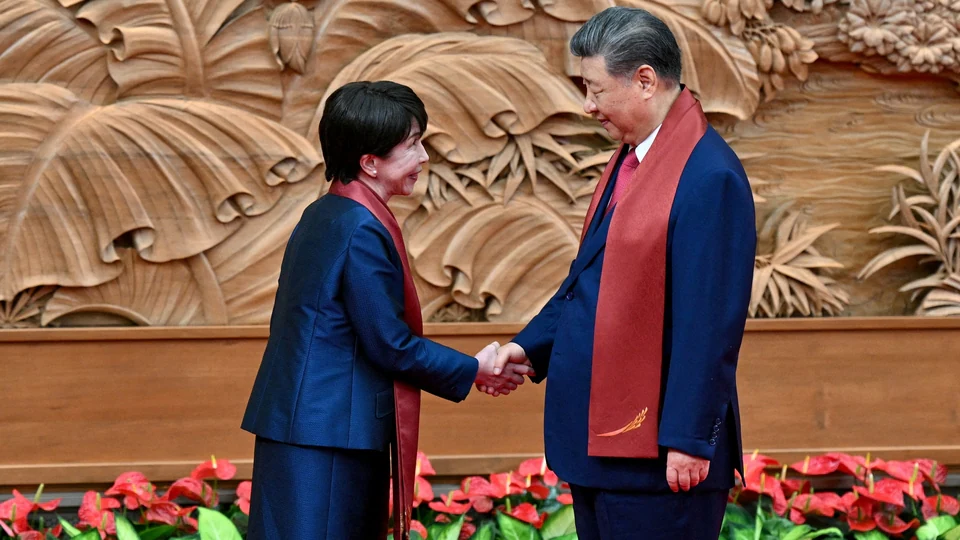
The first encounter between Xi and Takaichi since the Taiwan controversy took place at the APEC summit in Shenzhen on November 19, 2026. The two leaders shook hands, marking a visible moment of contact after a year of strained relations.
However, the meeting did not develop into formal bilateral talks. Takaichi received a relatively low-key welcome in China, falling short of the prominent reception given to some other visiting leaders.
The limited interaction reflected the continuing diplomatic distance between the two governments. A handshake offered an opportunity for contact, but it did not resolve the disagreement over Taiwan or the economic restrictions imposed during the dispute.
At a press conference during the summit, Takaichi said Japan’s position on Taiwan had not changed from the position expressed in the 1972 Japan-China Joint Communique. She reiterated that there had been no change to the country’s established position, while also describing China as an important neighbour with which Japan needed to communicate.
Her remarks indicated that Tokyo was seeking to maintain diplomatic engagement without withdrawing its earlier statement. China, meanwhile, continued to demand a retraction. The two sides therefore entered the next phase of their relationship without resolving the central disagreement.
Why Taiwan Is So Important to Japan’s Security Calculations
Taiwan’s location makes developments around the island particularly important to Japan. It lies close to Japan’s southwestern island chain, including areas around Okinawa, and is situated near strategically important sea routes in the western Pacific.
A military confrontation in the Taiwan Strait could affect regional shipping, trade and security. Japan’s proximity means that a major conflict could create direct challenges for its territory, military facilities and transport networks.
Japan also has a security alliance with the United States, which maintains military forces in the country. Any major confrontation involving US forces and China over Taiwan could therefore create difficult decisions for Tokyo about its alliance commitments and national security interests.
That is why Takaichi’s remarks attracted such strong attention. They brought into public discussion a question that previous Japanese leaders had generally handled with greater strategic ambiguity: under what circumstances could a Taiwan crisis become a threat to Japan’s survival?
Beijing’s position is fundamentally different. China regards Taiwan as part of its territory and opposes foreign military involvement in the issue. It views statements suggesting possible Japanese intervention as interference in its internal affairs and a challenge to its sovereignty claims.
How China’s Export Restrictions Could Affect Japanese Industry
The economic dimension of the dispute is particularly significant because of the role Chinese materials play in global manufacturing. Critical minerals and rare earth elements are used in products that require specialised properties, including high-performance magnets, electronic components and semiconductor technologies.
Japan has an advanced manufacturing base, with major industries in automobiles, electronics, machinery and industrial equipment. Disruptions to supplies of specialised materials can therefore affect businesses across multiple sectors.
The restrictions on dual-use exports also create a separate challenge for companies involved in products that have both civilian and military applications. Export controls can affect access to components and materials even when they are used in broader industrial supply chains.
For Japanese businesses, the immediate concern is not limited to whether a particular shipment is blocked. Uncertainty over licensing, delivery schedules and future restrictions can make it harder to plan production and maintain dependable supply chains.
The dispute has reinforced the importance of diversifying suppliers and reducing excessive dependence on a single source for strategically important materials. However, developing alternative supply chains is a long-term process, especially for minerals that require specialised extraction, processing and refining capabilities.
Can Japan and China Repair Their Relationship?
The November 19 handshake between Xi and Takaichi provided a limited opening for communication, but the central issues remain unresolved. China wants Takaichi to retract her Taiwan remarks, while Japan has maintained that its position on Taiwan remains consistent with the 1972 diplomatic framework.
The disagreement is also no longer confined to diplomatic statements. Export restrictions, seafood trade tensions, travel warnings and military-related incidents have created several separate areas of friction that would need to be addressed before relations could return to a more stable footing.
For Tokyo, maintaining its security relationship with Washington while avoiding an escalation with Beijing remains a difficult balancing act. For China, the Taiwan issue remains a major diplomatic priority, making it unlikely that the dispute can be resolved through economic negotiations alone.
The two governments still have reasons to maintain communication because their economies and regional security interests are closely connected. However, the absence of bilateral talks at the Shenzhen summit showed that diplomatic contact has not yet translated into a meaningful breakthrough.
What the Year-Long Rift Means for Asia
The Japan-China dispute illustrates how a security disagreement over Taiwan can spread into trade, industrial supply chains and regional diplomacy. A statement made in Japan’s parliament in November 2025 was followed by a series of measures that affected businesses, military-related organisations and relations between the two countries.
For the wider Asian region, the consequences extend beyond Tokyo and Beijing. Japan is a major manufacturing and technology economy, while China plays a central role in the supply of several critical materials. Prolonged restrictions can therefore create uncertainty for companies and industries operating across international supply chains.
The dispute also places regional governments in a difficult position as they seek to maintain economic ties with China while managing their own security relationships and interests in the Taiwan Strait.
One year after Takaichi’s remarks, the handshake with Xi has demonstrated that communication between the leaders remains possible. But with no formal bilateral talks, no retraction of the original statement and separate export restrictions still in force, the underlying conflict remains unresolved.
The next test will be whether both governments can restore regular diplomatic engagement and address the economic measures that have deepened the rift. Until then, Taiwan will remain at the centre of one of Asia’s most consequential bilateral disputes.
For breaking news and live news updates, like us on Facebook or follow us on Twitter and Instagram. Read more on Latest World on thefoxdaily.com.




COMMENTS 0