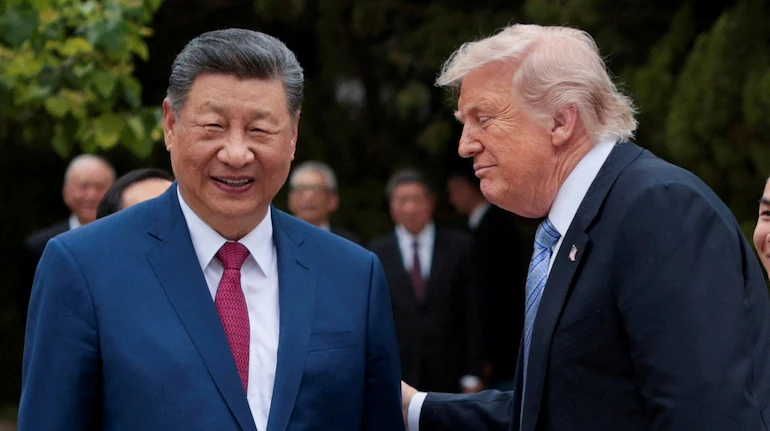
US President Donald Trump is not expected to discuss allegations of a Chinese intelligence operation involving former Nvidia chief executive Jensen Huang during his meeting with Chinese President Xi Jinping in Shenzhen on November 18 and 19, senior US administration officials said on Friday, according to CNBC.
The discussions are expected to focus primarily on implementing the existing US-China trade agreement. Restrictions on exports of advanced semiconductors from the United States to China are also expected to remain outside the negotiations.
The upcoming visit will also include Tesla and SpaceX CEO Elon Musk, who is expected to accompany Trump to China. His presence comes amid continuing discussions over trade, technology and the economic relationship between Washington and Beijing.
Key Highlights
- Trump is unlikely to raise the Jensen Huang espionage allegations during his meeting with Xi Jinping.
- The November 18-19 discussions are expected to focus on implementing the US-China trade agreement.
- US officials said advanced semiconductor export controls would not be part of the negotiations.
- Elon Musk will accompany Trump during his visit to Shenzhen.
- The Nvidia-related allegations remain under scrutiny, while China has rejected the espionage claims as baseless.
Trump-Xi Meeting to Focus on Trade Agreement
Trump and Xi are scheduled to meet on the sidelines of the Asia-Pacific Economic Cooperation (APEC) summit in Shenzhen on November 18 and 19. Senior US officials indicated that the main objective of the discussions would be to advance the implementation of the US-China trade agreement.
However, Washington is not expected to discuss its restrictions on exports of advanced semiconductor technology. One administration official reportedly told reporters that the United States does not negotiate its export controls.
The position suggests that sensitive national security and technology issues will remain separate from the immediate trade discussions. Advanced artificial intelligence chips, including those produced by Nvidia, have become a significant point of tension between the two countries.
The White House has also announced plans for a proposed three-way meeting involving Trump, Xi and Russian President Vladimir Putin on the sidelines of the summit. According to US officials, Musk will not participate in that meeting.
Why the Jensen Huang Espionage Allegations Matter
The decision not to raise the allegations comes amid scrutiny surrounding a reported intelligence operation involving Jensen Huang, who previously led Nvidia. The controversy concerns claims that Chinese intelligence may have targeted him through an individual suspected of passing information to Beijing.
Reports cited in the source material identify Alice Huang, a Chinese businesswoman and former executive at Singapore-based cloud-computing company Megaspeed, as the person suspected by US intelligence officials of sharing information with China. She is not related to Jensen Huang.
Megaspeed has also faced scrutiny over allegations that it helped divert billions of dollars’ worth of restricted Nvidia chips to China, potentially violating US export controls. China has rejected the espionage allegations against Alice Huang as baseless.
Nvidia’s board had reportedly initiated an investigation into whether Jensen Huang was targeted by a foreign intelligence operation. The controversy has drawn attention to the security risks surrounding the international supply chain for advanced artificial intelligence chips.
Nvidia Leadership and US Semiconductor Restrictions
The developments have added another dimension to Washington’s efforts to restrict China’s access to advanced semiconductor technology. The United States has maintained export controls on certain high-performance chips, citing national security concerns.
These restrictions have become a major issue in US-China economic relations, particularly as both countries compete in artificial intelligence and advanced computing. Nvidia’s products are central to the global AI hardware market, making its business activities particularly sensitive to changes in export policy.
US lawmakers from both major political parties have called for tighter controls, while questions have also been raised about the Commerce Department’s oversight under Secretary Howard Lutnick.
Despite the ongoing scrutiny, administration officials indicated that the allegations involving Jensen Huang would not form part of Trump’s discussions with Xi. One official reportedly said Washington was not prepared to brief Chinese authorities on national security investigations being conducted in the United States.
Why Elon Musk Is Joining Trump’s China Visit
Elon Musk will accompany Trump during the visit to Shenzhen, according to senior US officials. The Tesla and SpaceX chief has significant business interests connected to China, particularly through Tesla’s electric vehicle operations in the country.
When asked about Musk’s role, a US official referred to his business interests in US-China relations and his involvement in American national security activities. The official also suggested that Musk could serve as an adviser during the visit, while clarifying that the president would determine his precise role.
Musk had previously accompanied Trump on a visit to China in May. His participation in the upcoming trip highlights the importance of business and technology interests in the broader relationship between the two economies.
However, officials confirmed that Musk would not take part in the proposed trilateral meeting involving Trump, Xi and Putin.
US-China Relations Face Trade and Technology Challenges
The forthcoming meeting comes against the backdrop of continuing negotiations over trade and technology restrictions. While both governments are seeking to implement their trade agreement, disagreements over advanced semiconductors and national security remain significant challenges.
Washington’s decision to keep export controls outside the discussions indicates that progress on trade will not necessarily translate into changes in semiconductor policy. The Nvidia controversy adds further sensitivity to an already complicated technology relationship.
What to Expect from the Shenzhen Meeting
The Trump-Xi meeting is expected to concentrate on trade agreement implementation, while sensitive issues involving semiconductor exports and national security investigations are likely to remain separate. Musk’s presence will bring additional business and technology interests into the broader context of the visit.
Whether the discussions produce progress on trade will be closely watched by businesses and investors with exposure to the US and Chinese markets. For now, the administration’s stated position suggests that Washington intends to keep its national security investigations and semiconductor export restrictions separate from the immediate diplomatic negotiations.
For breaking news and live news updates, like us on Facebook or follow us on Twitter and Instagram. Read more on Latest Business on thefoxdaily.com.



COMMENTS 0