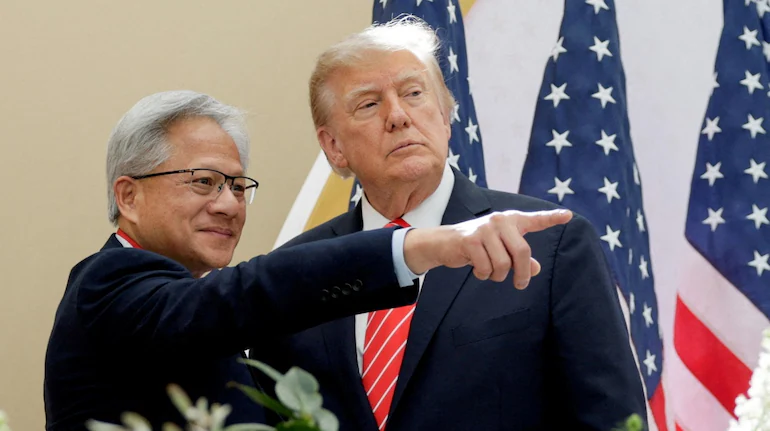
US President Donald Trump’s administration is planning to designate more than two dozen American technology companies, including Nvidia, OpenAI, Microsoft, Amazon and Anthropic, as Artificial Intelligence (AI) “national champions” to strengthen the country’s position in the global technology race with China, according to a report by The Wall Street Journal.
The proposed initiative is designed to help US technology firms expand into international markets by providing government support for overseas projects, access to federal financing and faster reviews of export licence applications. The programme aims to make American AI technology more accessible to foreign governments and businesses seeking advanced computing infrastructure and AI solutions.
Commerce Secretary Howard Lutnick is expected to announce the selected companies, with the announcement anticipated within the next week, although the timeline could change, the report said.
The plan reflects Washington’s growing focus on AI exports as a strategic priority. Rather than competing only through individual software products or semiconductor sales, the administration wants American companies to offer complete AI technology packages to international customers.
Which Companies Could Become AI National Champions?
The proposed list includes some of the most influential companies in the global AI ecosystem. Nvidia, Microsoft, Amazon, OpenAI and Anthropic are among the firms identified in the report.
These companies operate across different parts of the AI value chain. Nvidia supplies advanced processors used to train and operate AI models, while Microsoft and Amazon provide cloud computing infrastructure and enterprise technology services.
OpenAI and Anthropic develop AI models and applications that businesses and governments can integrate into their operations. Their participation could help the US offer international customers a combination of computing hardware, cloud platforms and advanced AI software.
The broader strategy is to encourage companies to work together through industry-led groups rather than promote isolated products. Such partnerships could allow American technology providers to offer integrated systems covering chips, data centres, cloud services, AI models and cybersecurity.
However, the final list of selected companies and the precise structure of their participation will depend on the administration’s designation process.
What Is the American AI Exports Program?
The proposed national champions designations are linked to the American AI Exports Program, established through an executive order signed by Trump on July 23, 2025.
The order directed the Commerce Department to develop a coordinated framework for promoting American AI technology overseas. It covers several areas of the technology ecosystem, including:
- Semiconductors: Advanced processors and specialised chips required for AI computing.
- Data centre infrastructure: Hardware and systems needed to operate large-scale AI facilities.
- Cloud services: Computing platforms that allow businesses and governments to access AI capabilities.
- AI models: Software systems used for generative AI, automation and other applications.
- Cybersecurity tools: Technologies designed to protect AI infrastructure, networks and sensitive information.
The programme is intended to create a coordinated export strategy that combines these technologies into complete solutions for international buyers.
This approach could give foreign governments access to a broader American technology ecosystem through partnerships involving multiple companies. It could also help US firms compete for large infrastructure contracts that require more than a single product or service.
78 Applications Received for Overseas AI Projects
The Commerce Department formally invited applications for the programme on April 1, 2026, setting June 30 as the deadline for submissions.
On July 6, the department confirmed that it had received 78 applications from industry consortia seeking government support for overseas AI projects. The proposals were expected to undergo reviews involving multiple federal agencies before final decisions were made by the Commerce Secretary.
The application process indicates that the initiative is designed around groups of companies capable of delivering integrated AI technology packages rather than individual firms seeking promotional support.
Such consortia could combine semiconductor suppliers, cloud operators, software developers and infrastructure companies. This would allow them to approach international customers with a more complete technology offering.
However, receiving an application does not guarantee selection. The final designations will depend on the government’s assessment of the proposals and their alignment with the programme’s objectives.
What Benefits Could Selected Companies Receive?
Companies designated as national champions could receive several forms of government assistance to support international expansion.
One potential benefit is government advocacy in overseas markets. American officials could help selected companies engage with foreign governments and businesses considering large-scale AI infrastructure investments.
The programme also provides for financing assistance and priority consideration during export licence reviews. These measures could make it easier for participating companies to compete for international contracts, particularly in markets where technology procurement involves complex regulatory and financial requirements.
Faster export licence reviews could be particularly relevant for semiconductor and computing infrastructure suppliers. Large AI projects often require specialised hardware and technology transfers, making regulatory timelines an important factor in project execution.
However, designation does not automatically guarantee federal funding, export licence approval or a commercial contract. Companies will still need to meet applicable regulatory requirements and secure agreements with overseas customers.
US Wants to Strengthen Its Position Against China
The initiative comes amid intensifying competition between the United States and China over AI infrastructure, advanced semiconductors and emerging technology markets.
Both countries are seeking to expand their influence over the technologies that will support future economic growth, industrial automation, scientific research and national security.
China has been developing its domestic semiconductor and AI industries while promoting its technology infrastructure to overseas markets. The United States, meanwhile, has sought to maintain its advantages in advanced chip design, cloud computing and leading AI models.
The national champions programme could give Washington another instrument to support American companies in international markets. By coordinating government assistance with private-sector capabilities, the administration hopes to make US technology offerings more competitive.
The strategy also reflects the importance of international adoption. Countries choosing AI infrastructure today could establish long-term relationships with technology suppliers, cloud providers and semiconductor manufacturers. Those decisions may influence future technology standards, supply chains and commercial partnerships.
National Champions Initiative Could Expand International Partnerships
The Trump administration has also sought to involve technology companies from partner countries in its broader AI export strategy.
Speaking at the India AI Impact Summit in New Delhi in February 2026, White House technology adviser Michael Kratsios announced a National Champions Initiative aimed at integrating companies from partner countries with American AI systems.
The initiative is intended to allow participating countries to develop their domestic technology industries while adopting American AI infrastructure.
This approach could create opportunities for local businesses to participate in data centre development, software integration, cloud services and other technology-related activities.
For the United States, partnerships with overseas companies could help expand the reach of its AI ecosystem without relying exclusively on direct exports from American technology firms.
For participating countries, access to American technology could support domestic AI development. However, the extent of local participation, technology access and economic benefits would depend on the terms of individual partnerships.
AI Export Promotion Comes Alongside Semiconductor Restrictions
The proposed designations come at a time when Washington is facing renewed scrutiny over restrictions on advanced semiconductor exports to China.
The United States has imposed controls on certain advanced chips and related technologies to limit China’s access to computing capabilities considered strategically sensitive. These restrictions are intended to prevent advanced American semiconductor technology from reaching restricted Chinese customers, including through indirect supply channels.
According to The Wall Street Journal, Lutnick has faced criticism over the Commerce Department’s handling of restrictions designed to prevent advanced American chips from reaching Chinese buyers through third countries.
US lawmakers have also pushed for tighter oversight of overseas chip shipments. The Commerce Department is preparing additional measures to address potential diversion of restricted semiconductor products, the report said.
This creates a two-part approach to American technology policy. Washington wants to expand international access to US-developed AI systems while maintaining restrictions on technology transfers that could strengthen China’s advanced computing capabilities.
Companies participating in the export programme will therefore need to comply with existing US export-control regulations. Government support for international expansion does not provide an exemption from restrictions on sensitive technology.
Why Nvidia, Microsoft and OpenAI Matter to the Strategy
The inclusion of companies operating across different parts of the AI industry is central to the programme’s approach.
Nvidia’s role is particularly important because advanced GPUs are essential for training large AI models and running demanding inference workloads. Access to these processors can influence how quickly countries and businesses develop their AI infrastructure.
Microsoft and Amazon bring cloud computing capabilities that allow customers to access computing resources without building every component of their infrastructure independently.
OpenAI and Anthropic contribute AI models and applications that can be integrated into enterprise systems, government services and other digital platforms.
Combining these capabilities could allow American companies to compete for large international projects with an integrated offering. Instead of negotiating separately with chip suppliers, cloud providers and model developers, customers could potentially work with coordinated groups of technology companies.
Such an approach could also strengthen commercial relationships between international buyers and American suppliers over several years.
Challenges Facing the US AI Export Strategy
Despite the potential advantages, the programme will face several challenges as the administration attempts to turn government support into overseas commercial success.
Competition from China: Chinese technology companies are expanding their AI hardware, software and cloud offerings. Price, local partnerships and infrastructure availability could influence purchasing decisions in international markets.
Export-control restrictions: Companies must ensure that overseas projects comply with US regulations governing advanced chips, software and other sensitive technologies. Regulatory restrictions could limit the products available to certain customers.
International market preferences: Foreign governments may prefer suppliers that offer local data storage, technology transfer, domestic employment and greater control over critical infrastructure.
Financing requirements: Large AI infrastructure projects require substantial investment in electricity, data centres, cooling systems and networking. Government assistance may support financing, but it will not eliminate commercial and operational risks.
Technology dependence: Some countries may be cautious about relying heavily on a single foreign technology ecosystem for strategically important digital infrastructure.
The programme’s success will therefore depend on more than the number of companies receiving national champion status. It will also depend on whether these firms can secure overseas customers and deliver projects that meet local requirements.
What the National Champions Plan Means for Global AI Competition
The proposed designation of more than two dozen American technology companies represents an effort to connect US industrial policy with the global expansion of artificial intelligence.
By supporting coordinated exports of chips, cloud infrastructure, AI models and cybersecurity tools, the administration wants to strengthen the international position of American technology providers.
The strategy could benefit companies such as Nvidia, Microsoft, Amazon, OpenAI and Anthropic by improving access to overseas markets and helping them compete for large infrastructure contracts.
However, the initiative also highlights the growing overlap between technology competition, trade policy and national security. The United States is seeking to promote its AI ecosystem internationally while restricting access to certain advanced technologies for China.
The next important development will be the final announcement of selected companies and the details of their participation. The actual impact will depend on whether government support translates into new overseas partnerships, financing opportunities and commercial contracts.
Ultimately, the national champions strategy reflects Washington’s belief that global AI leadership will depend not only on developing advanced technology but also on ensuring that international customers adopt and build around American AI systems.
For breaking news and live news updates, like us on Facebook or follow us on Twitter and Instagram. Read more on Latest Business on thefoxdaily.com.






COMMENTS 0