Humanity’s most distant spacecraft has crossed another remarkable boundary. NASA‘s Voyager 1 probe reached a distance of one light-day from Earth on November 18, 2026, becoming the first human-made object to travel so far from its home planet.
The milestone represents a journey of more than 26 billion kilometres, a distance so vast that even a signal travelling at the speed of light requires an entire day to cover it. Launched in 1977, Voyager 1 has spent nearly five decades travelling away from Earth and exploring regions of space beyond the Sun’s immediate influence.
NASA calculated that the spacecraft reached the one-light-day mark at 5:16 am Eastern Standard Time on November 18 (3:46 pm IST). NASA’s Solar System account announced the achievement in a post on X.
The milestone was based on the space agency’s advance calculations. Engineers at NASA’s Jet Propulsion Laboratory (JPL) in California would still need to wait for the spacecraft’s signal to confirm that it had crossed the distance threshold.
Voyager 1 project manager Suzanne Dodd described the achievement as extraordinary, saying, “Reaching one light-day is an astounding feat, one that I never expected to see.”
The achievement is more than a numerical distance record. It demonstrates how far a spacecraft designed with technology from the 1970s can travel and how long a carefully managed robotic mission can continue producing scientific information.
What does one light-day from Earth mean?
A light-day is the distance light travels through space in 24 hours. Since light moves at approximately 299,792 kilometres per second, one light-day works out to roughly 25.9 billion kilometres.
Voyager 1 reaching this distance offers a striking way to understand the scale of interstellar travel. Although the spacecraft moves at nearly 61,000 kilometres per hour, it has taken almost five decades to travel far enough for light itself to need a full day to cover the distance between the probe and Earth.
The milestone also has a practical consequence for mission operations. Radio signals sent by Voyager 1 take approximately 24 hours to reach Earth, while instructions transmitted from Earth take a similar amount of time to travel back to the spacecraft. A complete exchange involving a command and its response can therefore take roughly two days.
This communication delay means engineers cannot operate Voyager 1 in real time. The mission team must plan commands carefully, account for the enormous distance and rely on the spacecraft’s onboard systems to carry out instructions.
Voyager 1’s journey from Earth to interstellar space
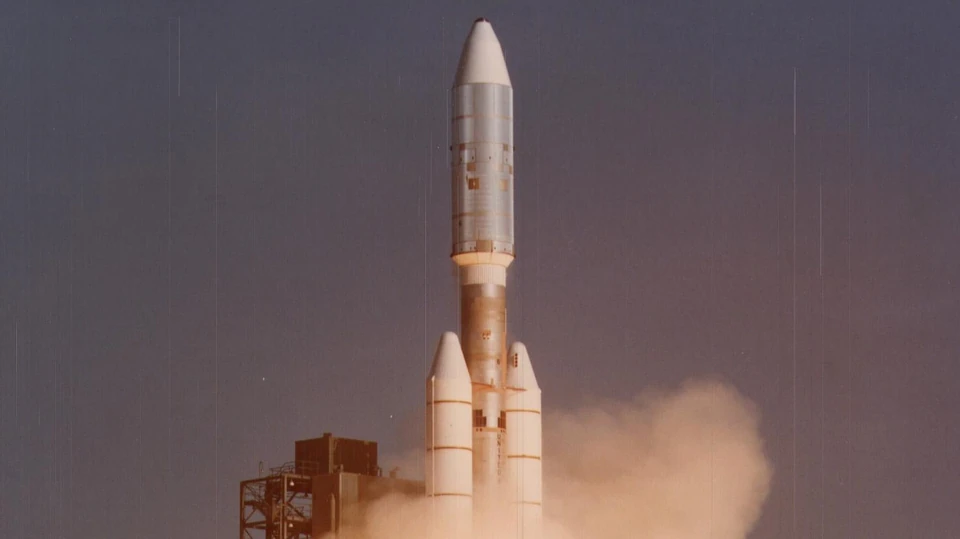
NASA launched Voyager 1 on September 5, 1977, from Cape Canaveral in Florida aboard a Titan/Centaur launch vehicle. Its original mission was to study the outer planets of the Solar System, particularly Jupiter and Saturn.
The spacecraft passed Jupiter and Saturn, sending back observations that expanded scientific understanding of these giant planets and their moons. Its instruments recorded information about planetary atmospheres, magnetic environments, rings and other features.
After completing its planetary encounters, Voyager 1 continued moving outward. Unlike missions designed to remain around a planet or operate within the inner Solar System, it was on a trajectory that would eventually take it beyond the region dominated by the Sun’s surrounding environment.
In 2012, Voyager 1 crossed the outer boundary of the heliosphere and entered interstellar space. This made it the first spacecraft to reach the region beyond the protective bubble created by the Sun’s solar wind and magnetic field.
The crossing was a major scientific milestone because it gave researchers an opportunity to study the environment beyond the Sun’s immediate influence using measurements collected directly by a spacecraft.
What is the heliosphere, and why was crossing it important?
The heliosphere is a vast bubble surrounding the Solar System, formed by the continuous flow of charged particles from the Sun, known as the solar wind, together with the Sun’s magnetic field.
This bubble extends far beyond the orbit of the planets. Its outer boundary, called the heliopause, marks the region where the outward pressure of the solar wind meets the surrounding interstellar environment.
Crossing the heliopause does not mean leaving the Solar System in every possible sense. The Sun’s gravitational influence extends much farther, but the boundary marks an important change in the space environment surrounding the spacecraft.
When Voyager 1 crossed the heliopause in 2012, its instruments began providing direct measurements of interstellar space. These observations helped scientists study the particles, magnetic fields and plasma conditions in an environment that cannot be examined in the same way from Earth.
Voyager 2, its twin spacecraft, also entered interstellar space, crossing the heliopause in 2018. Together, the two probes have provided observations from different directions, allowing researchers to compare conditions beyond the heliosphere.
Voyager 1 continues to send scientific data from interstellar space
Despite its age and extraordinary distance from Earth, Voyager 1 continues to collect and transmit scientific measurements. Its instruments provide information about magnetic fields, cosmic rays and plasma waves in the surrounding environment.
One particularly interesting observation involves a faint, steady hum detected by the spacecraft’s instruments. Scientists associate this signal with the vibrations of the small amounts of gas present in interstellar space.
These measurements help researchers understand the physical conditions beyond the heliosphere. The region is extremely sparse compared with the environments closer to the Sun, but it is not completely empty.
Voyager 1 sends its measurements to Earth through NASA’s Deep Space Network (DSN), an international system of large radio antennas designed to communicate with spacecraft exploring distant parts of the Solar System and beyond.
The network receives faint signals from Voyager and other deep-space missions. Because the spacecraft is so far away, the signals arriving at Earth are extremely weak and require sensitive antennas and specialised processing systems.
Voyager project manager Suzanne Dodd said the spacecraft continues to send measurements whenever the Deep Space Network points its antennas towards it. The data allow scientists to monitor changes in the interstellar environment long after the spacecraft completed its original planetary mission.
Scientists are still studying the Sun’s influence beyond the heliosphere
One of the continuing scientific questions concerns how the magnetic field behaves after a spacecraft crosses the heliopause.
According to Dodd, researchers expected the magnetic field direction to rotate towards the direction associated with the surrounding interstellar environment. However, measurements from both Voyager spacecraft showed that the field maintained the direction it had when they crossed the heliopause, one influenced by the Sun.
Scientists are continuing to monitor whether that magnetic field direction eventually changes. Understanding the transition could help clarify how the Sun’s magnetic influence interacts with the surrounding interstellar medium.
Voyager 1 has also detected effects associated with activity originating from the Sun. Powerful solar events, including coronal mass ejections (CMEs), can generate shock waves and pressure fronts that travel outward through space.
These disturbances can reach the distant regions where Voyager 1 operates, demonstrating that solar activity can have effects far beyond the planets.
Dodd said researchers are interested in understanding where the Sun’s influence finally ends and the surrounding interstellar environment begins. Voyager’s continued operation could help answer some of these questions.
How long can Voyager 1 continue communicating with Earth?
One of the biggest challenges facing the Voyager mission is the limited electrical power available aboard the spacecraft. Its power source has been gradually weakening over the decades, forcing engineers to make careful decisions about which systems and instruments can remain active.
NASA has introduced power-saving measures to extend the operational life of both Voyager spacecraft. By switching off selected systems and managing the available energy, the mission team has been able to preserve their ability to communicate and conduct scientific observations.
A representative of NASA’s Jet Propulsion Laboratory said the recent measures could provide the two spacecraft with enough power to remain in communication with Earth for another three to four years.
The immediate scientific goal is to keep the current suite of instruments operating through Voyager’s 50th launch anniversary in 2027. What happens beyond that point is less certain because the spacecraft are nearly five decades old and could experience technical problems that engineers cannot predict.
The challenge is not limited to electrical power. Ageing components, the extreme conditions of deep space and the increasing difficulty of maintaining reliable communication all affect how long the mission can continue.
Every additional year of operation provides researchers with more measurements from a region of space that no other operational spacecraft has explored in the same way.
Voyager 1 and Voyager 2: Two spacecraft exploring interstellar space
Voyager 1 is part of NASA’s twin Voyager programme, which was designed to take advantage of favourable planetary alignments and study the outer planets.
Both spacecraft were launched in 1977, but they followed different trajectories and reached interstellar space at different times.
- Voyager 1: Launched on September 5, 1977, and entered interstellar space in 2012. It is the most distant human-made object from Earth.
- Voyager 2: Also launched in 1977 and entered interstellar space in 2018. It continues to provide independent measurements of the environment beyond the heliosphere.
The twin spacecraft have given scientists two separate perspectives on the boundary between the heliosphere and interstellar space. Their observations are particularly valuable because the structure of this boundary is complex and cannot be fully understood through measurements from a single location.
Although both probes are operating with limited power, their continuing scientific contributions remain important for understanding the outer environment of the Solar System.
Why Voyager 1’s one-light-day milestone matters
Voyager 1 reaching one light-day from Earth is a landmark in the history of Space Exploration because it places the scale of interstellar travel into a distance that can be understood through the speed of light.
The achievement also highlights the durability of the Voyager mission. A spacecraft launched in the 1970s, using technology developed decades before modern smartphones and artificial intelligence, is still operating billions of kilometres from Earth.
Its journey has transformed scientific understanding of Jupiter, Saturn, the heliosphere and the space beyond it. The spacecraft’s current measurements continue to provide information about magnetic fields, cosmic rays and plasma in the interstellar environment.
However, the mission is approaching an uncertain final phase. Power limitations and ageing equipment mean that communication may eventually become impossible. Until then, NASA’s scientists will continue to use the remaining instruments to study the distant environment.
For now, Voyager 1’s one-light-day achievement is a reminder of how far human engineering and scientific curiosity can reach. The spacecraft is travelling through interstellar space, carrying instruments built nearly half a century ago and continuing to send information across a distance that takes light itself an entire day to cross.
Voyager 1 reaches one light-day: Frequently asked questions
1. What is the one-light-day milestone achieved by Voyager 1?
Voyager 1 became the first human-made object to reach a distance of one light-day from Earth on November 18, 2026. This means it is approximately 26 billion kilometres away, a distance light takes 24 hours to travel.
2. When was Voyager 1 launched?
NASA launched Voyager 1 on September 5, 1977, from Florida aboard a Titan/Centaur launch vehicle. Its original mission included studying Jupiter and Saturn.
3. How fast is Voyager 1 travelling?
Voyager 1 is travelling at nearly 38,000 miles per hour, or approximately 61,000 kilometres per hour.
4. Has Voyager 1 left the Solar System?
Voyager 1 crossed the heliopause and entered interstellar space in 2012. However, the Sun’s gravitational influence extends much farther, so crossing the heliopause does not mean leaving the Solar System in every sense.
5. Is Voyager 1 still sending signals to Earth?
Yes. Voyager 1 continues to transmit scientific measurements to Earth through NASA’s Deep Space Network, although communication is affected by the enormous distance and the spacecraft’s limited power.
6. How long does a signal from Voyager 1 take to reach Earth?
At a distance of one light-day, a radio signal travelling at the speed of light takes approximately 24 hours to reach Earth. A command sent from Earth also takes about a day to reach the spacecraft.
7. How long can Voyager 1 continue operating?
Recent power-saving measures could allow Voyager 1 and Voyager 2 to remain in communication with Earth for another three to four years, according to a Jet Propulsion Laboratory representative. The current scientific goal is to keep their existing instruments operating through the 50th launch anniversary in 2027.
8. What scientific information is Voyager 1 collecting?
Voyager 1 continues to measure magnetic fields, cosmic rays and plasma waves in interstellar space. Its observations help scientists study the environment beyond the heliosphere and understand how the Sun interacts with the surrounding interstellar medium.
For breaking news and live news updates, like us on Facebook or follow us on Twitter and Instagram. Read more on Latest World on thefoxdaily.com.





COMMENTS 0