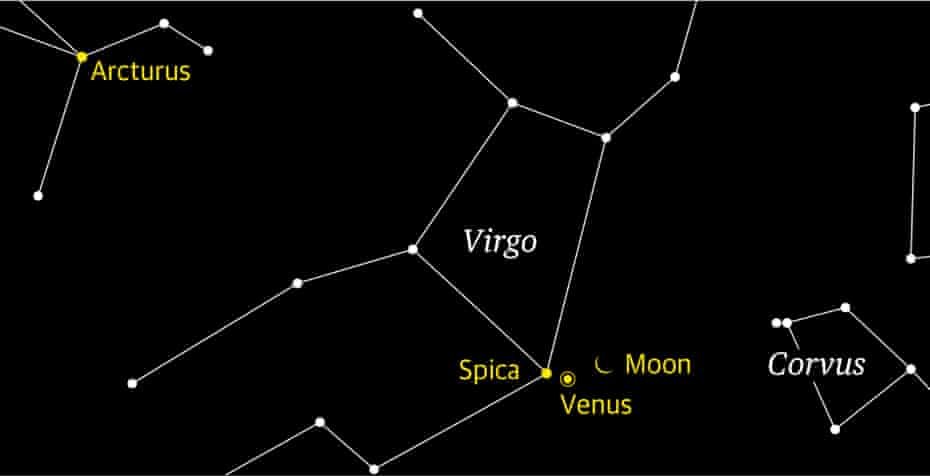
Early risers will have an opportunity to witness a striking celestial grouping this week as brilliant Venus appears alongside the waning crescent Moon and Spica, the brightest star in the constellation Virgo. The three objects will form a close-looking arrangement in the eastern morning sky before sunrise on November 7.
The sight will be particularly interesting because the Moon will appear as a thin crescent, with just 4% of its Earth-facing surface illuminated. Venus will be the easiest object to spot because of its exceptional brightness, while Spica will appear nearby as a bright star.
When and Where to See Venus, the Moon and Spica
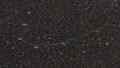
The grouping will be visible before sunrise on November 7. A sky chart showing the view from London at 0600 GMT places the three objects low above the east-south-east horizon.
Venus will stand out as the brightest object in the grouping. Spica, the brightest star in Virgo, will appear close to the planet, while the slender crescent Moon will complete the celestial arrangement.
Observers will need an unobstructed view towards the east-south-east to see the grouping clearly. Buildings, trees and other obstacles near the horizon could block the view, so choosing an open viewing location will be important.
Why the Waning Crescent Moon Will Look So Thin
On November 7, the Moon will be just two days away from its new Moon phase. Only 4% of the side facing Earth will be illuminated by sunlight, making it appear as a narrow crescent.
The remaining unlit portion may also reveal a faint outline, creating the impression that the entire lunar disc is visible. This effect is known as earthshine.
Earthshine occurs when sunlight reflects from Earth’s surface and atmosphere onto the Moon’s darker side, providing enough illumination for observers to notice parts of the lunar disc that are not directly lit by the Sun.
Spica: The Brightest Star in Virgo
Spica is the brightest star in the constellation Virgo, traditionally represented as a maiden. It is located approximately 250 light-years from Earth and will appear near Venus and the crescent Moon during the early morning display.
Unlike Venus, which is a planet in our Solar System, Spica is a distant star. Its presence alongside the Moon and Venus will bring together three different types of celestial objects in one part of the sky.
Why the Sky Will Look Different as Sunrise Approaches
At 0600 GMT, the sky will still be relatively dark, providing favourable conditions for spotting the three objects. However, as sunrise approaches, increasing daylight will gradually make fainter stars harder to see.
Venus should remain the easiest object to identify because of its brightness. Spica may become more difficult to distinguish as the sky brightens, while the thin crescent Moon could also require careful observation.
Will the Celestial Grouping Be Visible From the Southern Hemisphere?
The grouping will also be visible from the Southern Hemisphere, where Venus, the Moon and Spica will appear higher in the eastern sky before sunrise.
Their position will differ depending on the observer’s location, but the three objects will still form a noticeable grouping in the morning sky.
For skywatchers hoping to catch the display, the key is to look towards the eastern horizon before sunrise on November 7. With a clear view and relatively dark conditions, the brilliant planet, delicate lunar crescent and distant star will create a memorable early-morning sight.
For breaking news and live news updates, like us on Facebook or follow us on Twitter and Instagram. Read more on Latest Technology on thefoxdaily.com.


COMMENTS 0