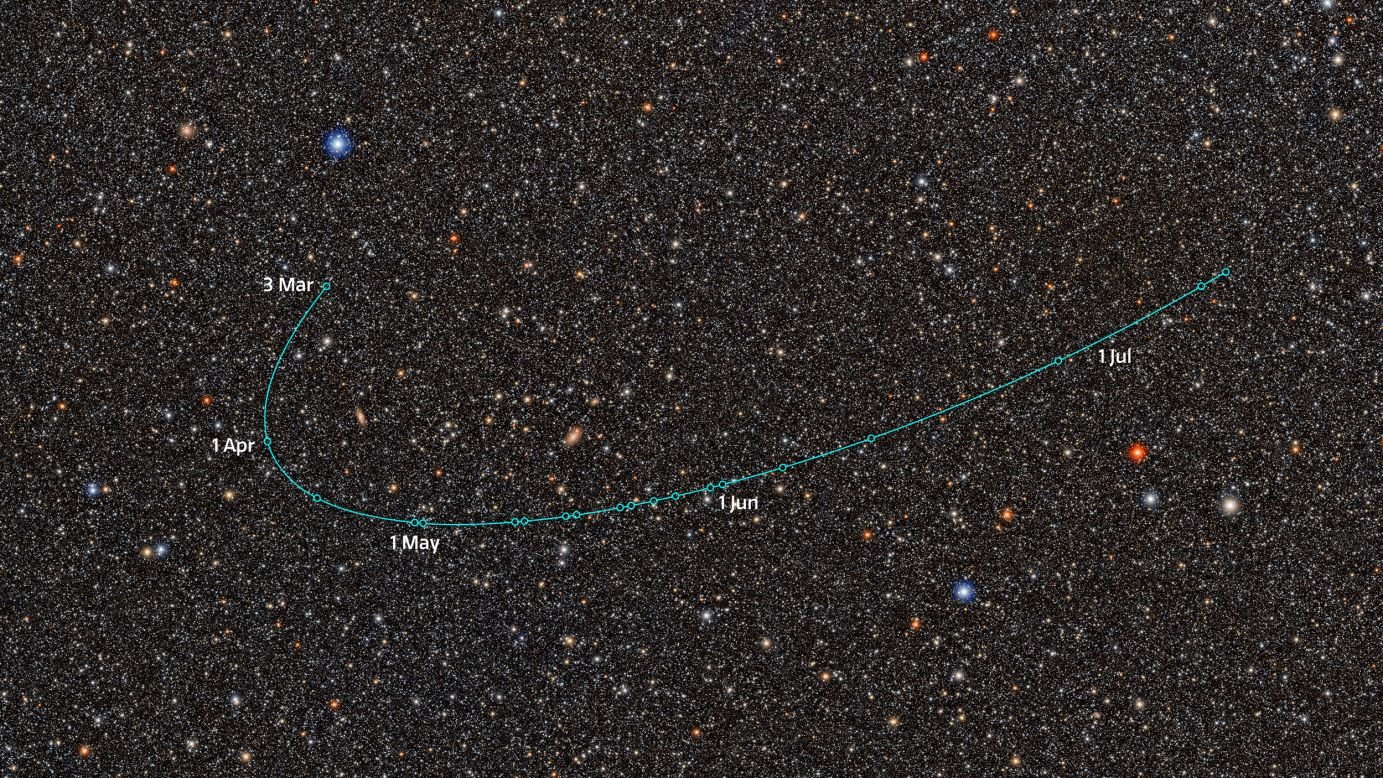
Astronomers have identified a new dwarf planet candidate beyond Pluto, provisionally named ED138, using observations from the Vera C. Rubin Observatory in Chile. The object could become the sixth officially recognized dwarf planet in the Solar System if further observations confirm its size and physical characteristics.
Researchers estimate that ED138 measures between 600 and 1,500 kilometers (370 and 930 miles) in diameter. It orbits the Sun at approximately 46 astronomical units, placing it beyond Pluto and among the distant objects that populate the outer solar system. However, scientists emphasize that its classification remains provisional until they can establish how large it is and determine whether it meets the criteria for a dwarf planet.
The discovery highlights the growing role of powerful astronomical surveys in identifying previously unknown objects. The Rubin Observatory, which began operating in 2025, is designed to image the entire sky every three days, giving scientists new opportunities to track asteroids, distant icy bodies and other moving objects across the solar system.
What Is ED138 and Why Is It Significant?
ED138 is a distant solar system object that astronomers have identified as a potential dwarf planet. Its estimated size places it within a range that could make it comparable to some of the smallest recognized dwarf planets, although its actual dimensions remain uncertain.
The International Astronomical Union (IAU) currently recognizes five dwarf planets: Ceres, Pluto, Haumea, Makemake and Eris. If ED138 is confirmed and officially classified, it could join this group.
Dwarf planets are bodies that orbit the Sun and have enough mass for their gravity to pull them into a nearly round shape, but have not cleared the neighborhood around their orbits of other objects. Unlike the eight recognized planets, they share their orbital regions with other bodies.
ED138 is also classified as a trans-Neptunian object, or TNO. These objects orbit the Sun beyond Neptune, the outermost of the eight recognized planets. Studying them can help astronomers understand the composition, structure and history of the solar system’s distant regions.
Although ED138’s estimated diameter suggests that it may be large enough to qualify as a dwarf planet, size alone does not establish its classification. Researchers need more information about its physical properties before reaching a conclusion.
How the Vera C. Rubin Observatory Helped Discover ED138
The discovery resulted from observations collected by the Vera C. Rubin Observatory, located on a 2,682-meter-high mountain in Chile. The facility houses the world’s largest digital camera and is designed to survey the sky repeatedly, allowing astronomers to detect objects that move or change in brightness over time.
The observatory began operating in 2025 and is capable of imaging the entire sky every three days. Its repeated observations are particularly valuable for finding distant solar system objects, which can appear as faint points of light moving slowly against the background of stars.
Matthew Holman, a senior astrophysicist at the Smithsonian and a lecturer in Astronomy at Harvard University, used a computer program he had codeveloped to examine data gathered by Rubin earlier in 2026. The program searched through billions of detections of moving objects.
When ED138 appeared in the results, Holman initially reacted with what he described as “excited disbelief.” Before accepting the finding, he checked whether the detection could have resulted from a false positive or an error in the software.
That verification process was essential because automated surveys generate enormous quantities of data. A potential discovery must be distinguished from processing errors, duplicated detections or unrelated objects before scientists can confidently establish that a new body has been observed.
Additional Observations Helped Confirm the Object
To investigate the detection further, Holman worked with Mario Jurić, Rubin’s solar system lead scientist and a professor in the University of Washington’s Department of Astronomy.
Jurić searched Rubin’s catalog for additional observations of ED138 and found 20 more detections dating back to March 2026. These observations provided further evidence that the object was real and could be tracked over time.
The researchers subsequently used other sources of information to reconstruct the object’s orbit as far back as 10 years. Establishing an orbit is a critical step in studying a newly identified solar system body because it helps scientists determine its path around the Sun and distinguish it from other moving objects.
Even with these observations, important questions remain unanswered. Holman has stressed that ED138 is still only a candidate, and that determining its physical size will require additional work.
“At this point, it’s still a candidate. We really need to know how physically big it is, and that will take a few months, probably.”
Researchers expect the next phase of observations to help narrow down the object’s size and establish whether it can be officially classified as a dwarf planet.
How Big Is ED138?
Current estimates place ED138’s diameter between 600 and 1,500 kilometers (370 and 930 miles). The broad range reflects the uncertainty that remains about its physical characteristics.
If the estimates prove accurate, ED138 would be larger than Ceres, the smallest of the five dwarf planets currently recognized by the IAU. Ceres is located in the asteroid belt between Mars and Jupiter, while ED138 occupies a much more distant region beyond Neptune.
Its estimated size makes the object particularly interesting to researchers studying the small worlds of the outer solar system. At this scale, a body may have physical characteristics that distinguish it from smaller asteroids and other minor objects.
However, astronomers cannot yet say whether ED138 has an icy surface, an atmosphere, geological activity or other features associated with known dwarf planets. Such details remain speculative until additional observations provide stronger evidence.
Michele Bannister, an associate professor at the University of Canterbury in New Zealand who studies small solar system worlds, described ED138 as scientifically interesting because it is both a trans-Neptunian object and relatively large, despite being much too faint to see with the naked eye.
Bannister noted that its estimated size falls within a range where scientists can begin considering it a distinct world. Other telescopes are expected to contribute further observations that could reveal more about its nature.
ED138 Orbits the Sun Beyond Pluto
ED138 currently orbits the Sun at a distance of approximately 46 astronomical units. One astronomical unit is the average distance between Earth and the Sun, making it a standard measurement for describing distances across the solar system.
At roughly 46 astronomical units, ED138 is located in the distant outer solar system, beyond Pluto. Its position makes it part of the trans-Neptunian population, which includes a wide variety of objects with different sizes, shapes and orbital characteristics.
These distant bodies are important to planetary science because they preserve clues about the conditions under which the solar system formed. Their orbits and physical properties can help researchers investigate how material was distributed during the solar system’s early history and how the outer regions evolved.
Because ED138 is so far from Earth, studying it presents considerable observational challenges. It appears faint even when viewed with advanced telescopes, and determining its physical properties requires more than simply detecting its position in the sky.
Why Astronomers Had Not Found ED138 Earlier
Despite its potentially substantial size, ED138 remained undiscovered until the recent observations. According to Holman, two factors made the object particularly difficult to identify: its location in the southern sky and its position against the crowded background of the Milky Way.
Its Location in the Southern Hemisphere
ED138 is situated in the southern hemisphere of the sky, making it difficult to observe from many locations in the northern hemisphere. This limits the number of telescopes that can effectively search for it.
Holman explained that the object’s position rules out entire groups of telescopes that might otherwise have detected it. He also noted that fewer telescopes conduct extensive searches of the southern sky, creating another obstacle to its discovery.
The Rubin Observatory’s location in Chile gives it an important advantage for surveying southern skies. Its wide-field camera and repeated observations allow researchers to identify moving objects across large areas rather than relying solely on targeted observations of known bodies.
Its Position Against the Milky Way
Another challenge is that ED138 lies along the plane of the Milky Way from Earth’s perspective. Holman explained that the object has spent roughly the past 20 years moving across this crowded region of the sky in apparent position.
The Milky Way contains enormous numbers of stars, making it difficult to distinguish faint moving objects from the dense background of starlight. Astronomers therefore face additional challenges when searching for distant solar system bodies in these regions.
Detecting a moving object requires researchers to compare observations taken at different times and identify changes in position. When the background is crowded with stars, the process becomes more complicated, particularly for objects that are faint and move slowly across the sky.
ED138’s discovery demonstrates how repeated imaging and advanced data-analysis techniques can help overcome these difficulties. The Rubin Observatory’s ability to survey the sky regularly could make it easier to identify other objects that have remained hidden for similar reasons.
Could More Dwarf Planet Candidates Be Discovered?
ED138 is part of a growing collection of solar system objects detected by the Rubin Observatory. Many of the observatory’s discoveries so far have involved asteroids and smaller trans-Neptunian objects.
Holman believes there could be a handful of additional objects comparable in size to ED138 that astronomers have not yet identified. He expects Rubin’s ongoing surveys to help researchers find some of them.
Repeatedly observing the sky is particularly useful for discovering distant objects because they may be difficult to distinguish from stars in a single image. By comparing images taken at different times, astronomers can identify objects that have shifted position and calculate their trajectories.
As the observatory collects more data, researchers will have opportunities to identify additional bodies, improve orbital calculations and refine estimates of their sizes. Some discoveries may turn out to be relatively small objects, while others could prove to be substantial members of the outer solar system.
However, detecting a candidate does not automatically mean that it will receive official dwarf planet status. Each object must be studied carefully, and researchers must establish whether the available evidence supports the classification.
How Would ED138 Get an Official Name?
If astronomers confirm that ED138 qualifies as a dwarf planet, the object would first receive a permanent number and later an official name. The naming process could take time, and the precise arrangements for deciding who gets to suggest or select the name have not yet been established in this case.
Holman said that people had already contacted him with possible names, although some suggestions were already being used by other astronomical objects.
He also indicated that he might be able to propose a name but was uncertain whether he would have a role in the process, given the scale of the broader project.
For now, ED138 remains a provisional designation rather than an official name. Astronomers will need to establish more about the object before the classification and naming process can move forward.
What Scientists Hope to Learn About ED138
Beyond determining its size, researchers hope future observations will reveal more about ED138’s physical characteristics. Its distance and estimated dimensions make it an intriguing target for studying the diversity of objects in the outer solar system.
Known dwarf planets offer examples of how varied these distant worlds can be. Pluto, for instance, has a complex surface that includes frozen materials and nitrogen ice. Scientists do not yet know whether ED138 shares any comparable features.
Bannister suggested that a future spacecraft mission could potentially reveal whether ED138 has characteristics such as a nitrogen glacier. She emphasized, however, that this possibility remains speculation because researchers currently know relatively little about its physical nature.
At present, the strongest conclusions concern the object’s detection, estimated size and distant orbit. Further telescopic observations will be needed to establish its physical properties, while a spacecraft visit would be required to examine it at close range.
The discovery therefore represents an early step in understanding a potentially significant new member of the solar system rather than a complete picture of the object.
Why the Discovery Matters for Solar System Research
The identification of ED138 illustrates how advances in astronomical surveys are expanding scientists’ ability to study the solar system’s outer reaches. Objects that were previously difficult to detect can become visible through repeated observations, sensitive imaging equipment and computer programs capable of processing vast datasets.
If ED138 is confirmed as a dwarf planet, it would expand the group of officially recognized worlds and provide another object for researchers to investigate. Even if its classification remains unresolved, studying its orbit and physical properties could help improve understanding of the distant population beyond Neptune.
The discovery also demonstrates why astronomers distinguish between a candidate and an officially recognized object. Initial detections can identify promising targets, but further observations are necessary to establish their characteristics and support formal classification.
For now, ED138 remains a promising dwarf planet candidate. Researchers expect additional observations over the coming months to help determine its size and clarify whether it belongs among the solar system’s recognized dwarf planets.
Conclusion
Astronomers have identified ED138, a potential dwarf planet beyond Pluto, using data from the Vera C. Rubin Observatory. With an estimated diameter of 600 to 1,500 kilometers and an orbit about 46 astronomical units from the Sun, the object could become the sixth dwarf planet recognized by the International Astronomical Union.
Its discovery was made possible by repeated observations and computer-assisted analysis of moving objects, despite the challenges posed by its southern-sky location and its position against the crowded Milky Way. Scientists must still determine its physical size and gather further evidence before confirming its classification.
The Rubin Observatory is expected to detect more distant objects as its survey continues. ED138 could be one of several large bodies awaiting discovery, offering researchers new opportunities to investigate the solar system beyond Neptune.
For breaking news and live news updates, like us on Facebook or follow us on Twitter and Instagram. Read more on Latest Technology on thefoxdaily.com.






COMMENTS 0