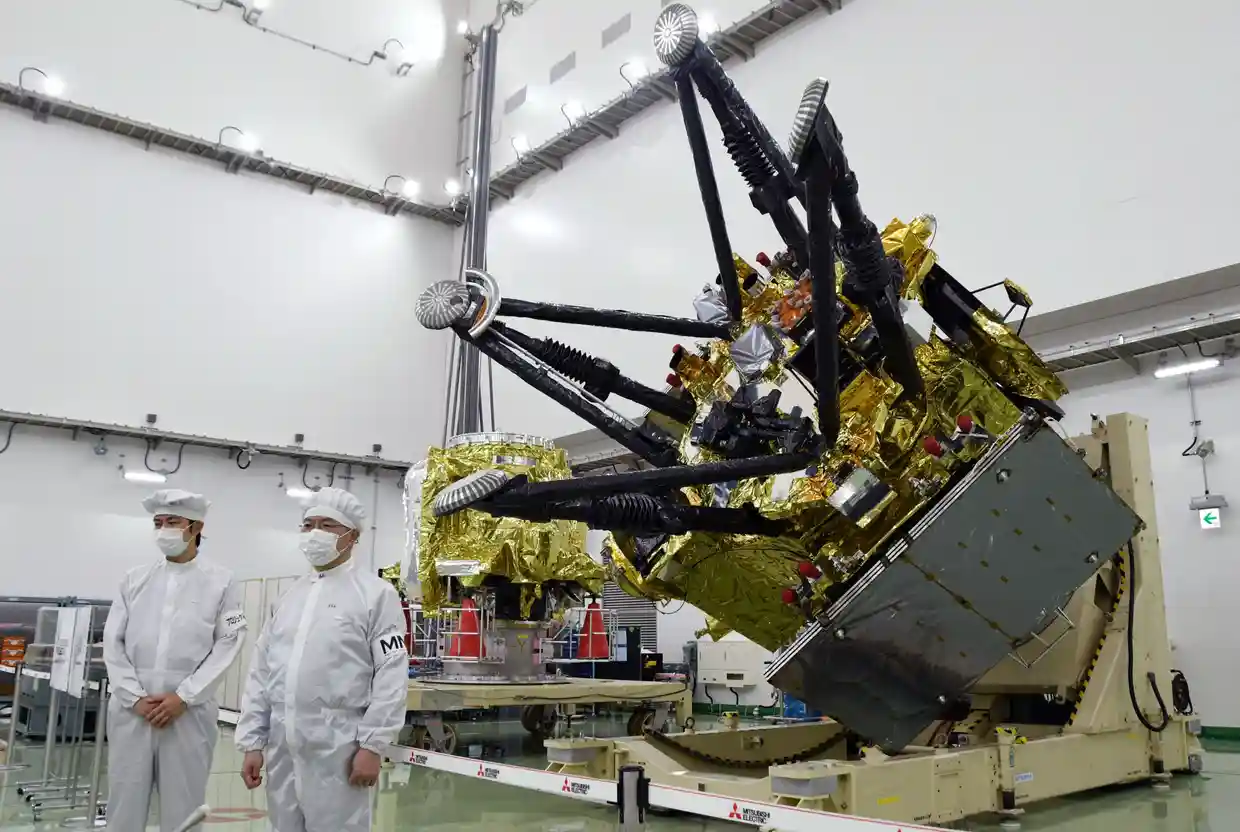
Japan is preparing to lead a groundbreaking space mission to collect samples from Phobos, one of Mars’ two small moons, and return them to Earth for scientific analysis. The Martian Moons eXploration (MMX) mission, led by the Japan Aerospace Exploration Agency (JAXA), aims to help scientists determine how the Martian moons formed and improve understanding of the early history of the solar system.
The ambitious mission is designed to travel to the Mars system, study Phobos up close, collect at least 10 grams of material and bring the samples back to Earth. Researchers hope the material could help resolve a long-standing debate over whether Phobos and its smaller sibling, Deimos, formed from debris created by an impact on Mars or originated as asteroids captured by the planet’s gravity.
The spacecraft is planned to launch aboard Japan’s H3 rocket and will carry 13 scientific instruments, including a French-German rover, a NASA sampling device and European communications technology. The mission also includes observations of Deimos and measurements intended to support future human exploration of Mars.
If successful, MMX will deliver rare material from a Martian moon directly to laboratories on Earth, allowing scientists to examine its composition in far greater detail than spacecraft observations alone can provide.
Japan’s MMX mission aims to unlock the mysteries of Mars’ moons
Phobos and Deimos have remained among the least understood major objects in the immediate vicinity of Mars, despite decades of robotic exploration of the Red Planet. While numerous spacecraft have visited Mars since the 1960s, obtaining samples directly from either of its moons has proved challenging.
JAXA’s Martian Moons eXploration mission is designed to address that gap. Rather than relying exclusively on remote measurements, the spacecraft will travel to Phobos, examine its surface and collect material for analysis after returning to Earth.
Yasuhiro Kawakatsu, the MMX project manager, has described the Martian moons as among the most important unexplored destinations in the solar system. He said studying them could provide useful information about their formation and their potential role in future missions to Mars.
The mission is also expected to strengthen scientists’ understanding of the relationship between Mars and its moons. Their composition may preserve evidence of processes that occurred during the early stages of the solar system, when planets and smaller celestial bodies were taking shape.
Although the mission is centred on Phobos, its scientific objectives extend beyond a single moon. Measurements of Deimos and comparisons between the two bodies could help researchers determine whether they share a common origin.
Why scientists want to collect samples from Phobos
Phobos is the larger of Mars’ two moons, measuring approximately 27 kilometres across at its widest point. It orbits relatively close to the planet, at a distance of about 6,000 kilometres, and completes roughly three orbits around Mars every Earth day.
Its proximity to Mars makes it a particularly interesting target for scientists investigating the planet’s history. Material on Phobos may include a small amount of debris ejected from Mars by ancient impacts, potentially preserving clues about the planet’s geological past.
JAXA officials estimate that material originating from Mars could account for around 0.1% of the samples collected from Phobos. Although this would represent only a small fraction of the total material, even that amount could be scientifically valuable if researchers can distinguish it from the moon’s native surface material.
Studying the samples could help scientists investigate the composition of Phobos, the history of impacts in the Martian system and the processes that shaped the planet and its surroundings.
Collecting material directly also offers an important advantage over observations made from orbit. Laboratories on Earth can use a wider range of analytical techniques to examine mineral composition, chemical signatures and microscopic structures than a spacecraft can typically carry.
The findings could therefore provide a more detailed picture of Phobos and help researchers evaluate competing explanations for the moon’s origin.
Did Mars’ moons form from an ancient impact or captured asteroids?
One of the central questions behind the MMX mission is how Phobos and Deimos came into existence. Scientists have proposed two leading explanations, but the available evidence has not conclusively settled the debate.
Under the impact hypothesis, a large celestial object collided with Mars, ejecting material into space. Some of that debris may have remained in orbit and eventually come together to form the planet’s moons.
An alternative explanation is that Phobos and Deimos are asteroids that originated elsewhere in the solar system before being captured by Mars’ gravity. Their irregular shapes and heavily cratered surfaces are consistent with objects that have experienced long histories of collisions, although these features alone do not establish how the moons formed.
The two possibilities imply different histories for the Martian system. If the moons formed largely from material ejected by Mars, their composition could preserve evidence of the planet and the impact that produced the debris. If they are captured asteroids, their samples could reveal more about the population of small bodies that travelled through the early solar system.
Kiyoshi Kuramoto, the mission’s principal investigator, has said researchers expect the returned soil samples to help resolve the question.
However, reaching a definitive conclusion will depend on what the spacecraft collects and what laboratory analysis reveals. Scientists will need to examine the samples carefully and compare their chemical and mineral characteristics with those expected under different formation models.
How the spacecraft will travel to Mars and return to Earth
The MMX mission is designed as a multiyear journey involving interplanetary travel, operations around Mars, surface sampling and a return trip to Earth. The spacecraft will use Japan’s H3 rocket for launch before travelling towards the Red Planet.
According to the mission timeline in the supplied report, the spacecraft is expected to reach the Mars region around August 2027. It will then spend approximately three years conducting observations and operations around Phobos before beginning its return journey.
The mission is planned to bring the samples back to Earth in 2031. The journey will cover a substantial distance: although Mars can come within approximately 55 million kilometres of Earth at its closest approach, the spacecraft’s actual flight path is expected to extend roughly 500 million to 600 million kilometres.
The difference reflects the complexity of interplanetary navigation. Spacecraft do not generally travel along a straight line between planets; their trajectories must account for the movement of Earth and Mars, orbital mechanics and the fuel and time required to reach the destination.
Once the spacecraft completes its work at Phobos, a dedicated return capsule will carry the collected material towards Earth. The capsule is designed to withstand the heat and physical stresses of atmospheric re-entry.
The mission plan calls for the capsule to land in Australia before the recovered samples are transported to Japan for scientific examination.
Three spacecraft modules will support exploration and sample return
The MMX spacecraft consists of three main modules designed to handle different stages of the mission: propulsion, exploration and return.
The propulsion module will help the spacecraft travel through space and manoeuvre around Mars and its moons. The exploration module will support observations and operations near Phobos, including the sampling activities needed to obtain surface material.
The return module will carry the collected samples back to Earth. Only this module is intended to return home with the material, while the other spacecraft components will not make the same journey back to the planet.
This modular approach allows the mission to combine complex operations around Phobos with the separate requirements of safely returning samples to Earth. The return capsule must protect its contents throughout the journey and survive the intense heating associated with re-entry into the atmosphere.
The success of the mission will depend on the coordination of these systems over several years. Each stage, from launch and navigation to surface sampling and capsule recovery, presents its own engineering challenges.
French-German rover Idefix will prepare for surface sampling
A major part of the mission is Idefix, a small rover jointly developed by France and Germany. It is scheduled to reach Phobos ahead of the main sampling operation and conduct a surface exploration campaign lasting approximately 100 days.
The rover’s role is to examine the terrain and provide information that can help the Japanese spacecraft select a suitable location for landing and collecting samples. Phobos has an irregular, cratered surface, making it difficult to identify a safe landing area using remote observations alone.
Topographical data gathered by Idefix will help mission planners assess the shape and roughness of the terrain. The aim is to choose a relatively smooth and level site where the spacecraft can make contact with the surface while reducing the risk of instability.
Operating a rover on Phobos presents unusual challenges because the moon’s gravity is extremely weak. Its surface gravity is estimated to be about one two-thousandth of Earth’s, meaning that movements and contact with the ground can have very different effects from those experienced by a rover on Earth.
JAXA says the rover is equipped with wheels designed to maintain traction in low gravity and a mechanism that can help it right itself if it tips over. Its movements will be slow and carefully controlled.
The rover’s observations will provide an important foundation for the later sampling operation, helping the main spacecraft assess the terrain before attempting to collect material.
How MMX will collect samples from the Martian moon
JAXA scientists aim to collect at least 10 grams of material from Phobos through two sampling attempts. The mission will use both American and Japanese sampling technologies to obtain material from different depths.
NASA is contributing a sampling device that uses pressurised gas to lift surface dust into a collection container. JAXA’s system will use a coring method designed to retrieve material from approximately two centimetres below the surface.
The first sampling operation is planned to collect both surface material and subsurface samples using the two methods. A second landing will provide an opportunity to obtain additional underground material.
Using more than one technique could improve the scientific value of the collection by providing samples with different characteristics. Surface material may have experienced prolonged exposure to radiation, solar wind and impacts, while material from below the immediate surface may preserve different information about the moon’s history.
Collecting samples from multiple locations or depths can also improve the chances of obtaining material suitable for particular scientific investigations. Researchers will need to evaluate the returned samples to determine what they reveal about Phobos and whether they contain material originating from Mars.
The mission’s minimum target of 10 grams may appear small, but even a limited amount of material can support extensive laboratory analysis when it is carefully preserved and distributed among research teams.
Could the samples reveal clues about ancient life on Mars?
One of the broader scientific possibilities associated with MMX is that material from Phobos could include traces of Mars’ ancient environment. If impacts ejected Martian rocks or soil into space, some of that material may have reached the nearby moon and become incorporated into its surface deposits.
Scientists hope that examining such material could provide information relevant to the search for evidence of past microbial life on Mars. The returned samples could help researchers investigate whether any Martian material is present and whether it preserves chemical or mineral features of scientific interest.
However, the possibility of finding evidence related to ancient life should not be confused with a prediction that the mission will discover it. The amount of Martian material expected in the collection is small, and any potential biological signatures would require careful verification.
Scientists would also need to distinguish genuine evidence of past biological activity from non-biological processes that can produce similar chemical or mineral patterns.
Even if the samples contain no evidence of life, they could still provide valuable information about Mars, Phobos and the early solar system. Determining the origin and composition of the moon’s material is itself a major scientific objective.
Why landing on Phobos is an engineering challenge
Phobos is a difficult destination for a landing mission because of its weak gravity and uneven surface. A spacecraft touching down on the moon cannot rely on the same gravitational forces that help stabilise landers on larger planetary bodies.
If the spacecraft approaches too quickly or makes contact with an uneven surface, it could bounce away or lose stability. The mission therefore needs carefully planned contact procedures and equipment designed to absorb the forces generated during landing.
The MMX exploration module will use four-legged landing gear with shock-absorbing features intended to reduce bouncing at touchdown. The landing site will also be selected using topographical information gathered during the mission.
Low gravity creates additional challenges for the rover. Wheels must maintain traction even when the vehicle presses only lightly against the surface, and engineers must account for the possibility that the rover could tip over while travelling across rough terrain.
These engineering considerations help explain why exploring Phobos requires more than simply reaching Mars. The spacecraft must navigate the local environment, approach a small celestial body safely, perform surface operations and collect samples that can be returned to Earth years later.
International cooperation behind Japan’s Mars moon mission
Although JAXA is leading the MMX mission, the project relies on contributions from several international partners. NASA is providing sampling technology and scientific equipment, while France and Germany have jointly developed the Idefix rover.
The mission also includes a European Space Agency contribution involving deep-space communications technology. Japanese instruments will measure gamma rays and monitor radiation, among other scientific tasks.
The radiation measurements are expected to contribute to research relevant to future human exploration of Mars. Understanding the radiation environment around Mars and its moons can help scientists and engineers assess the challenges that astronauts may face during future missions.
International cooperation allows the mission to combine specialised technologies and scientific expertise from different space agencies. It also means the data and samples could support research by scientists across several countries.
Sample-return missions require coordinated work across launch systems, spacecraft engineering, navigation, surface operations, communications and laboratory analysis. The MMX mission brings these disciplines together in an effort to investigate a destination that has resisted direct exploration.
How MMX could support future human missions to Mars
Beyond its scientific objectives, MMX could help researchers evaluate the potential role of Mars’ moons in future human exploration. Phobos’ proximity to Mars makes it an object of interest when considering how astronauts might conduct observations or support robotic activities around the planet.
Kawakatsu has said that samples from Phobos could provide useful data for scientists considering whether a Martian moon could serve as a base for future crewed missions to Mars.
Studying the moon’s surface composition, terrain and radiation environment could help inform future mission planning. Such information may be relevant when assessing the risks and operational requirements associated with working near Mars.
However, the MMX mission is not itself a crewed exploration programme, and its findings will not automatically establish that Phobos is suitable for a human base. Additional engineering, environmental and safety assessments would be required before any such plan could be realised.
The mission’s immediate purpose remains scientific: to collect and return material from Phobos, investigate the moon’s origin and improve understanding of the Martian system.
What happens after the samples return to Earth?
Once the return capsule lands in Australia, the samples are expected to be transported to Japan for detailed analysis. Scientists will examine the material using laboratory instruments that can investigate its mineral structure, chemical composition and other physical characteristics.
Researchers will also compare the findings with observations collected by the spacecraft and rover during their time at Phobos. Combining direct sample analysis with measurements made in space should provide a more complete picture of the moon’s environment and geological history.
The returned material may be studied by multiple research teams, allowing scientists to investigate different questions using carefully allocated portions of the collection. Because the mission aims to return at least 10 grams, preserving the samples and planning their use will be important for maximising their scientific value.
The analysis could help researchers assess the competing theories of how Phobos formed, determine whether Martian material is present and investigate how the moon has changed over time.
As with other sample-return missions, some of the most important discoveries may emerge after the material reaches laboratories on Earth. Scientists will be able to apply new analytical techniques as they become available, potentially extending the value of the samples well beyond the mission’s initial research programme.
Why Japan’s Phobos mission matters
Japan’s MMX mission represents a major effort to investigate one of the solar system’s least understood destinations. By collecting material from Phobos and returning it to Earth, JAXA aims to answer questions that decades of remote observations have not fully resolved.
The mission will examine the origins of Mars’ moons, investigate the possibility that some of Phobos’ material came from Mars and gather information that could support future exploration. Its international scientific instruments and rover will also demonstrate how different technologies can work together during a complex planetary mission.
The journey will require several years of operations, from launch and arrival at Mars to landing, sampling and the eventual return of the capsule. Each phase presents technical risks, particularly because Phobos is small, irregular and extremely weak in gravity.
If the mission succeeds, the returned samples could provide scientists with a new source of evidence about the formation of the Martian moons and the early history of the solar system. They may also offer clues about Mars’ past environment, although any evidence relevant to ancient life would require careful analysis.
For now, the most important milestone will be the spacecraft’s successful launch and its subsequent journey to the Mars system. The results of the mission will depend on whether the spacecraft can safely reach Phobos, collect the planned material and deliver it to Earth for scientific study.
For breaking news and live news updates, like us on Facebook or follow us on Twitter and Instagram. Read more on Latest Technology on thefoxdaily.com.






COMMENTS 0